ABSTRACT
Evaluation of local muscle fatigue has been conducted over past decades to investigate the process of fatigue accumulation and to reduce effect of fatigue in EMG field. The purpose of this study was to investigate fatigue in isotonic contractions, which can inflict the same fatigue on the subject during dynamic contractions. Local muscle fatigue was measured by changing the load level and exercise time in dumbbell curl comprising isotonic contractions through power spectrum changes. Five healthy males and five healthy females performed dumbbell curls with 1 kg load for two minutes, and on other days when no fatigue occurred due to the previous exercise, performed for one minute with a 2 kg load. The muscle fatigue was estimated by median frequency before and after fatigue, the decrease was greater than in the trial wherein a load of 2 kg was applied for one minute than in the trial where a load of 1 kg was applied for two minutes for the females. The decrease in the median frequency is quantitative data indicated by the slowing of the motor unit actional potential (MUAP), suggesting exercise intensity is more sensitive to the slowing of the MUAP than the exercise duration.
-
KEYWORDS: Electromyography, Muscular fatigue, EMG median power frequency, Isotonic contraction
1. Introduction
Muscle fatigue, which is commonly felt in daily life, appears as a temporary decrease in generate force
[1]. Fatigued muscles consume more energy to contract than non-fatigue muscles due to limitation of their nerve ability to generate sustained force. If fatigue continues to accumulate in the muscles, it takes a long time to recover, making it difficult for you in any situation that requires movement. It can be fatal during rehabilitation or sports exercise, as it is difficult to recognize the point at which fatigue occurs that slows the recovery. All type of human movement consists of contraction and relaxation of muscle, so muscles are indispensable components of the human body without substitute factors. The importance of investigating muscle fatigue has led to the ongoing study of the background in which muscles remain less fatigued and mechanism of neural fatigue with measurement of muscle fatigue. Fatigue, which is difficult to predict fatigue accumulation due to a complex connection of multiple factors has been investigated from several aspects. Although there have been attempts to interpret the process of muscle fatigue from a cellular point of view, the assessment of fatigue has been mainly conducted in the experimental field as the process by which muscle induces fatigue has not yet been clearly defined.
Collecting bio-signals to feedback muscle status after fatigue is the most objective method to express fatigue, a subjectively felt phenomenon. Local muscle fatigue has been investigated in the experimental field through the measurement of surface electromyography (EMG), the most dominant method of muscle signal feedback
[2]. The myoelectric activity observed as the sum of action potentials of a number of motor units has the potential to have different results depending on how the force output is maintained. With these EMG features, muscle fatigue in EMG is measured as a change in the myoelectric signal at certain muscle contraction. In the EMG signal that detects the signal of muscle contraction, it has been observed that fatigue of sustained maximal voluntary contraction (MVC) maintaining the same muscle power output in static contraction is accompanied by changes in power spectrum of surface electromyography
[3,
4]. Based on these investigations, EMG has been conjugated as quantitative fatigue indices in the fatigue study
[5]. Fatigue indices was mainly investigated by comparing the pre-fatigue and the post-fatigue.
The type of muscle contraction, which depends on the type of movement, has a different effect on the muscle fatigue, so that measurement of the fatigue level is mostly performed in the specific experimental task or the same contractile activity. The evaluation of muscular fatigue using EMG in the protocol was mainly measured in isometric contraction in which the muscle is contracted with a constant length
[6,
7], the signals indicate fatigue by increasing amplitude and decreasing power spectrum. Fatigue in isometric contractions performed at a fixed angle was mainly investigated in several muscles for load
[8,
9]. Movements are limited in these protocols, so studies on fatigue caused by other protocol configuration variables other than load level are insufficient. Since isometric contraction is different from dynamic in which the muscle contracts with varying lengths, a few studies have been conducted on fatigue of dynamic exercise.
Muscle fatigue in dynamic contractions has been studied by setting the task as needed, as it depends on the details of the task performed in EMG field
[10-
12]. Specifically, it is measured for certain movements or performed in load based dynamic extension
[13-
15]. It was conducted on specific movements to relieve the fatigue of those who frequently perform certain movements or to reduce fatigue in movements essential for daily life for patients who want to return to their daily routine, specific movements were performed. The reason for investigating the fatigue of a dynamic task is that it is required to measure the fatigue in specific operation. However, it is applicable only to limited range and has the disadvantage in that it is impossible to study the parts composed of other movements. In addition, fatigue of a dynamic task proceeds in a specific task that requires investigation, so the fatigue of dynamic tasks is difficult to be applied to experimental studies on the mechanism of neural fatigue. It is necessary to investigate the neural fatigue mechanism in a wider range beyond the limits applied only to the narrow field of fatigue research for a specific subject or task.
The investigation of fatigue in dynamic tasks, which is varied by modulation of fatigue-sensitive protocol parameters, is important to utilize them in various movement. Although muscle fatigue results measured in specific dynamic work is difficult to apply in general, it is essential since it is more demanding in daily life and sports field. Therefore, it is necessary to measure muscle fatigue in dynamic task while minimizing external factors that interfere with fatigue research in dynamic work and controlling fatigue inducing factors. In the study of fatigue induced at various intensities so far, muscle fatigue was defined as a decrease in the force capacity a muscle can produce
[16]. Based on this, the protocol used to quantify muscle fatigue is consisted of short spontaneous maximal contractions estimating a decrease in maximal capacity
[17]. Short spontaneous contractions were investigated only in one contraction section, and fatigue in the process of changing contractions was rarely investigated. In order to minimize fatigue in various fields, it is necessary to investigated fatigue by repeating a short contraction method in which eccentric and concentric contraction methods are repeated in one short contraction method. Additionally, we investigate the muscle fatigue by considering the time of exercise protocol as a variable along with intensity. Until now, studies on fatigue changes due to load have been mainly conducted to focus on the force output, whereas fatigue changes due to changes in exercise time have hardly been investigated. In order to investigate how fatigue accumulates, it is necessary to investigate the level of fatigue caused by changes in exercise time. We adopted dumbbell curls with high biceps dependence, considering the characteristics that EMG signal is detected only in one muscle by blocking external factors that interfere with EMG signal.
The present study was carried out to observe the factors that are more sensitive to muscle fatigue by measuring EMG signals to changes in exercise intensity and duration. The main focus of this paper is to understand of the mechanisms of muscle fatigue by examining the fatigue induced by load levels and duration.
2. Methods
2.1 Experimental Protocol
Five men (Mean Age of 24.8±1.6 years, Mean Height of 174.4±2.9 cm and Mean Weight of 72.2±9.6 kg) and five women (Mean Age of 23.8±1.1 years, Mean Height of 161.6±6.8 cm and Mean Weight of 50±4.6 kg) were experimented, excluding subjects with a history of neuromuscular disease. The study was approved by the Incheon National University institutional review board, and written informed consent was obtained from all participants. Each subject performed all sessions with the upper arm fixed to the body in a stool to measure the muscle fatigue of the bicep brachii. All EMG signals were measured using sEMG sensors (Trigno, Delsys, United States), all subject’s skin was trimmed with alcohol before sensor attachment. The electrode was attached to the center of the bicep brachii between the acromion and the fossa cubit
[18]. The protocol consisted of two experimental session repeated over two days. Each experimental session was isotonic contraction that repeated concentric contraction and eccentric contraction for a certain period of time with a constant load applied to the beat of the metronome (30 bpm). Since most measurement of maximum voluntary contraction is measured during contractions for 3 to 5s
[19,
20], the metronome beat was set to 30 bpm so that eccentric contraction proceeds for 2 seconds and the concentric contraction proceeds for 2 seconds. Before the experiment proceeded, the subjects had a simple adaptation time to become familiar with the beat of the metronome. All subjects underwent a contraction trial three times for two minutes with a load of 1 kg, and on the other day when the fatigue was completely recovered, a trial of one minute with a load of 2 kg was performed. In order to give a difference low and high strength conditions, 1 and 2 kg were set as values with increase rate of isometric tension among loads from 1 to 10 kg and a low risk of causing muscle injury
[21]. Fatigue expressed the level of fatigue that occurred in both conditions by comparing how much the change in median frequency was larger in the high intensity than in the long duration condition
[22].
The EMG signal were collected at a sampling frequency of 2 kHz, Delsys® Trigno Wireless Biofeedback System was used for data collection and filtered from 20 to 450 Hz. Since EMG signals are very vulnerable to noise, values below 20 and above 450 Hz, which are estimated as noise, were filtered out in most EMG measurements
[23,
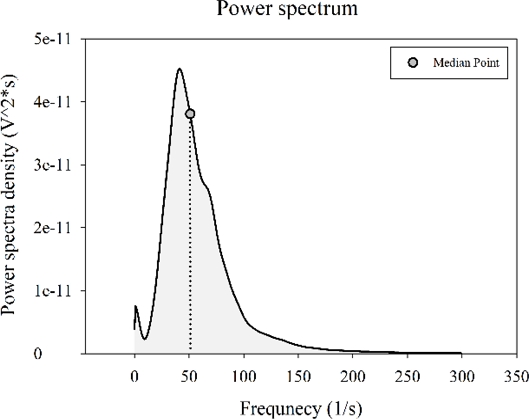
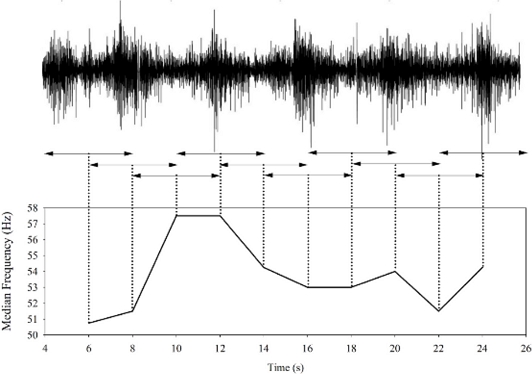
24]. A consecutive Fast Fourier Transform (FFT) was carried out using EMG Works Acquisition (ver.4.7.9) to collect Median frequency (MDF). MDF was collected at the point where the integral values on the left and right sides of the power spectrum became equal during each section of contraction and relaxation (
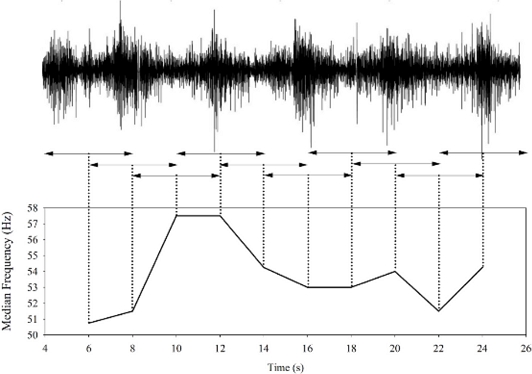
Fig. 1), and one point for two seconds were collected. Since contraction and relaxation were performed in keeping with the beat of the metronome, the time of the contraction and relaxation section was fixed at one second. Additionally, the window increment was performed at half the window length to prevent the burst signal from being dropped and the MDF data being corrupted. In other words, the window length was set to capture burst signal and the overlapped section was set to 50% (
Fig. 2).
Fig. 1Collected median frequency from power spectral density
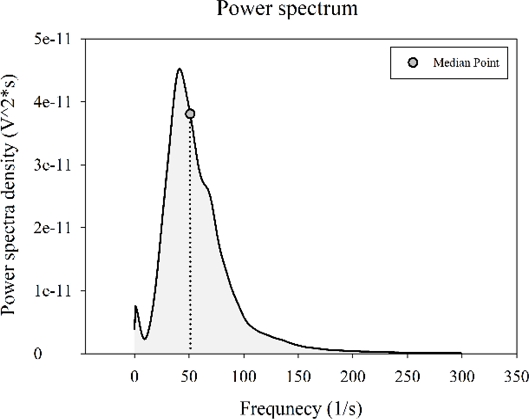
Fig. 2Window length and window increment
During the experiment protocol, unification of all factors other than variables is essential. It is difficult to limit the range of motion of the joint due to the characteristic of the isotonic contraction, the EMG MDF data were collected for the attempt to maintain a more constant force among the two trials, excluding the practice for adaptation and 1st trial.
Since sEMG, which is measured non-invasively, is easily contaminated with noise, it is difficult to quantify muscle fatigue with MDF data extracted from raw data. In order to minimize the effect of the contaminated MDF value, the muscle fatigue is measured in the frequency domain using the method of linear regression of the MDF
[25]. The starting and ending points of the linear regression line indicate the tendency of fatigue accumulated in the muscles during the session. The MDF value measured during the contraction period is represented as a linear regression prediction value
Eqs. (3) obtained through
(1) and
(2).
The MDF start point and MDF end point are compared to quantify the degree of muscle fatigue. Muscle fatigue is estimated by calculating how much the MDF value is shifted at the start and end of the exercise. Mean Absolute Error (MAE) was used to indicate the reliability of the MDF value expressed as a linear regression line
Eq. (4). The shifted values are checked whether there is a statistically significant difference using SPSS version 14.0 (SPSS Inc., Chicago).
3. Results
3.1 Linear Regression for Median Frequency
The collected MDF data were approximated using a linear regression method, it indicates the degree of muscle fatigue
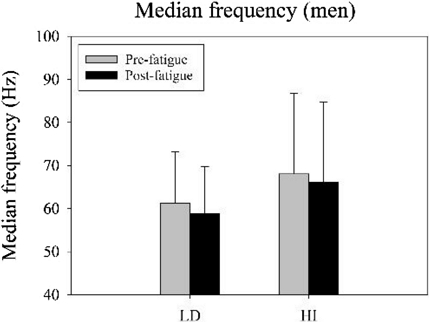
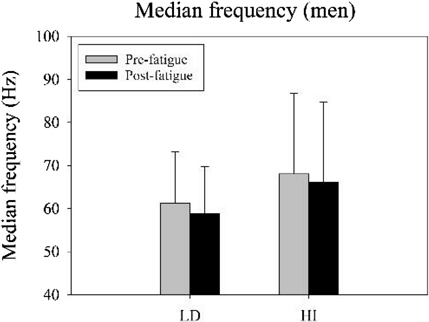
[26]. In men, under the long duration (LD) condition in which isotonic contractions were performed with 1 kg for two minutes, the median frequency decreased approximately. Before fatigue, it decreased from 61.1816±12.0470 to 58.7487±11.0481, and regression error used for median frequency estimation was 2.5864±0.2765. Except for one subject, all decreased and the degree of decrease was different depending on individual characteristics. Since the experiment was carried out by fixing the weight and time, the frequency change of the EMG signal was different by subjects. In the high-intensity (HI) condition in which isotonic contractions were performed at 2 kg for one minute, the results in men showed a less decreased or similar tendency compared to the previous exercise condition (
Fig. 3). Before fatigue, it decreased from 68.0522±18.7353 to 66.0326±18.7585, and regression error used for median frequency estimation was 3.2617±1.13209. The exceptional subject who did not have a decrease in MDF under the long duration condition did not change their MDF even under the high intensity exercise condition.
Fig. 3The start and end of median frequency at long duration and high intensity exercise condition in men
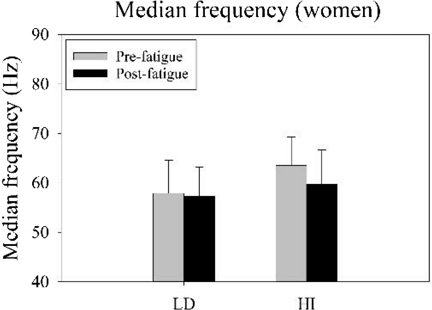
The experimental results of the women in LD condition tended to remain or little decreased for each subject. As with men, the frequency change in women was different by subjects, because weight and time are fixed. Before fatigue, it decreased from 57.8951±6.7473 to 57.2926±5.9619, and regression error used for median frequency estimation was 2.0522±0.2568. In the HI condition, the all experimental results of women showed a tendency to decrease compared to the previous exercise condition (
Fig. 4). Before fatigue, it decreased from 63.5755±5.6748 to 59.7360±6.9723, and regression error used for median frequency estimation was 1.9276±0.4616. The difference in frequency at the start and end points of the two conditions did not have a significant difference in the two conditions for men, and it was found that median frequency decreased with a large effect size in women at high intensity (
Table 1).
Fig. 4The start and end of median frequency at long duration and high intensity exercise condition in women
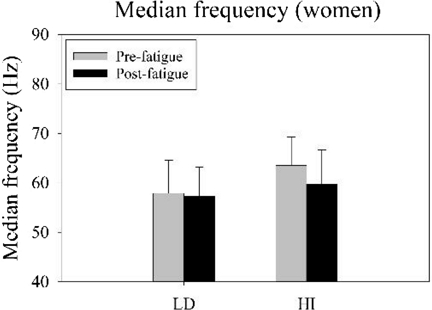
Table 1T-Test for median frequency from the start to the end of the median frequency under fatigue condition
Table 1
|
Gender |
Fatigue
condition |
Mean |
SD |
CI |
Effect
size |
P |
|
Men |
Long
duration |
2.4329 |
4.1391 |
-2.7106
7.5724 |
0.2105 |
0.259 |
|
High
intensity |
2.0195 |
2.2166 |
-0.7327
4.7718 |
0.1077 |
0.111 |
|
Women |
Long
duration |
0.6025 |
3.3947 |
-3.6126
4.8176 |
0.0946 |
0.712 |
|
High
intensity |
3.8395 |
3.5724 |
-0.5962
8.2751 |
0.604 |
0.074 |
The difference between pre-fatigue and post-fatigue of the estimated values was t-tested by linear regression of the collected median frequencies. It can be inferred that the larger the difference, the higher the fatigue.
3.2 Median Frequency Distance
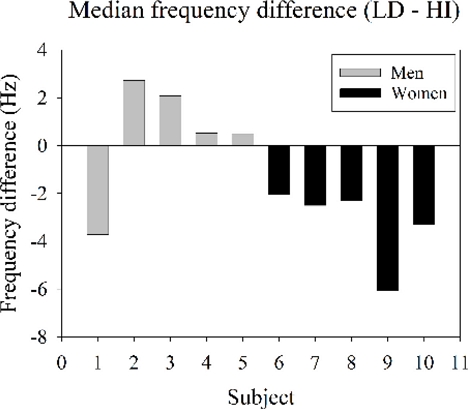
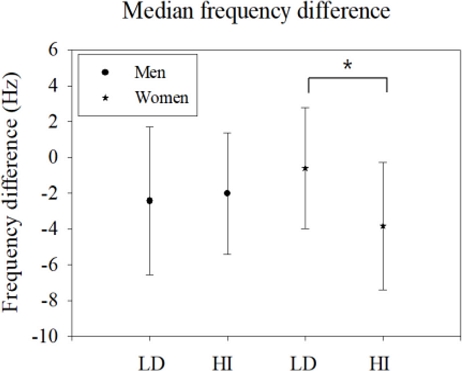
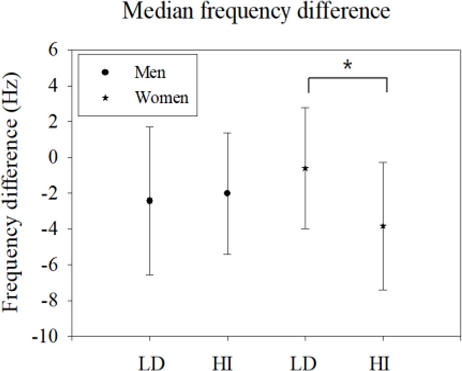
The difference in MDF reduced in each condition was compared individually for each subject. Men tended to decrease more in long duration than in high intensity exercise condition, however there was no significant difference (p = 0.731). In women, it tended to decrease more in the high intensity exercise condition than in the long duration, which is a statistically significant difference (p = 0.012) (
Table 2). Although the degree of decrease in frequency was different (
Fig. 5), a statistically significant result was obtained that MDF decreased more at HI condition than LD condition in women (
Fig. 6). Fatigue for each subject was indicated through the frequency difference between the start and end of the exercise, suggesting that HI condition showed greater fatigue than LD condition in women.
Table 2T-Test about the difference of median frequency between two fatigue condition
Table 2
|
Gender |
Mean |
SD |
CI |
P |
|
Men |
-0.4134 |
2.5110 |
-3.5312
2.7044 |
0.731 |
|
Women |
3.2370 |
1.6547 |
1.1824
5.2916 |
0.012 |
Fig. 5Median frequency difference in long duration and high intensity condition by subject
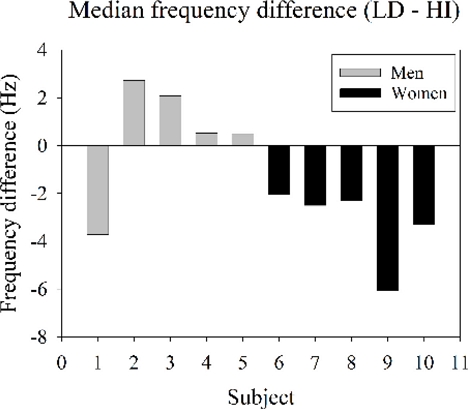
Fig. 6Median frequency by exercise condition
4. Discussion
Factors more vulnerable to fatigue during exercise duration and intensity were investigated in the course of repetitive load exercise with the fatigue index that obtained from the muscle EMG signal. Muscle fatigue caused by changes in exercise duration and intensity were founded a significant difference in women, while no significant differences were found in the men. These results can be caused by difference fast muscle fiber thickness in men and women
[27]. Although there is no difference in the number of muscle fibers and the ratio of fast to slow muscle between men and women, the thickness of fast muscle fibers is larger in men than women
[28]. As a result, men with a large thickness of fast muscle fibers that produce fuel using anaerobic metabolism can produce relatively greater power, which is advantageous for generating bursts of short speed or high intensity. It is inferred that there was no significant difference between the two conditions in men due to the influence of fast muscle fibers that produce a lot of force quickly in short protocol times of one and two minutes. For men with greater influence of fast muscle fibers compared to women, further experiment with protocols based on maximum voluntary contraction that consumes different maximum power for each individual is required. The limitations of the protocol consisting of fixed load and time did not sufficiently induce muscle fatigue in men, so it is required further research on fatigue of men in isotonic condition However, it is possible to measure muscle fatigue based on the data of women who clearly showed a decrease in MDF.
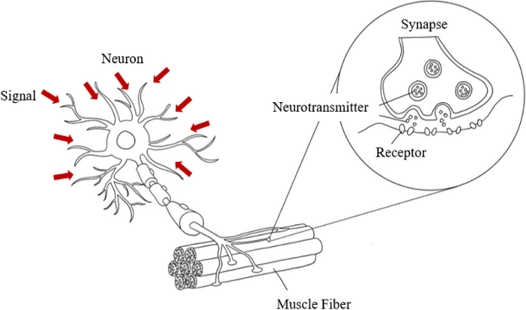
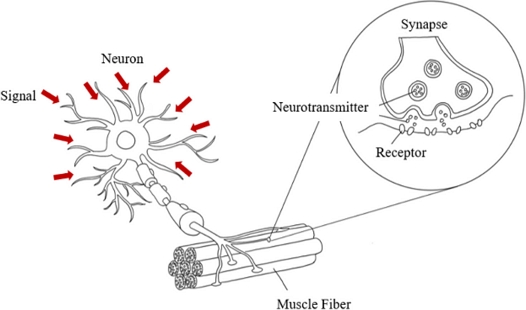
The fatigue was quantified by the frequency domain of EMG, which measures the change in potential within the muscle. When the central nervous system, which is the first stage of muscle movement, gives a command to contract, nerve substances are transmitted through neurons. This transmitted neuronal material arrives at the muscle and activates the motor unit inside the muscle (
Fig. 7). In order to maintain the force, this process continues to be activated at a high rate, which causes the motor unit to slow down. The continued slowing of the motor unit causes a potential change in the motor unit, and it is confirmed by a decrease in the median frequency in the power spectrum of the EMG signal
[29]. Through this process, the decrease in frequency was accepted as an indicator of fatigue, and it was proved that the women of this experiment showed greater fatigue under high-intensity exercise conditions than long duration condition.
Fig. 7 Muscle activation
The decrease in EMG median frequency is closely related to the firing rate, which is the frequency of activation of the motor unit action potential (MUAP). The firing rate of the motor unit, which is the smallest unit that can be controlled by a person, does not appear to be constant. The fluctuations in these firing rates are correlated with changes in muscle force output
[30], and when the amplitude of the motor unit action potential reflected in the EMG raw data increases, the decrease in the mean firing rates is decreased at 10 and 30% of maximum voluntary contraction
[31]. As additional motor units are required as progress is made to maintain a constant force output, it increases the likelihood of fatigue induced in more motor units. In this study, the factors that are more fatal to the reduction of the firing rate among the force maintaining time and force size were investigated in isotonic contraction that repeats eccentric and concentric contractions. In the existing MVC method that contracts for a short time, the size of the MUAP increased linearly as the force increased, and the firing rate remained relatively constant up to 30% of the maximum force
[32]. The greater decrease with increasing intensity in the firing rate, which accelerates the accumulation of fatigue in voluntary isometric contractions, supports that fatigue is more sensitive to intensity than time.
The suggestion that fatigue is more sensitive at high intensity was mainly investigated in isometric contractions that were spontaneously contracted for a short period of time. When investigated at relative high intensity of MVC 90% and moderate intensity of MVC 50%, greater MUAP was found in high intensity contraction compared to moderate strength
[33]. Even when compared with the lower intensity of MVC 70% and MVC 25% of the maximum, the decrease in median frequency was more evident at MVC 70%
[34]. Since fatigue is more evident in repeated high-force explosive contractions than in spontaneous contractions in repetitive load work used as a method of applying fatigue
[35], it seems that the same results as in voluntary isotonic contractions in repetitive load work are shown. Since the investigation of the muscle fatigue mechanism is based on the measured results, it is difficult to estimate that all causes are a decrease in MUAP, but it can be estimated that intensity contributed to the decrease in MUAP in that all of them were accompanied by a decrease in median frequency in common.
Our findings, which appear to be more sensitive to fatigue by load intensity under exercise conditions, can be help extend to an extensive investigation of muscle fatigue in support of our findings, which appear to be more sensitive to fatigue by load intensity in exercise conditions. It will be helpful to clearly analyze the mechanism of muscle fatigue by adding the research results on isotonic contraction to the existing isometric contraction-centered research results.
Our study attempted to further expand the study for the identification of the fatigue mechanism by adding a new fatigue variable, exercise time, to the intensity-based surveys measured as voluntary maximum force contractions in isometric contractions. Fatigue due to voluntary contraction was measured until the force could no longer be maintained, which hardly took the time factor into account. The repeated load exercise for a relatively long time makes the muscle fatigue maintained for a longer period of time, so it is also essential to analyze it from the perspective of time. Fatigue from long working hours was mostly not accompanied by a decrease in the frequency domain over very long periods of time
[36,
37]. As a result of the investigation by adjusting the time of repetitive work for a relatively long time and a short time in consideration of the disturbance factors of the measurement for a long time in the EMG signal measurement, it is suggested that time has less of an effect on the reduction of the firing rate than the load. The increase in intensity slowed down the firing rate more than the increase in time, suggesting that the change in intensity in the exercise session responds more sensitively than change in time to fatigue.
In terms of muscle physiology, it is argued that fatigue is manifested by lack of energy. Adenosine triphosphate (ATP), the main energy source for energy supply, is used for contraction, and high-energy phosphate transfer, glycolysis and oxidative phosphorylation are recruited to maintain ATP levels at the muscle cell level. When the decrease is faster than ATP production due to continued exercise, the accumulation of degradation products causes an imbalance in Ca²+ cycling and Na+/K+ balance, leading to decrease in ATP. And the ATP decrease causes production of adenosine diphosphate (ADP) and output during concentric contraction is reduced
[38-
40].
The degree of fatigue was defined to the extent that the median frequency decreased based on the firing rate, which is the activation frequency of the motor unit action potential, without considering the physiological aspects. In addition to considering physiological variables, research on dynamic conditions should be further conducted. Based on this study, it has been proven that the muscle fatigue in isotonic contraction is greater under high-intensity condition, but additional investigation on the recovery rate of muscle in isotonic contraction is needed. Because of the limitations of the current study that investigates factors vulnerable to fatigue in bicep brachii with a protocol in which concentric and eccentric exercises are repeated, a detailed analysis of fatigue according to the method of muscle activation is also needed. The investigation of sensitive factors of muscle fatigue through various experimental measurements will be able to prevent injuries in rehabilitation and exercise programs through strength training and derive maximum efficiency.
Muscle fatigue is caused by a variety of causes and plays a major role in our movement. As an additional experiment in which the relative intensity of men was controlled, it is necessary to prove that as well as women show greater fatigue in intensity than in the time of the protocol, similar to the contraction method of isometric contractions without movement. If substantiated, it can be concluded that the intensity is more sensitive in eccentric and concentric contractions, although the fatigue level appears different. These conclusions can make it possible to predict the fatigue of motions caused by repetition of concentric and eccentric contractions. In addition, if you investigate the fatigue accumulation and fatigue by dividing the two contraction methods, an in-depth analysis of the neural fatigue mechanism will be possible.
ACKNOWLEDGMENTS
This work was supported by Incheon National University Research Grant in 2020.
REFERENCES
- 1.
Edwards, R. H., (1981), Human muscle function and fatigue, Human Muscle Fatigue: Physiological Mechanisms, 82, 1-18.
10.1002/9780470715420.ch1
- 2.
Reaz, M. B. I., Hussain, M. S., Mohd-Yasin, F., (2006), Techniques of EMG signal analysis: Detection, processing, classification and applications, Biological Procedures Online, 8(1), 11-35.
10.1251/bpo115
- 3.
Bigland-Ritchie, B., Donovan, E., Roussos, C., (1981), Conduction velocity and EMG power spectrum changes in fatigue of sustained maximal efforts, Journal of Applied Physiology, 51(5), 1300-1305.
10.1152/jappl.1981.51.5.1300
- 4.
Moritani, T., Nagata, A., Muro, M., (1982), Electromyographic manifestations of muscular fatigue, Medicine and Science in Sports and Exercise, 14(3), 198-202.
10.1249/00005768-198203000-00008
- 5.
De Luca, C. J., (1997), The use of surface electromyography in biomechanics, Journal of Applied Biomechanics, 13(2), 135-163.
10.1123/jab.13.2.135
- 6.
Li, L., Shin, H., Li, X., Li, S., Zhou, P., (2016), Localized electrical impedance myography of the biceps brachii muscle during different levels of isometric contraction and fatigue, Sensors, 16(4), 581.
10.3390/s16040581
- 7.
Dimitrova, N., Arabadzhiev, T., Hogrel, J.-Y., Dimitrov, G., (2009), Fatigue analysis of interference EMG signals obtained from biceps brachii during isometric voluntary contraction at various force levels, Journal of Electromyography and Kinesiology, 19(2), 252-258.
10.1016/j.jelekin.2007.08.007
- 8.
Öberg, T., SANDSJö, L., Kadefors, R., (1994), Subjective and objective evaluation of shoulder muscle fatigue, Ergonomics, 37(8), 1323-1333.
10.1080/00140139408964911
- 9.
Petrofsky, J. S., Glaser, R. M., Phillips, C. A., Lind, A. R., Williams, C., (1982), Evaluation of the amplitude and frequency components of the surface EMG as an index of muscle fatigue, Ergonomics, 25(3), 213-223.
10.1080/00140138208924942
- 10.
Hunter, S. K., Duchateau, J., Enoka, R. M., (2004), Muscle fatigue and the mechanisms of task failure, Exercise and Sport Sciences Reviews, 32(2), 44-49.
10.1097/00003677-200404000-00002
- 11.
Petrofsky, J. S., (1979), Frequency and amplitude analysis of the EMG during exercise on the bicycle ergometer, European Journal of Applied Physiology and Occupational Physiology, 41(1), 1-15.
10.1007/BF00424464
- 12.
Örtengren, R., Andersson, G., Broman, H., Magnusson, R., Petersén, I., (1975), Vocational electromyography: Studies of localized muscle fatigue at the assembly line, Ergonomics, 18(2), 157-174.
10.1080/00140137508931449
- 13.
Roy, S. H., Bonato, P., Knaflitz, M., (1998), EMG assessment of back muscle function during cyclical lifting, Journal of Electromyography and Kinesiology, 8(4), 233-245.
10.1016/S1050-6411(98)00010-8
- 14.
Komi, P. V., Tesch, P., (1979), EMG frequency spectrum, muscle structure, and fatigue during dynamic contractions in man, European Journal of Applied Physiology and Occupational Physiology, 42(1), 41-50.
10.1007/BF00421103
- 15.
MacIsaac, D., Parker, P. A., Scott, R. N., (2001), The short-time Fourier transform and muscle fatigue assessment in dynamic contractions, Journal of Electromyography and Kinesiology, 11(6), 439-449.
10.1016/S1050-6411(01)00021-9
- 16.
Bigland-Ritchie, B., Furbush, F., Woods, J., (1986), Fatigue of intermittent submaximal voluntary contractions: Central and peripheral factors, Journal of Applied Physiology, 61(2), 421-429.
10.1152/jappl.1986.61.2.421
- 17.
Stephens, J., Taylor, A., (1972), Fatigue of maintained voluntary muscle contraction in man, The Journal of Physiology, 220(1), 1-18.
10.1113/jphysiol.1972.sp009691
- 18.
Hermens, H. J., Freriks, B., Merletti, R., Stegeman, D., Blok, J., Rau, G., Disselhorst-Klug, C., Hägg, G., (1999), European recommendations for surface electromyography, Roessingh Research and Development, 8(2), 13-54.
- 19.
Orizio, C., Perini, R., Diemont, B., Maranzana Figini, M., Veicsteinas, A., (1990), Spectral analysis of muscular sound during isometric contraction of biceps brachii, Journal of Applied Physiology, 68(2), 508-512.
10.1152/jappl.1990.68.2.508
- 20.
Rainoldi, A., Galardi, G., Maderna, L., Comi, G., Conte, L. L., Merletti, R., (1999), Repeatability of surface EMG variables during voluntary isometric contractions of the biceps brachii muscle, Journal of Electromyography and Kinesiology, 9(2), 105-119.
10.1016/S1050-6411(98)00042-X
- 21.
Freund, H.-J., Büdingen, H.-J., (1978), The relationship between speed and amplitude of the fastest voluntary contractions of human arm muscles, Experimental Brain Research, 31(1), 1-12.
10.1007/BF00235800
- 22.
Potvin, J., Bent, L., (1997), A validation of techniques using surface EMG signals from dynamic contractions to quantify muscle fatigue during repetitive tasks, Journal of Electromyography and Kinesiology, 7(2), 131-139.
10.1016/S1050-6411(96)00025-9
- 23.
Clancy, E. A., Morin, E. L., Merletti, R., (2002), Sampling, noise-reduction and amplitude estimation issues in surface electromyography, Journal of Electromyography and Kinesiology, 12(1), 1-16.
10.1016/S1050-6411(01)00033-5
- 24.
Hermens, H. J., Freriks, B., Merletti, R., Stegeman, D., Blok, J., Rau, G., Disselhorst-Klug, C., Hägg, G., (1999), European recommendations for surface electromyography, Roessingh Research and Development, 8(2), 13-54.
- 25.
Coorevits, P., Danneels, L., Cambier, D., Ramon, H., Vanderstraeten, G., (2008), Assessment of the validity of the Biering-Sørensen test for measuring back muscle fatigue based on EMG median frequency characteristics of back and hip muscles, Journal of Electromyography and Kinesiology, 18(6), 997-1005.
10.1016/j.jelekin.2007.10.012
- 26.
Cifrek, M., Medved, V., Tonković, S., Ostojić, S., (2009), Surface EMG based muscle fatigue evaluation in biomechanics, Clinical Biomechanics, 24(4), 327-340.
10.1016/j.clinbiomech.2009.01.010
- 27.
Miller, A. E. J., MacDougall, J., Tarnopolsky, M., Sale, D., (1993), Gender differences in strength and muscle fiber characteristics, European Journal of Applied Physiology and Occupational Physiology, 66(3), 254-262.
10.1007/BF00235103
- 28.
Trappe, S., Gallagher, P., Harber, M., Carrithers, J., Fluckey, J., Trappe, T., (2003), Single muscle fibre contractile properties in young and old men and women, The Journal of Physiology, 552(1), 47-58.
10.1113/jphysiol.2003.044966
- 29.
Arendt-Nielsen, L., Mills, K., (1985), The relationship between mean power frequency of the EMG spectrum and muscle fibre conduction velocity, Electroencephalography and Clinical Neurophysiology, 60(2), 130-134.
10.1016/0013-4694(85)90019-7
- 30.
Conwit, R. A., Stashuk, D., Suzuki, H., Lynch, N., Schrager, M., Metter, E. J., (2000), Fatigue effects on motor unit activity during submaximal contractions, Archives of Physical Medicine and Rehabilitation, 81(9), 1211-1216.
10.1053/apmr.2000.6975
- 31.
Conwit, R., Stashuk, D., Tracy, B., McHugh, M., Brown, W., Metter, E., (1999), The relationship of motor unit size, firing rate and force, Clinical Neurophysiology, 110(7), 1270-1275.
10.1016/S1388-2457(99)00054-1
- 32.
Yu, F., Hedström, M., Cristea, A., Dalén, N., Larsson, L., (2007), Effects of ageing and gender on contractile properties in human skeletal muscle and single fibres, Acta Physiologica, 190(3), 229-241.
10.1111/j.1748-1716.2007.01699.x
- 33.
Miller, J. D., Lippman, J. D., Trevino, M. A., Herda, T. J., (2020), Neural drive is greater for a high-intensity contraction than for moderate-intensity contractions performed to fatigue, The Journal of Strength & Conditioning Research, 34(11), 3013-3021.
10.1519/JSC.0000000000003694
- 34.
Crenshaw, A., Karlsson, S., Gerdle, B., Friden, J., (1997), Differential responses in intramuscular pressure and EMG fatigue indicators during low- vs. high-level isometric contractions to fatigue, Acta Physiologica Scandinavica, 160(4), 353-361.
10.1046/j.1365-201X.1997.00168.x
- 35.
Buckthorpe, M., Pain, M. T., Folland, J. P., (2014), Central fatigue contributes to the greater reductions in explosive than maximal strength with high-intensity fatigue, Experimental Physiology, 99(7), 964-973.
10.1113/expphysiol.2013.075614
- 36.
El Falou, W., Duchêne, J., Grabisch, M., Hewson, D., Langeron, Y., Lino, F., (2003), Evaluation of driver discomfort during long-duration car driving, Applied Ergonomics, 34(3), 249-255.
10.1016/S0003-6870(03)00011-5
- 37.
Clancy, E. A., Bertolina, M. V., Merletti, R., Farina, D., (2008), Time-and frequency-domain monitoring of the myoelectric signal during a long-duration, cyclic, force-varying, fatiguing hand-grip task, Journal of Electromyography and Kinesiology, 18(5), 789-797.
10.1016/j.jelekin.2007.02.007
- 38.
Gauche, E., Couturier, A., Lepers, R., Michaut, A., Rabita, G., Hausswirth, C., (2009), Neuromuscular fatigue following high versus low-intensity eccentric exercise of biceps brachii muscle, Journal of Electromyography and Kinesiology, 19(6), e481-e486.
10.1016/j.jelekin.2009.01.006
- 39.
De Luca, C., LeFever, R., McCue, M., Xenakis, A., (1982), Behaviour of human motor units in different muscles during linearly varying contractions, The Journal of Physiology, 329(1), 113-128.
10.1113/jphysiol.1982.sp014293
- 40.
Green, H., (1997), Mechanisms of muscle fatigue in intense exercise, Journal of Sports Sciences, 15(3), 247-256.
10.1080/026404197367254
Biography
- Dahyun Nam
M.S candidate in the Department of Mechatronics Engineering at Incheon National University. She received B.S in the Department of Mechatronics Engineering, Incheon National University. Her research interest is fatigue analysis in dynamic movement through bio-signals and biomechanical analysis of fatigue and human movements.
- Kiwon Park
Associate Professor in the Department of Mechatronics Engineering, Incheon National University. He worked at Trine University, USA, from 2011 to 2018 as an Assistant and Associate Professor after receiving his Ph.D. in the Department of Mechanical Engineering from University of Illinois at Urbana-Champaign. He obtained his B.S. from Inha University, Korea, in Mechanical Engineering. Dr. Park’s studies focus on the dynamical/biomechanical analysis of human body motions and on the development of a new technique to characterize coupled joint patterns in human gait.