ABSTRACT
This study presents a method for fabricating customized insoles using fused filament fabrication (FFF) and user-specific foot shape data. We evaluated the method's effects through plantar pressure distribution and Arch Index (AI) analysis. To capture plantar contours, we designed a kit-type impression-based acquisition process. The resulting impressions were digitized using three-dimensional (3D) scanning. We aligned the scanned plantar impression with a base insole CAD model, iteratively modifying and verifying the upper surface to reconstruct a customized insole geometry. The final insole model was exported in STL format and produced using FFF with a thermoplastic polyurethane (TPU) filament and a 25% honeycomb infill structure. A subject with a high arch wore the customized insoles during daily activities for one month, with plantar pressure data collected three times before and after the wear period. After using the customized insoles, the midfoot contact area increased from approximately 10–15% to 20–25% of the total plantar contact area, and the plantar load distribution shifted from a forefoot-rearfoot concentration to a more balanced pattern. These results demonstrate that the proposed FFF-based customized insole effectively enhances medial arch support and promotes a balanced plantar load distribution.
-
KEYWORDS: Customized insole, Additive manufacturing, Plantar pressure distribution, Arch index
-
KEYWORDS: 개인맞춤형 인솔, 적층제조, 족저압분포, 아치 지표
1. 서론
사람 발의 형상은 내측 종 아치(Medial Longitudinal Arch)의 높이에 따라 정상족(Normal), 평족(Flat Arch) 그리고 요족(High Arch)으로 분류된다[
1,
2]. 그리고 이러한 아치의 형상은 족저면의 압력 분포와 체중 지지 방식에 직접적인 영향을 미친다. 즉, 평족은 아치가 낮아 발의 중앙부가 바닥과 넓게 접촉하는 형태의 발이다. 이 경우 발의 안쪽으로 하중이 집중되는 경향이 있으며 이는 충격 흡수 능력을 저하시켜 피로 누적과 보행 불안정성을 유발하며, 발의 내측 회전이 과도하게 발생하면서 발목과 무릎의 정렬에도 영향을 주는 것으로 알려져 있다[
3,
4]. 요족은 아치가 과도하게 높아 발의 앞쪽과 뒤꿈치에 하중이 집중되는 형태를 보이는 것으로, 발 전체에 하중이 고르게 분산되지 못하여 전족부나 후족부에 반복적인 압력이 과도하게 가해져 피로성 통증이나 조직 손상의 위험이 증가한다[
5]. 발 형상의 구조적 차이는 장시간 보행과 같은 반복 하중 조건에서 발의 안정성과 피로 저항성에 영향을 주는 것으로 알려져 있으며, 따라서 인솔을 이용하여 이를 개선하기 위한 연구가 이루어지고 있다[
6-
13]. 이러한 인솔을 이용한 접근 방식은 크게 두 가지 방식으로 구분될 수 있다. 첫번째 방식은, 일반적인 발 형태를 기준으로 아치 높이를 형성하여 발의 구조를 교정하는 방법으로서 주로 범용 제품을 대량 생산하여 이용하므로 제작 단가가 낮고 일반인들의 접근성이 좋다. 그러나 사용자의 족형이나 보행 특성에 따른 개별적 차이를 반영하지 못하여 착용자의 피로 누적 상태나 착용 환경에 따라 교정 효과가 일정하지 않은 것으로 보고되고 있다[
6-
8]. 두 번째 방식은, 사용자의 발 형상 및 보행 데이터를 정밀하게 분석하여 인솔을 설계 및 제작하는 것으로서 사용자 발 형상 측정을 기반으로 제작하므로 개인별로 최적화된 구조를 구현하게 된다[
9-
13]. 이와 같은 개인 맞춤형 인솔은 평족, 요족 등 다양한 족형 조건에서 하중 분포를 개선하고 보행 안정성을 향상시키는 것으로 알려져 있다[
9-
12]. 최근에는 적층제조 공정 기술을 적용하여 발 형상을 정밀하게 재현한 인솔 제작 연구 또한 이루어지고 있다. Park 등[
13]은 3D 프린팅 기반 아치 지지 인솔이 보행 역학과 발목 정렬에 미치는 영향을 분석하였으며, Hsu 등[
14]은 서로 다른 형상 조건에서의 하지 생체역학 변화를 비교하였다. 또한 Sterman 등[
15]은 점진적 강성 구조를 적용한 인솔을 제안하였고, Chatpun 등[
16]은 내부채움 밀도 및 패턴이 족저압 분포에 미치는 영향을 평가하였다. Baranowski 등[
17]은 셀룰러 구조 기반 3D 프린팅 신발 밑창이 족저압 분포에 미치는 영향을 실험적으로 분석하였다. 이러한 연구들은 맞춤형 인솔의 구조적 설계 또는 생체역학적 성능 개선 가능성을 제시하였다는 점에서 의미가 있다.
한편, 발 형상을 인상 기반 방법으로 획득한 후 이를 디지털화 하여 인솔 제작에 적용하는 접근 역시 보조기 제작 분야에서 활용되어 왔다[
18]. 그러나 기존 연구들은 주로 제작된 인솔의 임상적 효과나 압력 분포 변화 분석에 초점을 두고 있으며, 족저 형상 데이터 획득–CAD 정렬 및 보정–적층제조로 이어지는 전 과정의 공정 흐름을 체계적으로 정리하고 검증한 연구는 상대적으로 제한적이다. 특히 스캔 데이터와 기본 인솔 형상 간의 정렬 및 반복 보정 절차를 명확히 기술한 사례는 많지 않다. 한편, 맞춤형 인솔 제작에는 숙련된 인력과 이에 따른 전문 장비가 필요해 제작 비용이 고가이고 따라서 일반 사용자가 이용하기에는 접근성이 낮다는 한계가 있다. 따라서 사용자 형상 데이터를 효율적으로 활용하면서도 제조 과정을 단순화할 수 있는 공정 기반 접근이 요구된다. 이에 따라 필라멘트 재료 압출 기반 적층제조(Fused Filament Fabrication, FFF) 기술이 이러한 요구를 충족할 수 있는 효과적 대안으로 주목받고 있다[
19]. 특히, 3D 스캐너를 통해 획득한 족부 형상 데이터를 FFF 기반 인솔 설계 및 제작에 직접 적용할 수 있다면 기존의 고가형 맞춤 인솔 대비 동등한 구조적 성능을 유지하면서도 제작 단가를 크게 절감할 수 있을 것으로 기대된다. 이에 본 연구는 저비용 키트형 인상 기반 계측 방법과 CAD 기반 정렬·검증 절차를 결합한 FFF 적층제조 공정 흐름을 제시하고, 족저압 분포와 아치 지표를 활용한 정량적 분석을 통해 제안 공정의 합리성과 유효성을 검증하고자 하였다.
2. 제작 공정 설계
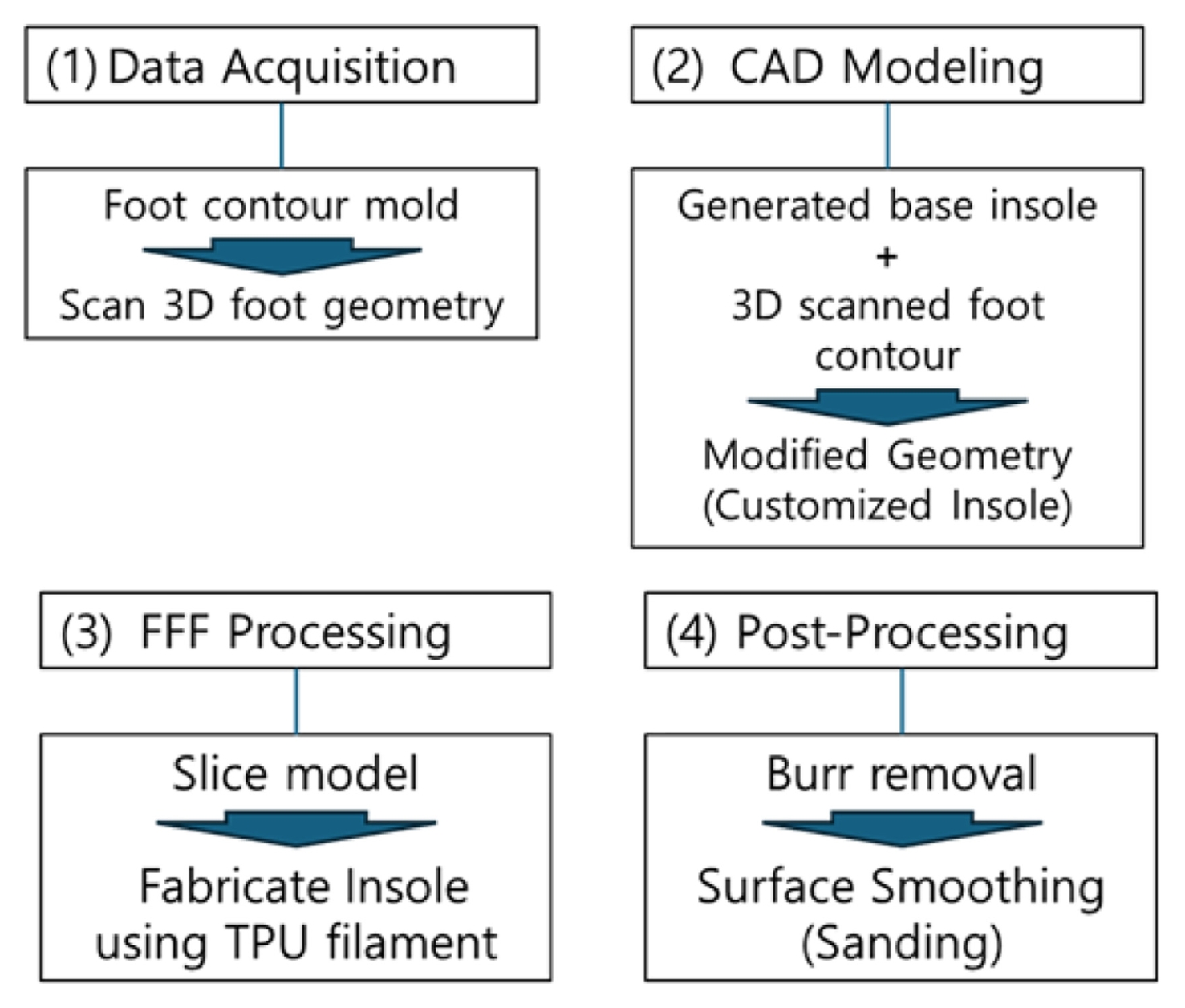
본 연구에서 제안한 맞춤형 인솔의 제작 공정은
Fig. 1과 같이 총 네 단계의 ① 족저면 형상 데이터 획득, ② CAD 모델링, ③ FFF 기반 적층제조 그리고 ④ 후가공 과정으로 구성된다.
본 연구에서는 족저면 형상 데이터를 효율적으로 수집하기 위해 키트형 인상 기반 계측(Kit-type Impression-based Acquisition) 과정을 설계하였다. 이는 (1) 음형 형성 단계(Negative Impression Formation)와 (2) 스캐닝 및 디지털화 단계(Scanning and Digitization) 의 두 단계로 이루어진다.
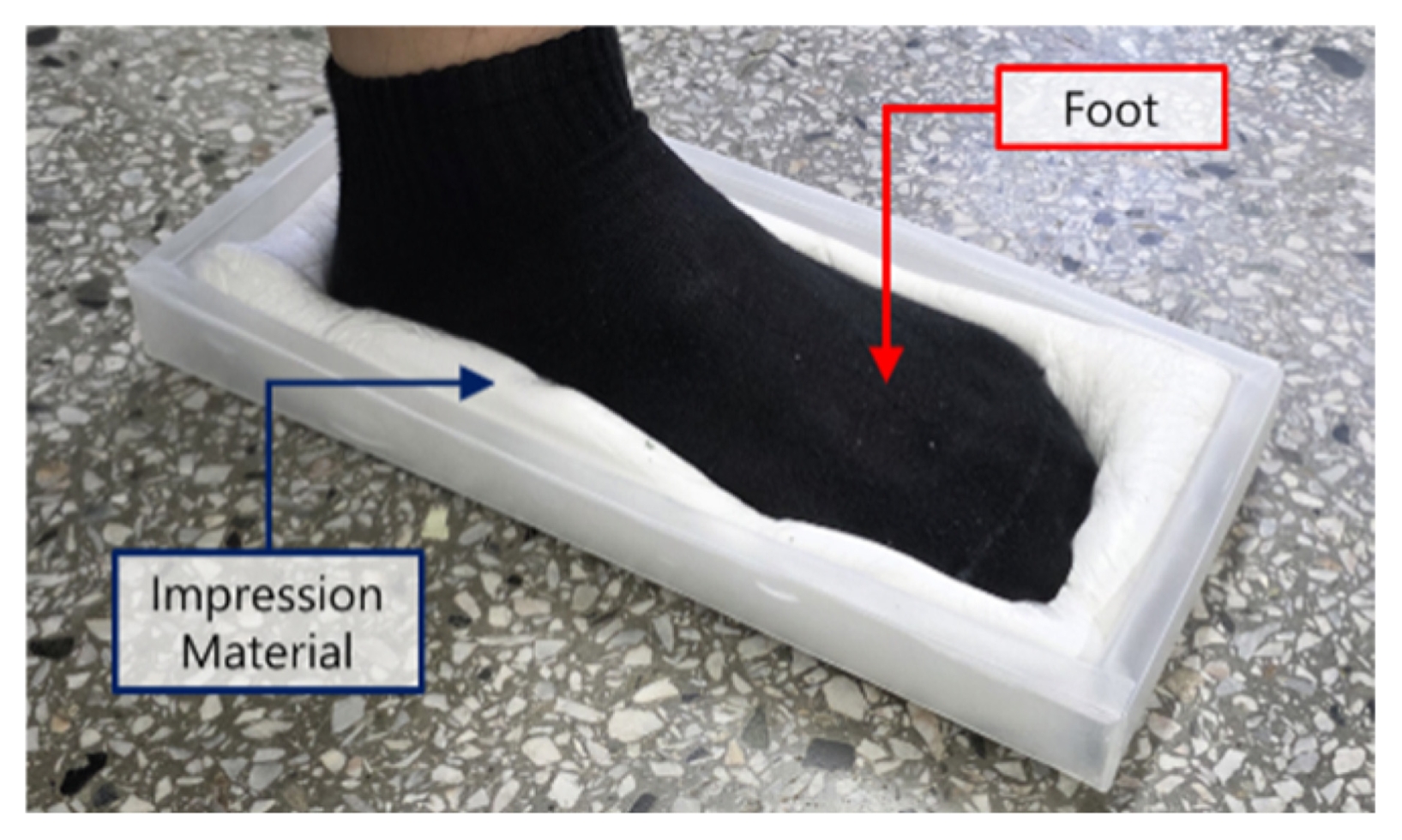
음형 형성 단계에서는 피험자의 족저면 표면 형상 정보를 안정적으로 확보할 수 있다. 일정 두께의 점토를 직사각 용기에 충전한 인상재(Impression Material) 위에 피험자가 올라서서 발바닥 전체가 점토 표면에 균일하게 접촉하도록 하여 족저면의 음형을 형성하였다(
Fig. 2). 본 연구에 사용된 점토는 가소성 및 표면 재현성이 높아 형상 복제 정밀도가 우수하다[
20,
21].
스캐닝 및 디지털화 단계에서는 제작된 음형을 3차원 디지털 데이터로 변환한다. 즉, 음형의 표면 형상을 3D 스캐너(Einscan Pro X2, Shining 3D)를 사용하여 획득하고, 전용 소프트웨어(EXScan Pro, Shining 3D)를 이용해 STL 파일 형식으로 트웨어(EXScan Pro, Shining 3D)를 이용해 STL 파일 형식으로 저장하였다. 해당 장비는 기준 형상 대비 평균 표면 거리 오차(Mean Radial Error) 약 0.1 mm 및 거리 오차의 제곱평균제곱근(RMSE) 1 mm 이하의 정확도가 검증된 바 있다[
22].
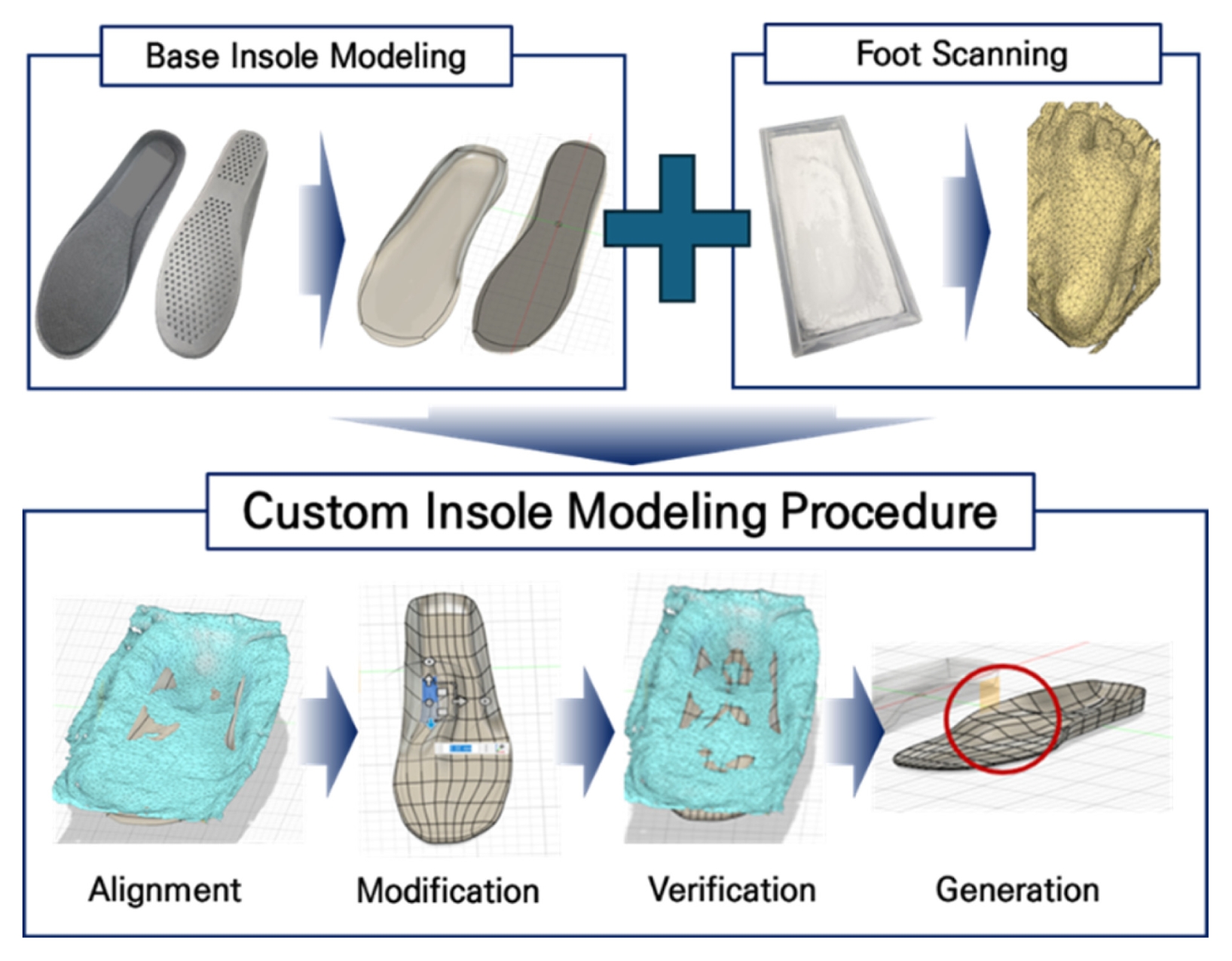
3D 스캐닝을 통해 획득한 STL 데이터를 기반으로 사용자 족저면 형상을 반영한 맞춤형 인솔의 3D CAD 모델을 제작하기 위한 절차는
Fig. 3과 같다. 우선, 인솔이 장착될 신발 내부 형상에 맞춘 기본 인솔의 CAD 모델을 제작하였다. 이후, 스캐닝으로 얻은 족저면 음형 데이터를 기본 인솔과 동일한 좌표계에 배치하고 위치를 결정하는 정렬 단계(Alignment)를 수행하였다. 정렬된 족형 데이터를 기준으로 인솔 상부 형상을 측정된 족저면의 높이와 곡률에 맞도록 단계적으로 변형시키고(Modification), 변형된 형상이 실제 스캔된 족저면 음형과 일치하는지 반복적으로 비교·보정하여 정확도를 확보하였다(Verification). 마지막으로, 검증이 완료된 사용자 맞춤형 인솔 형상을 적층제조가 가능한 STL 파일 형식으로 저장하는 형상 생성 단계(Generation)를 수행하였다. 이 과정을 통하여 스캔 데이터와 기본 인솔 형상이 통합된 최종 3D CAD 모델을 생성 하였으며, 이후 이는 맞춤형 인솔 제작을 위한 적층제조 공정의 입력 데이터로 사용하였다.
CAD 모델링을 통해 완성된 맞춤형 인솔의 3D 모델을 FFF 적층제조 공정을 이용하여 제작하였다. 문헌에 따르면 FFF 공정은 ±0.2-0.5 mm 수준의 치수 편차가 발생할 수 있으며[
23-
25], 이는 인체 적용 교정구의 기하학적 스케일에 비해 상대적으로 작은 범주에 해당한다. 따라서 본 연구에서는 해당 공정을 적용하였다. 제작에는 Bambu Lab P1S를 사용하였으며 재료는 유연성과 내마모성을 가진 열가소성 폴리우레탄(Thermoplastic Polyurethane, TPU) 필라멘트를 사용하였다. 이 때 인솔 내부는 벌집모양의 구조를 갖도록 설계하여 인솔에 요구되는 유연성을 확보하도록 하였다. 해당 구조는 적층제조 기반 인솔에서 내부 채움 패턴 및 셀룰러 구조가 유연성 및 족저압 분산 특성에 영향을 미친다고 보고한 선행 연구[
15-
17]를 참고하여 적용하였다. 인솔 성형 시 압출 헤드는 250 mm/s의 속도로 이송되었으며, 필라멘트 압출을 위한 노즐 온도는 230°C로 설정하였다.
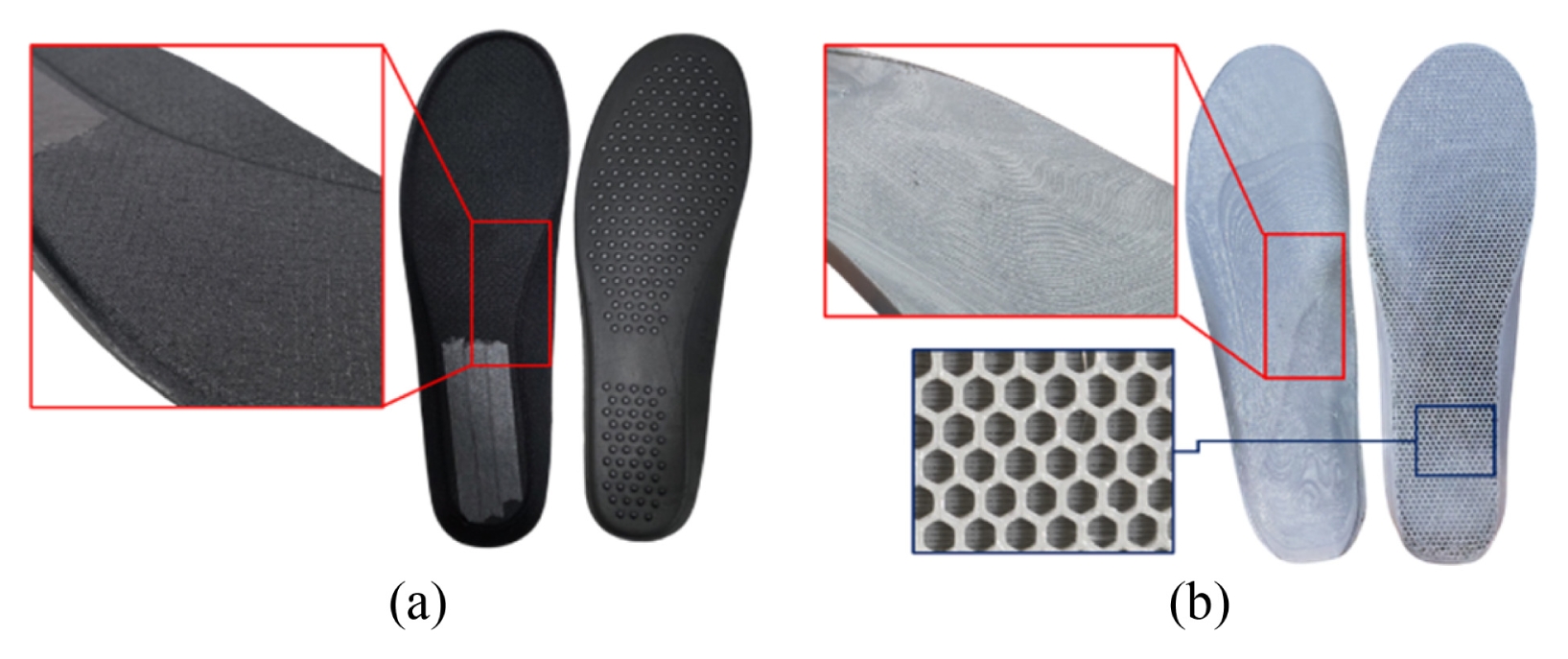
Fig. 4는 일반 운동화 등에 사용되는 상용 인솔(a)과 본 연구에서 제작한 맞춤형 인솔(b)을 비교한 것이다. 두 인솔 모두 일반 운동화 등에 적용이 가능하도록 바닥면이 평탄하다. 하지만 상용 인솔의 윗면은 일반적인 발 바닥의 형태이고, 맞춤형 인솔의 윗면은 사용자 족저면 형상을 반영하여 보다 복잡한 표면 형상을 갖는다.
3. 검증 실험
본 연구에서 FFF 공정으로 제작된 인솔 자체는 착용 예비 실험에서 표면이 좀 더 딱딱하고 또한 국부적으로 발바닥에 과도한 압력이 가해진다는 사용자의 불편함이 있었다. 이는 사용자의 발 형상에 맞춘 형상에 기인하므로 장시간 착용 시 불편함이 해소될 수 있을 것이다. 하지만 피험자가 장시간 착용해야 하는 상황을 고려해 인솔 상면에 두께 1.8 mm의 EVA (Ethylene-vinyl Acetate) 폼을 부착한 후 인솔의 착용 평가 실험을 수행하였다.
3.1 착용 평가 및 데이터 획득
본 연구에서는 요족을 가진 피험자의 신발에서 기존 인솔을 제거하고 제작된 맞춤형 인솔을 장착하여 1개월간 착용 평가를 수행하였다. 요족은 아치가 과도하게 높아 발의 전족부와 후족부에 하중이 집중되는 특성을 가지기 때문에 본 연구에서 제작 된 맞춤형 인솔의 하중 분산 및 균형 개선 효과를 검증하기에 적합한 사례로 판단하였다[
3-
5]. 피험자는 본 연구에서 제작된 맞춤형 인솔을 일상생활 및 보행 환경에서 지속적으로 착용하였으며 평균 착용 시간은 하루 약 8시간 내외였다.
착용 전후 비교를 위해 족저면 압력 분포(Plantar Pressure Distribution)와 아치 지표(Arch Index, AI)를 주요 평가 지표로 선정하였다. 족저면 압력 분포는 발바닥의 어느 부위에 하중이 집중되는지를 보여주는 지표이며[
1,
2,
8,
12], 아치 지표는 족저면의 2차원 접촉 형상을 기반으로 족형을 분류하는 데 사용되는 정량적 지표이다[
8,
12]. 두 지표는 각각 발의 하중 전달 특성과 족저면 형상을 평가하는 서로 다른 지표이므로, 이를 동시에 활용하면 인솔 착용 전후의 변화를 더 정확하게 분석할 수 있다. 측정은 양말을 착용한 상태에서 10 Hz의 샘플링 주파수 조건으로 10초간 데이터를 수집하는 방식으로 수행되었으며, 동일 조건에서 3회 반복 측정하였다. 모든 실험은 평지 조건에서 진행하였다.
3.1.1 족저면 압력 분포 및 아치 지표
족저면 압력 분포는 발바닥의 어느 부위에 하중이 더 가해지는 지를 보여주며, 인솔 착용이 발바닥에 가해지는 체중의 분배에 어떤 변화를 유도하는지 확인할 수 있다. 아치 지표는 족저면 접촉 면적의 비율을 이용해 내측 아치의 높이를 정량화하는 지표로, 착용 전후 아치 형태 변화를 객관적으로 판단하는 데 활용된다.
아치 지표는 전체 접촉 면적 중 중족부 면적의 비율로 정의 되며
식(1)과 같이 계산된다[
1,
2].
여기서I는 아치 지표,
Arear는 전체 접촉 면적 중 후족부(rearfoot)의 면적,
Amid는 중족부(Midfoot)의 면적 그리고
Afore는 전족부(Forefoot)의 면적이다.
식(1)에 의해 계산된 아치 지표 값이 0.21 미만이면 요족, 0.21-0.28이면 정상족, 그리고 0.28 초과면 평족으로 분류되며, 본 연구에서는 Menz 등[
2]이 제안한 기준을 참고하여 정상족 범위를 0.21-0.28로 설정하였다.
아치 지표 계산을 위해 전용 분석 알고리즘을 개발하고 이를 Python으로 구현하였다. 즉, 발가락 부분이 제외된 족저면 압력 분포 이미지를 회색조로 변환한 뒤, 0이 아닌 픽셀을 유효 압력 영역으로 간주하여 이진 마스크를 생성하고 발바닥 접촉 영역을 추출하였다. 이후 마스크의 세로 방향 분포를 기준으로 하단 약 30% 영역을 후족부 후보, 상단 약 4 0% 영역을 전족부 후보로 정의하고, 각 영역의 중심점을 계산하여 후족부 중심점과 전족부 중심점을 구하였다. 두 중심점을 연결하는 직선을 발의 길이 방향 기준축으로 설정한 뒤, 모든 접촉 픽셀을 이 축 방향으로 투영하여 얻은 투영 거리의 최소–최대 범위를 전체 발 길이로 정의하였다. 이후, 이를 1/3 간격으로 세 구간으로 분할하여 후족부, 중족부, 그리고 전족부 영역을 구분하였다.
Figs. 5와
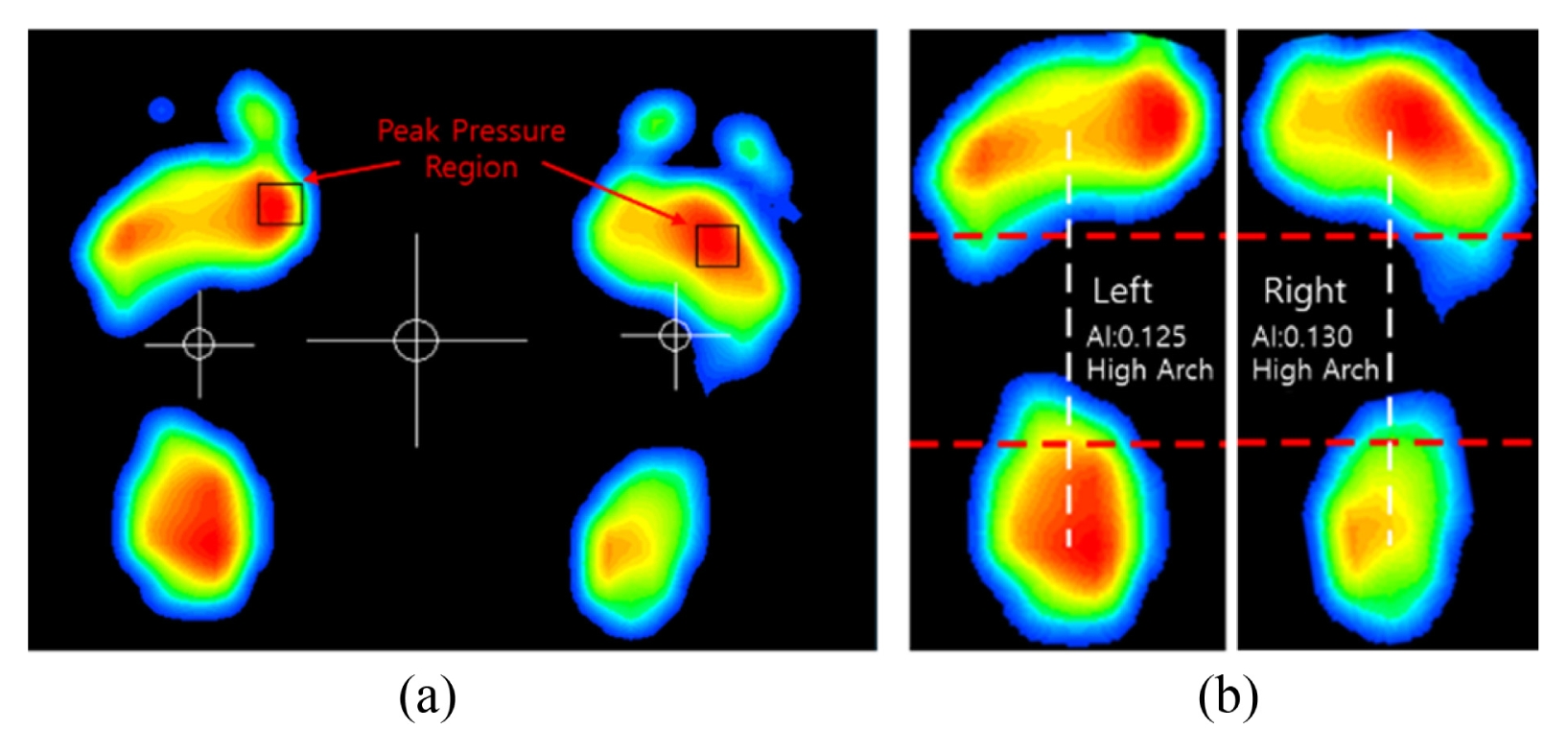
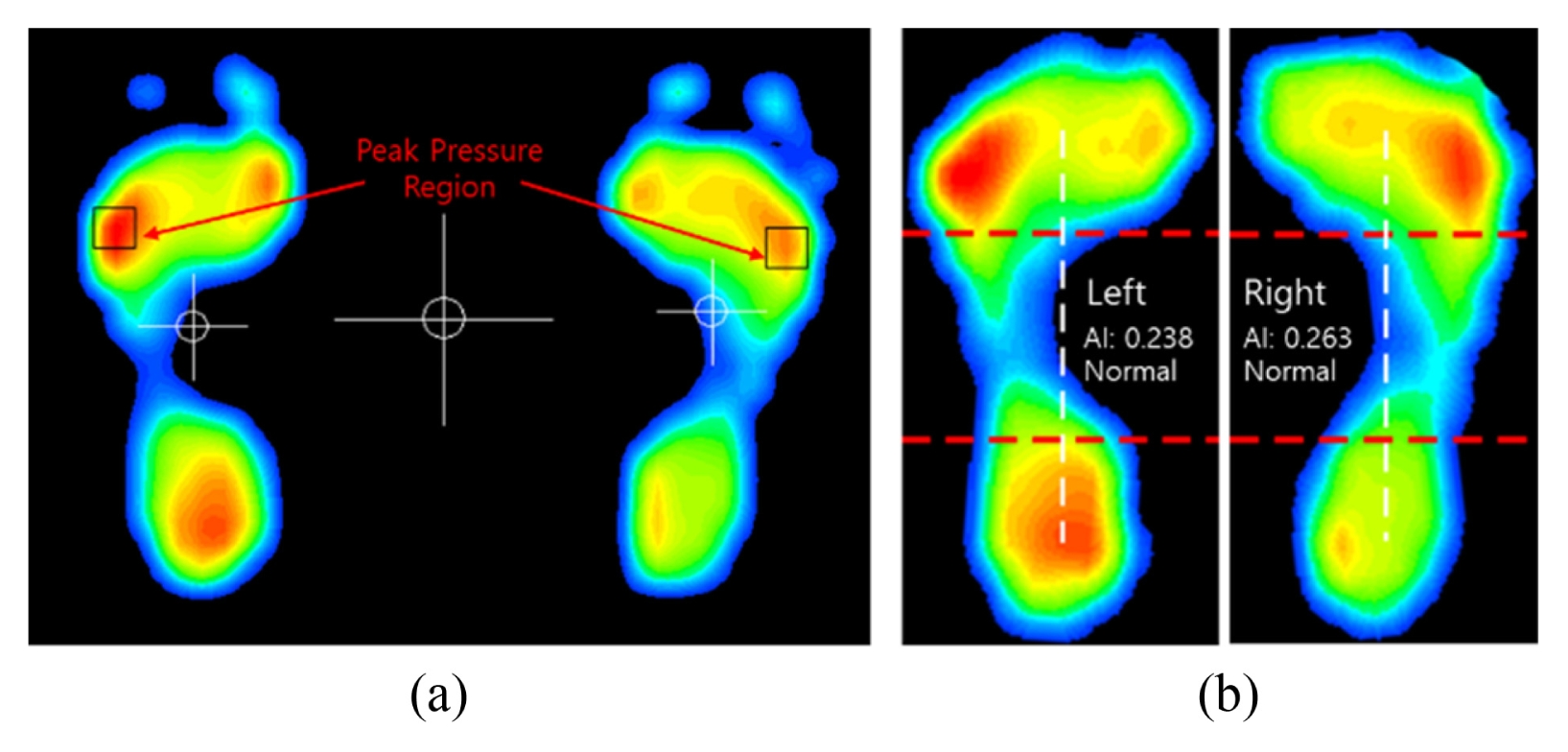
6은 각각 인솔 착용 시험 전후 측정된 데이터 중 대표 사례를 도식화한 결과로, 족저면 압력 분포와 아치 지표 계산 과정을 시각적으로 보여준다. 착용 전에는 전족부와 후족부 모두 상대적으로 높은 하중 집중과 높은 아치 형태가 관찰되었다(
Fig. 5). 하지만 1개월 착용 후에는 중족부 접촉 면적이 확대되고 하중이 보다 균등하게 분산되는 경향이 나타났다(
Fig. 6).
Table 1은 측정된 데이터를 기반으로 인솔 착용 전(
Fig. 5)과 1개월 착용 후(
Fig. 6)의 아치 지표 및 중족부 면적 변화를 요약한 결과이다. 착용 전 피험자는 아치 지표 값이 0.21 미만으로 요족에 해당하였으나, 착용 후에는 평균 아치 지표가 0.22-0.26 수준으로 증가하여 정상족 범위로 변화하였다. 또한, 중족부 면적이 전체 면적 대비 약 10-15% 수준에서 20-25%로 증가되어 하중 분포가 보다 균등해진 것으로 나타났다.
4. 결론
본 연구에서는 키트형 인상 기반 계측을 통해 족저면 형상을 획득하고, 3D 스캐닝 데이터의 CAD 정렬·반복 보정 절차를 거쳐 FFF 적층제조로 제작까지 연결되는 맞춤형 인솔 디지털 제조 공정을 제안하였다. 인솔은 3D 스캔 데이터를 CAD로 보정하고, 이를 FFF 기술로 적층제조 하였다. 제안 공정의 적용 가능성은 요족을 가진 피험자 1명을 대상으로 한 1개월 착용 평가를 통해 확인하였으며, 맞춤형 인솔 착용 후 중족부 접촉 면적이 증가하고 전·후족부 중심의 하중이 보다 균형 있게 분산되는 경향을 보였다. 아치 지표 역시 정상족 범위에 해당하는 수준으로 변화하는 경향이 관찰되었다. 이러한 결과는 본 연구에서 제안한 공정으로 제작한 인솔이 하중 분포 특성에 변화를 유도할 가능성이 있음을 보여준다.
특히 본 연구는 형상 데이터 획득-디지털 정렬 및 보정-적층 제조로 이어지는 전 공정 흐름을 구체적으로 제시하고, 이를 저비용·간소화된 절차로 구현하였다는 점에서 기존 맞춤형 인솔 연구와 차별성을 가진다. 향후 피험자 수와 족형 유형을 확대하고, 다양한 보행 조건과 장기 착용 효과를 포함한 추가 검증을 통해 본 공정의 적용 범위와 임상적 유효성을 체계적으로 평가할 필요가 있다.
FOOTNOTES
-
RESEARCH ETHICS STATEMENT
본 연구는 인간 대상 연구 윤리 기준을 준수하여 수행되었으며,모든 실험 절차는 충북대학교 생명윤리위원회(Institutional Review Board, IRB)의 승인(CBNU-2025-A-0116)을 받은 후 진행되었음.
Fig. 1Overall process for fabricating the custom insole using additive manufacturing
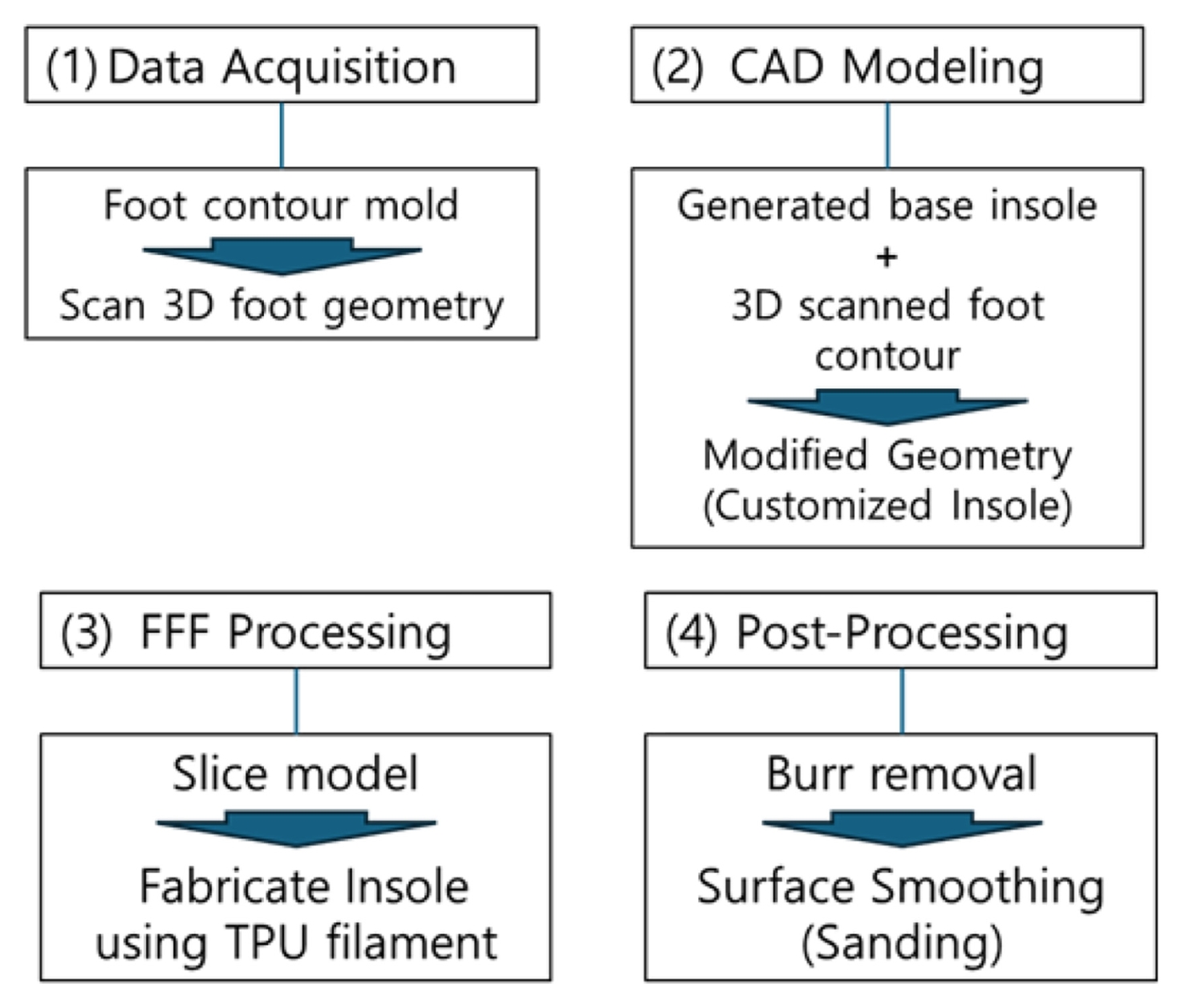
Fig. 2Photograph showing the subject capturing the plantar shape using the impression-based acquisition kit
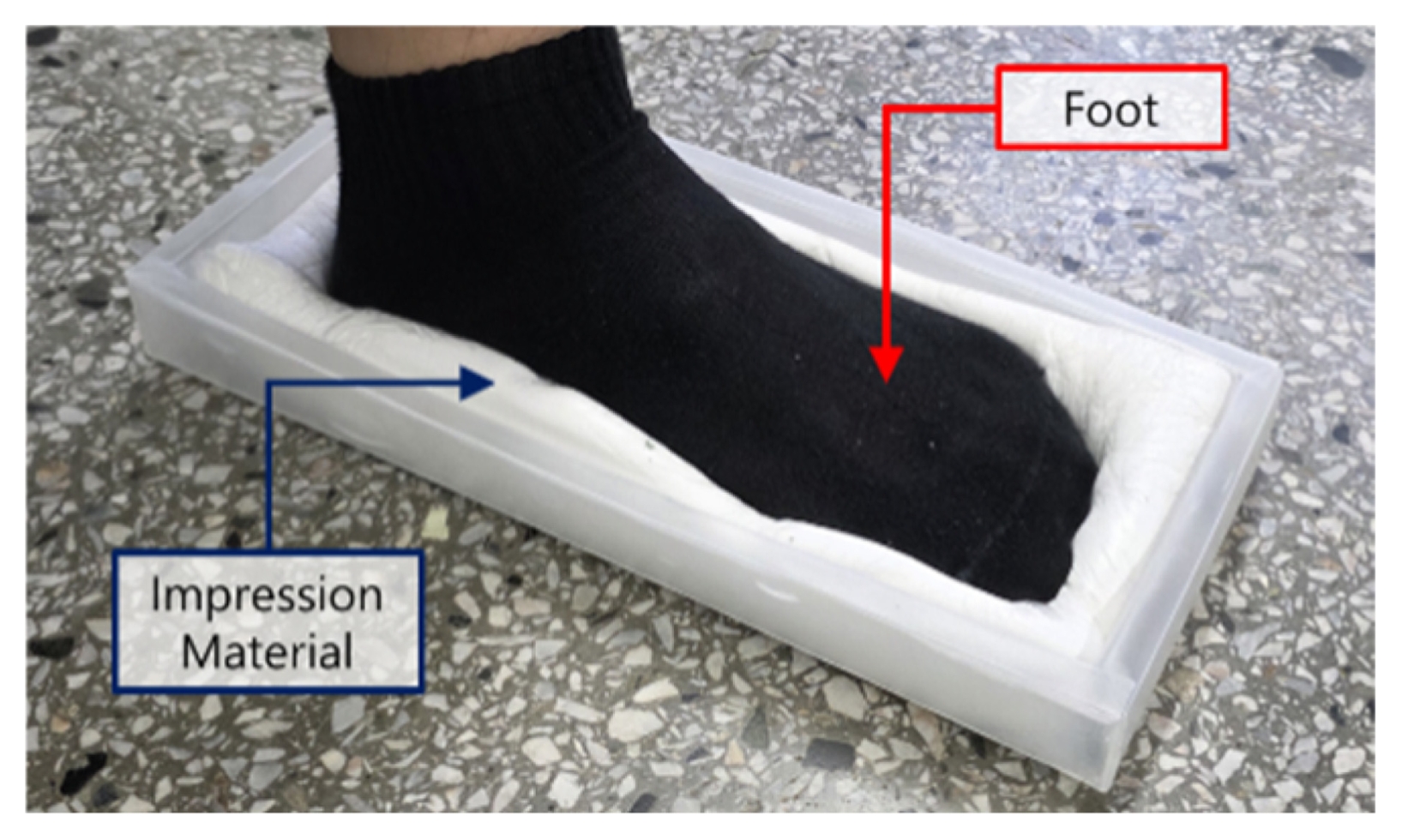
Fig. 3Illustration showing the custom insole modeling procedure
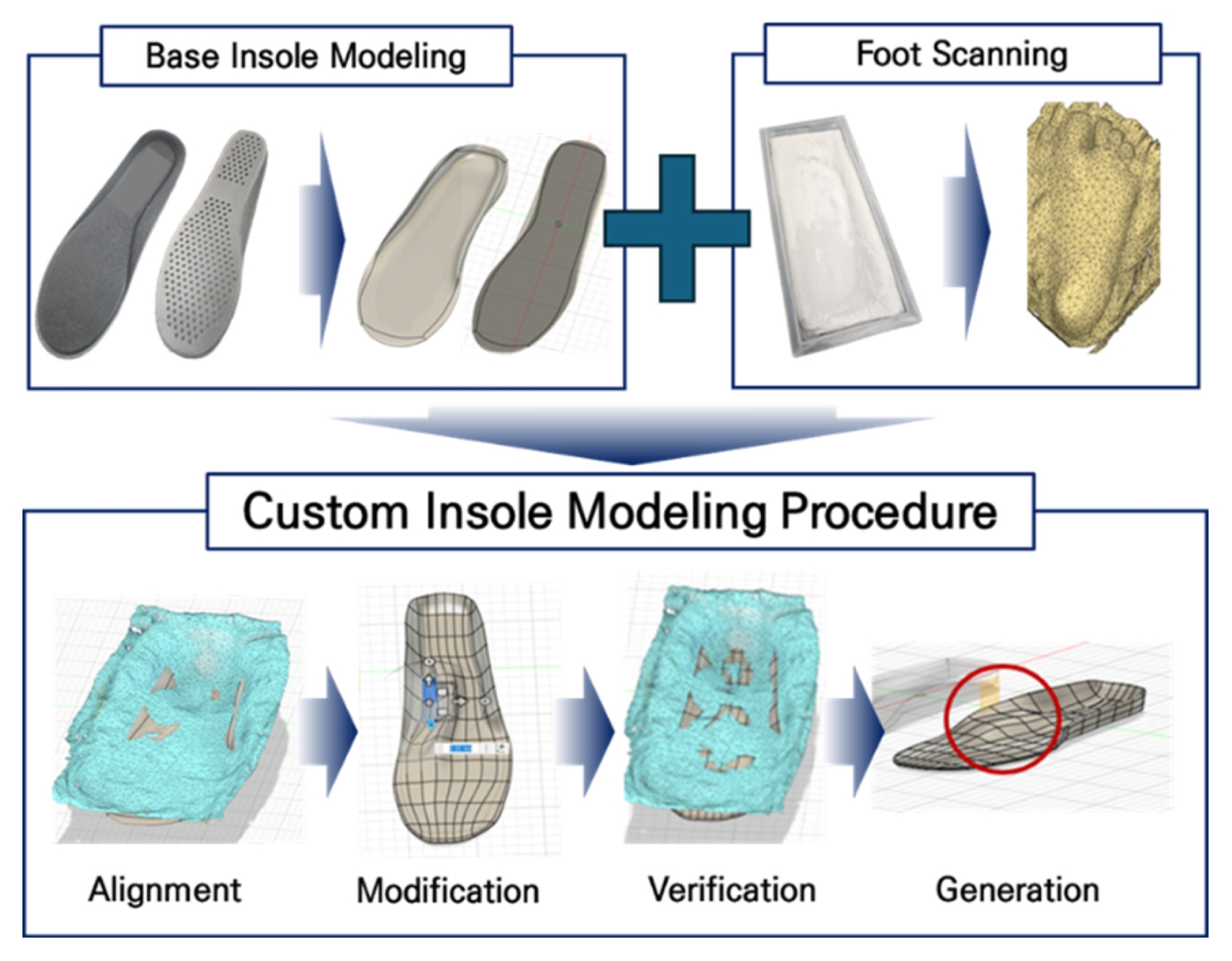
Fig. 4Comparison between (a) the commercial insole and (b) the customized insole, showing both top and bottom views of each insole
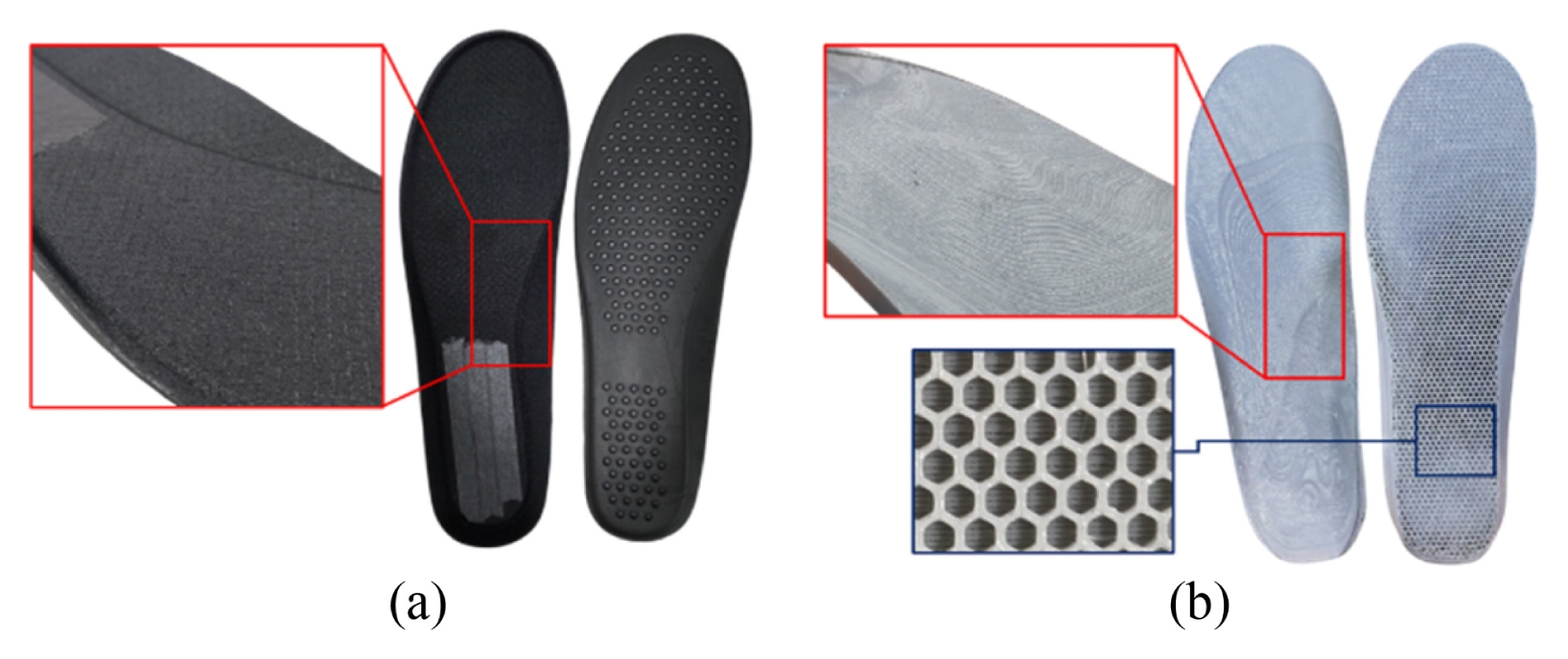
Fig. 5Representative example of pre-wear measurements: (a) Plantar pressure distribution with peak pressure region indicated, and (b) AI computation visualizing high-arch characteristics
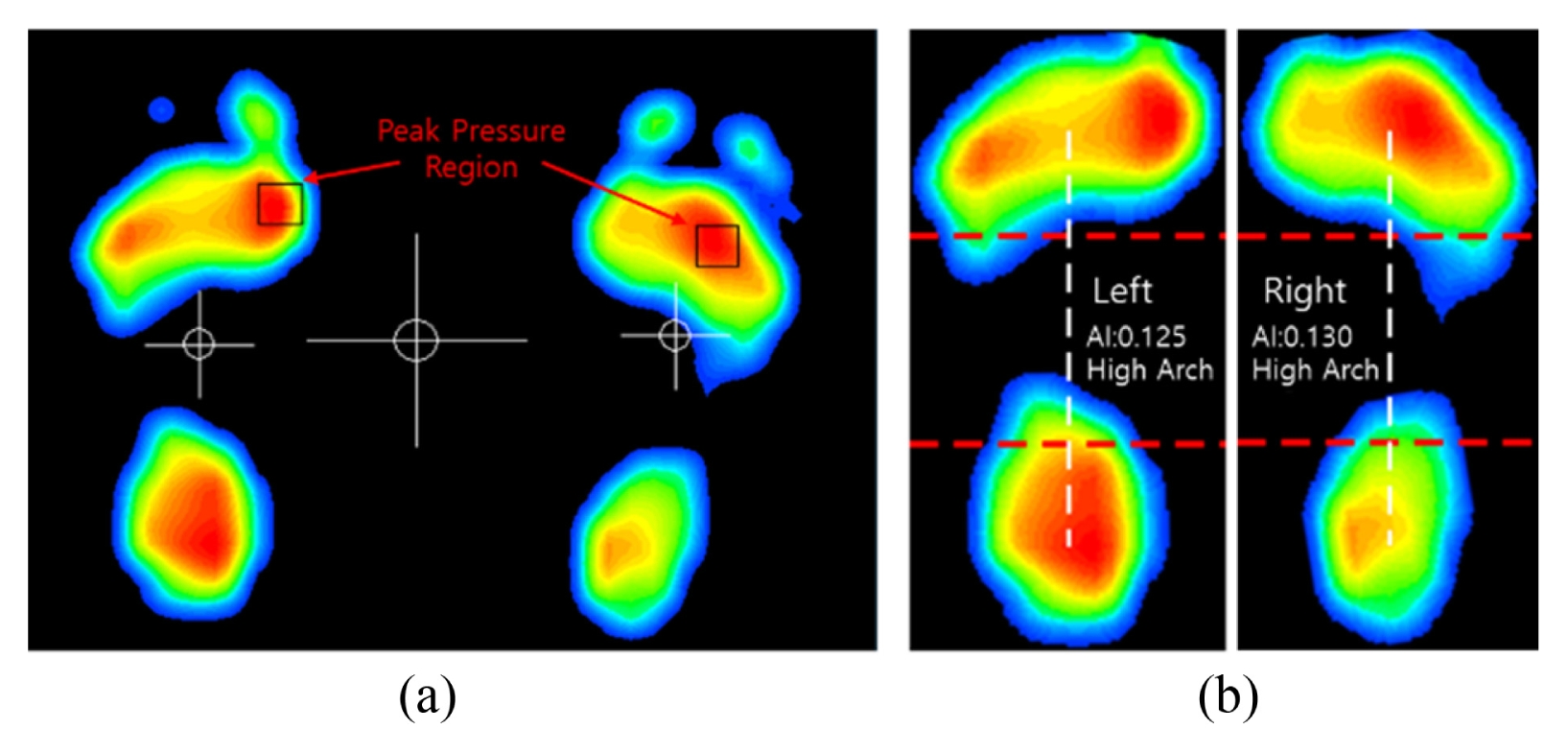
Fig. 6Representative example of post-wear measurements after 1 month of insole use: (a) Plantar pressure distribution with peak pressure region indicated, demonstrating increased midfoot engagement, and (b) AI computation visualizing normal characteristics
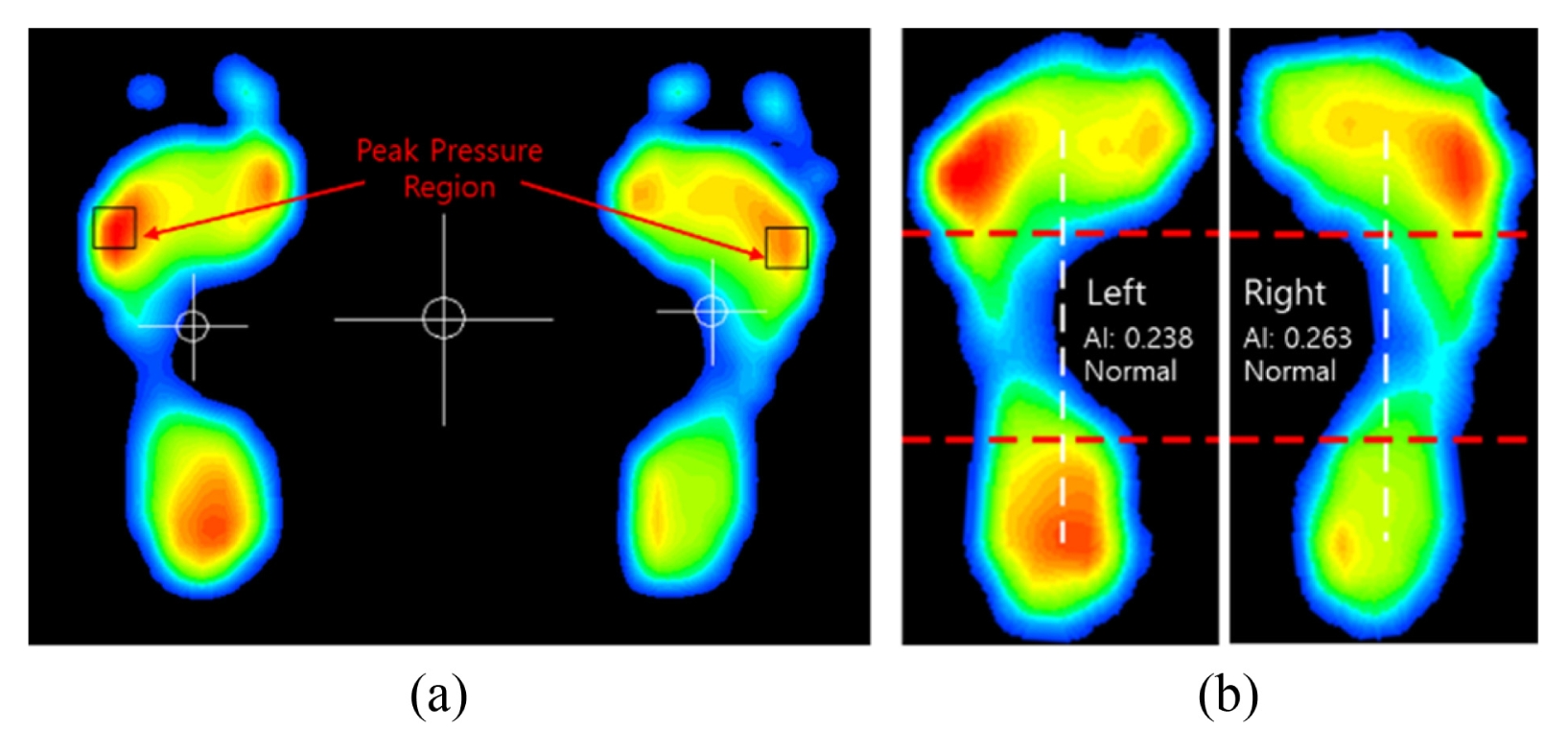
Table 1Comparison of Arch Index and midfoot contact area before and after 1-month insole wear
Table 1
|
Condition |
Before wear (M ± SD) |
After 1 month (M ± SD) |
|
Average AI (Left / Right) |
0.1040 ± 0.0148 / 0.1553 ± 0.0337 |
0.2280 ± 0.0168 / 0.2467 ± 0.0152 |
|
Classification |
Both high arch |
Both normal |
|
Midfoot area ratio (Left / Right) |
10.40 ± 1.49% / 15.56 ± 3.36% |
22.79 ± 1.71% / 24.65 ± 1.50% |
|
Overall tendency |
Concentrated pressure at forefoot and heel |
Increased midfoot contact and improved load balance |
REFERENCES
- 1. Cavanagh, P. R., Rodgers, M. M., (1987), The arch index: A useful measure from footprints, Journal of Biomechanics, 20(5), 547-551.
- 2. Menz, H. B., Fotoohabadi, M. R., Wee, E., Spink, M. J., (2012), Visual categorisation of the arch index: A simplified measure of foot posture in older people, Journal of Foot and Ankle Research, 5(1), 10.
- 3. Filardi, V., (2018), Flatfoot and normal foot a comparative analysis of the stress shielding, Journal of Orthopaedics, 15(3), 820-825.
- 4. Buldt, A. K., Forghany, S., Landorf, K. B., Murley, G. S., Levinger, P., Menz, H. B., (2018), Centre of pressure characteristics in normal, planus and cavus feet, Journal of Foot and Ankle Research, 11(1), 3.
- 5. Mootanah, R., Song, J., Lenhoff, M. W., Hafer, J. F., Backus, S. I., Gagnon, D., Deland, J. T. III, Hillstrom, H. J., (2013), Foot type biomechanics part 2: Are structure and anthropometrics related to function?, Gait & Posture, 37(3), 452-456.
- 6. Cheung, R. T., Ng, G. Y., (2007), Efficacy of motion control shoes for reducing excessive rearfoot motion in fatigued runners, Physical Therapy in Sport, 8(2), 75-81.
- 7. Mills, K., Blanch, P., Chapman, A. R., McPoil, T. G., Vicenzino, B., (2010), Foot orthoses and gait: A systematic review and meta-analysis of literature pertaining to potential mechanisms, British Journal of Sports Medicine, 44(14), 1035-1046.
- 8. Redmond, A. C., Landorf, K. B., Keenan, A.-M., (2009), Contoured, prefabricated foot orthoses demonstrate comparable mechanical properties to contoured, customised foot orthoses: A plantar pressure study, Journal of Foot and Ankle Research, 2(1), 20.
- 9. Açak, M., (2020), The effects of individually designed insoles on pes planus treatment, Scientific Reports, 10(1), 19715.
- 10. Herchenröder, M., Wilfling, D., Steinhäuser, J., (2021), Evidence for foot orthoses for adults with flatfoot: A systematic review, Journal of Foot and Ankle Research, 14(1), 57.
- 11. Thong-On, S., Harutaichun, P., (2023), Effects of customized insoles with medial wedges on lower extremity kinematics and ultrasonographic findings in plantar fasciitis persons, Scientific Reports, 13(1), 8642.
- 12. Kirmizi, M., Sengul, Y. S., Akcali, O., Angin, S., (2024), Effects of foot exercises and customized arch support insoles on foot posture, plantar force distribution, and balance in people with flexible flatfoot: A randomized controlled trial, Gait & Posture, 113, 106-114.
- 13. Park, S., Jung, J.-H., Lei, S., Jung, E.-Y., Cho, H.-Y., (2025), 3d-printed customized arch-support insoles improve gait mechanics and ankle alignment in young adults with functional flat foot during uphill walking, Medicina, 61(2), 281.
- 14. Hsu, C.-Y., Wang, C.-S., Lin, K.-W., Chien, M.-J., Wei, S.-H., Chen, C.-S., (2022), Biomechanical analysis of the flatfoot with different 3d-printed insoles on the lower extremities, Bioengineering, 9(10), 563.
- 15. Sterman, Y., Solav, D., Rosen, N., Saffuri, E., Shmilov Zaritsky, L., (2024), Custom orthotic insoles with gradual variable stiffness using 3d printed spacer technique, Virtual and Physical Prototyping, 19(1), e2336151.
- 16. Chatpun, S., Dissaneewate, T., Kwanyuang, A., Nouman, M., Srewaradachpisal, S., Movrin, D., (2025), Infill pattern and density of 3d-printed insoles alter energy and pressure distribution in gait, Applied Sciences, 15(7), 3916.
- 17. Baranowski, P., Kapusta, A., Płatek, P., Sarzyński, M., (2024), Influence of 3d-printed cellular shoe soles on plantar pressure during running-experimental and numerical studies, Biocybernetics and Biomedical Engineering, 44(4), 858-873.
- 18. Ren, Y., Wang, H., Song, X., Wu, Y., Lyu, Y., Zeng, W., (2024), Advancements in diabetic foot insoles: A comprehensive review of design, manufacturing, and performance evaluation, Frontiers in Bioengineering and Biotechnology, 12, 1394758.
- 19. Moroni, R. C., Majewska, K., (2025), Innovations in orthotic devices: Additive manufacturing, auxetic materials and smart sensors for enhanced rehabilitation, Applied Sciences, 15(18), 10167.
- 20. Carter, C. B., Norton, M. G., (2007), Ceramic materials: Science and engineering, 2nd Edition, Springer; New York.
- 21. Diz-Mellado, E., Perez-Fenoy, J., Mudarra-Mata, M., Rivera-Gómez, C., Galan-Marin, C., (2024), Enhancing 3D-printed clay models for heritage restoration through 3D scanning, Applied Sciences, 14(23), 10898.
- 22. Cutti, A. G., Santi, M. G., Hansen, A. H., Fatone, S., (2024), Accuracy, repeatability, and reproducibility of a hand-held structured-light 3D scanner across multi-site settings in lower limb prosthetics, Sensors, 24(7), 2350.
- 23. Kasmi, S., Ginoux, G., Labbé, E., Alix, S., (2022), Multi-physics properties of thermoplastic polyurethane at various fused filament fabrication parameters, Rapid Prototyping Journal, 28(5), 895-906.
- 24. Mohamed, O. A., Masood, S. H., Bhowmik, J. L., (2016), Optimization of fused deposition modeling process parameters for dimensional accuracy using I-optimality criterion, Measurement, 81, 174-196.
- 25. Gurrala, P. K., Regalla, S. P., (2014), Part strength evolution with bonding between filaments in fused deposition modelling: This paper studies how coalescence of filaments contributes to the strength of final FDM part, Virtual and Physical Prototyping, 9(3), 141-149.
Biography
- Kwang Yeol Yu
Ph.D. candidate in the Department of Mechanical Engineering, Chungbuk National University. His research interest lies in additive manufacturing-based biomechanical and structural design.
- Ye Ji Baek
M.S. candidate in the Department of Production Engineering, Chungbuk National University. Her research interest is biomechanics.
- Jinsil Yoo
Team leader in Excelix Co., Ltd. Her research interest is customized insole manufacturing.
- Seung Hun Woo
Professor in the department of the orthopedic surgery, Pusan National University. His research interest include the foot and ankle surgery.
- In Hwan Lee
Professor in the Department of Mechanical Engineering, Chungbuk National University. His research interest are additive manufacturing and biomechanics.
Citations
Citations to this article as recorded by