ABSTRACT
This study proposes a novel flow-field design strategy that incorporates porous inserts into the bipolar plate (BP) flow channels to address flooding and improve the performance of polymer electrolyte membrane fuel cells (PEMFCs). The BPs were fabricated by maintaining the traditional flow-field structure while varying the number and arrangement of melamine foam inserts, with the electrochemical performance changes analyzed comparatively. The findings revealed that the configuration featuring five porous inserts achieved the highest performance enhancement, with a peak power density increase of approximately 13.4% compared to the conventional cell. This improvement is attributed to localized pressure gradients created by the porous inserts, which facilitated transverse gas transport toward the gas diffusion layer and reduced flooding in the flow channels. However, excessive insertion resulted in increased flow resistance and mass transport limitations, leading to performance degradation. The study also confirmed the impact of insert arrangement on PEMFC performance. Overall, the introduction of porous inserts into BP flow channels, without the need for additional machining processes, offers an effective method for managing water and gas transport in PEMFCs, providing valuable insights for flow-field optimization and the development of high-performance fuel cell systems.
-
KEYWORDS: Polymer electrolyte membrane fuel cell, Flow channel, Electrochemical impedance spectroscopy, Mass transfer, Porous insert
-
KEYWORDS: 고분자 전해질막 연료전지, 유로, 전기화학적 임피던스 분광법, 물질 전달, 다공성 삽입물
1. 서론
전 세계적으로 기후 변화에 대응하고자 하는 움직임이 증가함에 따라, 자동차 산업을 비롯한 제조업에 다양한 친환경 정책이 도입되고 있다. 대한민국도 이러한 흐름에 맞추어 저/무공해차 보급 목표제 추진, 내연기관 자동차 온실가스 배출 허용 기준의 점진적 강화 등의 내용이 담긴 ‘제5차 국가 환경 종합 계획’ 과 같은 정책을 발표했다. 이러한 정책적 기조에 따라 전기자동차, 수소 연료전지 자동차(Fuel Cell Electric Vehicle, FCEV) 등 무공해 차량 기술에 대한 관심이 증가하고 있으며, 특히 주행 중 이산화탄소를 배출하지 않는 무공해 특성과 빠른 시동 속도 등의 장점을 지닌 FCEV는 차세대 친환경 모빌리티의 핵심 대안으로 주목받고 있다[
1,
2]. FCEV는 수소와 산소의 전기화학 반응을 통해 전력을 생산하는 연료전지를 동력원으로 사용하며, 이 중 고분자 전해질막 연료전지(Polymer Electrolyte Membrane Fuel Cell, PEMFC)는 낮은 작동온도, 빠른 시동 특성, 높은 출력 밀도로 차량용 연료전지 시스템에 사용된다[
3].
그러나 PEMFC는 여전히 높은 제조 비용과 물 관리의 어려움, 내구성의 한계를 지니고 있다. 그중, 플러딩은 PEMFC 내부의 물이 원활히 배출되지 못하는 현상으로, 가스 확산 경로를 차단하여 셀의 성능 및 장기 운전 안정성을 저해하는 주요 열화 요인 중 하나라고 알려져 있다[
4,
5]. 이러한 플러딩 문제를 완화하기 위해 막 전극 집합체의 소재 및 구조의 개선뿐만 아니라, 반응 가스 공급과 물 배출을 직접적으로 담당하는 분리판의 유로 구조 및 소재에 대한 연구가 활발히 이루어지고 있다[
6-
8].
특히 분리판 유로의 형상 및 내부 구조를 제어함으로써 생성수의 이동과 배출 특성을 개선하고, 반응 가스의 원활한 공급을 유지하려는 접근이 주목받고 있다[
9,
10]. 이에 따라, 유로 채널 내부에 다공성 구조를 도입하거나 채널 형상을 변형하는 설계 전략을 통해 물 거동을 효과적으로 제어하는 다양한 연구들이 보고되고 있다[
11]. Marappan 등의 연구에는 PEMFC 유로 설계가 반응 가스 분배와 물 배출에 미치는 영향을 정리하고, 플러딩 억제를 위해 기존 유로의 변형 및 다공성 구조 적용과 같은 설계를 제안하였다[
12]. Palaniswamy 등의 연구에서는 환원극 유로에 다공성 탄소 삽입물을 적용하고, 삽입물의 배치와 공극률 조건을 최적화함에 따라 전력 밀도가 향상되었음을 보고하였다[
13]. 또한, Karthikeyan 등의 연구는 환원극 유로에 다공성 삽입물을 도입하고 크기 및 배치의 최적화가 전력밀도 향상 및 플러딩 완화를 가능하게 한다고 보고하였다[
14]. 그러나 이러한 연구들은 기존 유로를 가공하여 삽입물을 추가하는 방식으로, 추가적인 가공 공정이 요구되며 이로 인해 유로 구조의 기계적 손상 가능성이 존재한다는 한계가 있다. 실제로 흑연 분리판은 고유한 취성과 복잡한 유로 가공의 어려움으로 인한 높은 제조 비용으로 인해 점차 퇴출되고 있는 실정이다. 특히, 가공 과정의 전단력으로 인한 전도성 입자의 파괴는 입자의 형태를 변형시켜 소재 내부의 전도 경로를 차단함으로써 분리판의 전기적 성능을 근본적으로 저해하게 된다[
15,
16]. 따라서 유로 구조의 복잡한 가공 없이도 적용 가능하며, 제조 공정 측면에서의 실용성을 확보할 수 있는 새로운 분리판 설계 전략이 요구된다.
본 연구에서는 기존 연료전지 분리판의 유로 구조를 변경하거나 추가적인 물리적 가공을 수행하지 않고, 유로 채널 내부에 멜라민 폼을 삽입하는 간단한 설계 전략을 제안한다. 멜라민 폼의 다공성 구조를 활용하여 생성수를 흡수 및 저장함으로써 플러딩을 완화하고, 이를 통해 연료전지의 전기화학적 성능 향상을 도모하고자 하였다. 그러나 유로 내부에 다공성 삽입물이 도입될 경우 국소적인 압력 상승으로 인한 반응 향상 효과와 동시에 유로 차폐에 따른 물질 전달 저항이 증가할 수 있다. 이에 본 연구에서는 다양한 삽입 조건에서 실험을 수행하여, 이러한 상반된 효과가 전체 셀 성능에 미치는 영향을 분석하였다.
2. 실험 방법
2.1 막 전극 집합체 제작
촉매 코팅 전해질막은 전해질막 양쪽 면에 백금 촉매 잉크를 코팅하여 제작되었다. 촉매 잉크는 Pt/C (40 wt%, Alfa Aesar, United States), Nafion
® 이오노머 용액(Sigma-Aldrich, United States), 이소프로필 알코올(Daejung Chemicals Co., Republic of Korea), 탈이온수를 일정 비율로 혼합해 제작되었다. 제작된 잉크는 초음파 분산기를 통해 1시간 동안 분산되었다. 분산된 촉매 잉크는 스프레이 코팅을 통해 Nafion
® 211 전해질막 양쪽 면에 0.12 mg/cm
2의 로딩량으로 증착되었으며, 각 활성 영역은 5 cm
2이다. 이후,
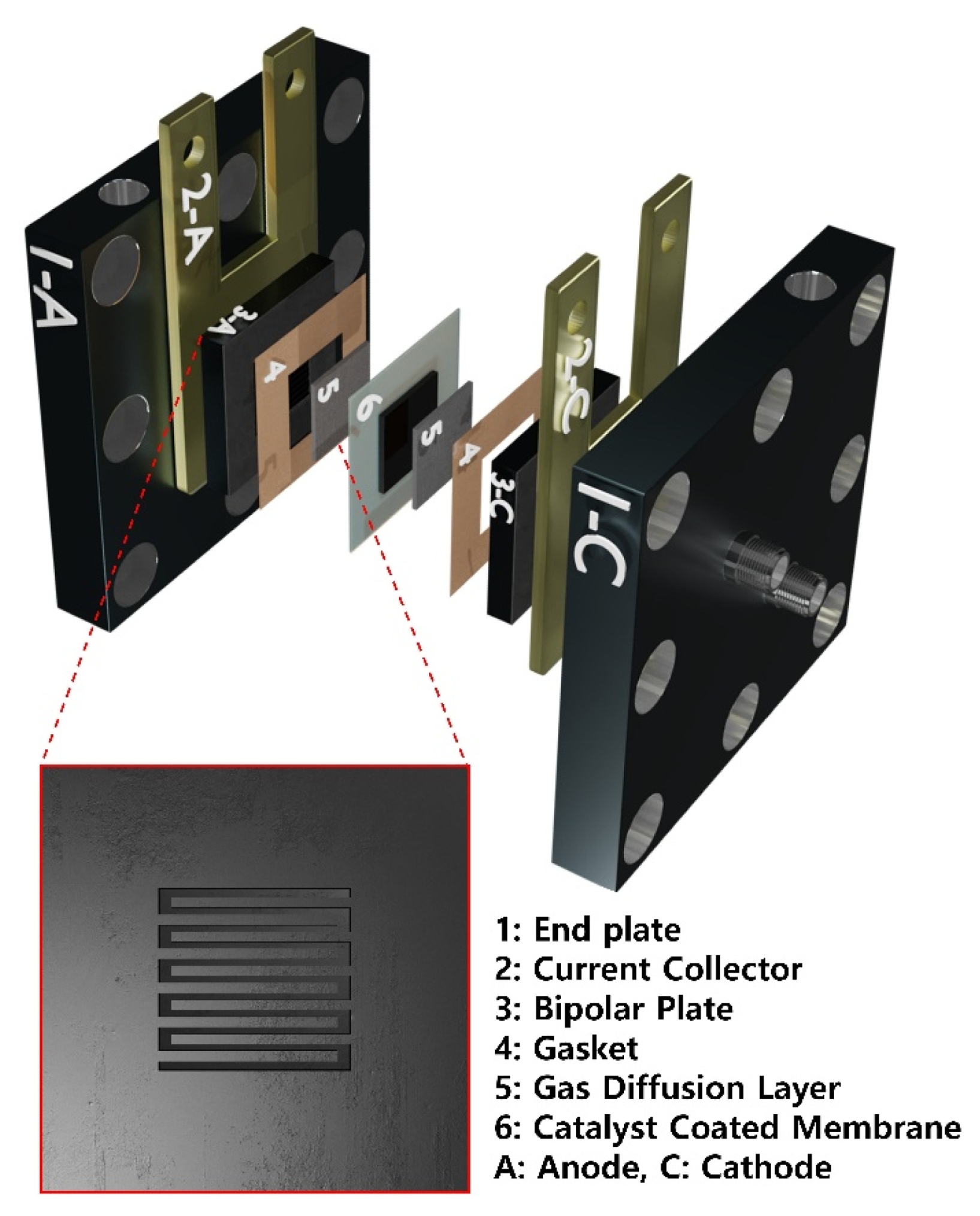
Fig. 1에서 보이는 것처럼 양쪽 면에 기체확산층(36BB, SGL Carbon Inc., Germany)과 가스켓(PTFE sheet, Tommy Heco Co., Republic of Korea)을 전해질막에 대칭적으로 적층해 막 전극 집합체를 제작하였다.
셀은 막 전극 집합체, 분리판, 전류 집전체, 엔드 플레이트로 구성되며,
Fig. 1과 같이 조립된다. 전류 집전체는 전자 전도도 향상을 위해 황동에 금 도금을 진행하여 제작되었다. 엔드 플레이트는 전기 절연을 위해 알루미늄 소재에 아노다이징을 적용해 제작되었으며, 밀링을 통해 8개의 홀을 가공하였다. 분리판은 흑연 소재로 이루어진, 단일 채널 사형 구조를 지니고 있다. 분리판의 두께는 10 mm이고, 유로와 리브의 폭은 각각 1 mm이다.
실험에 사용된 다공성 삽입물이 포함된 분리판은
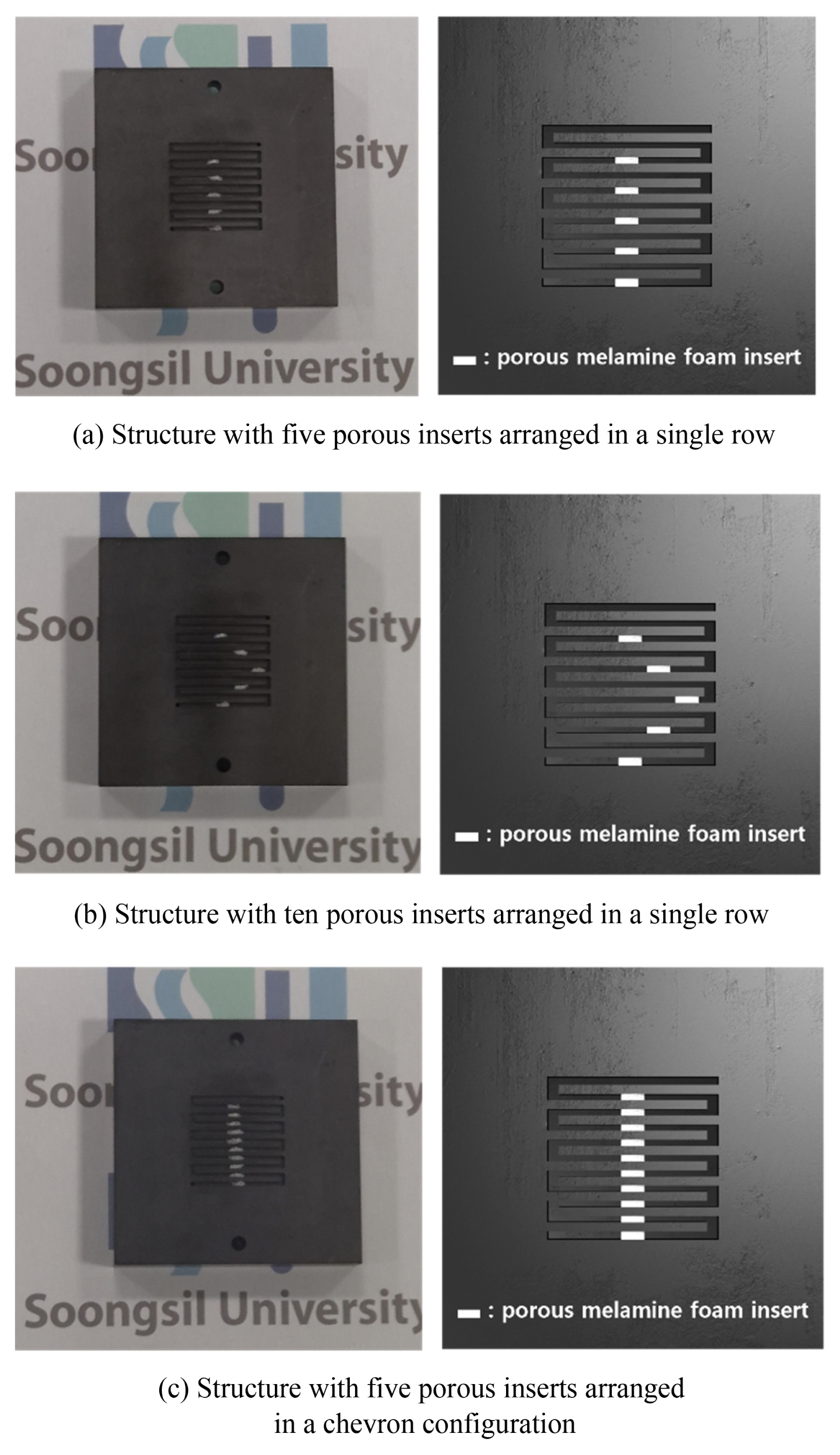
Fig. 2에 나타난다. 흰색으로 표시된 부분은 멜라민 폼 다공성 삽입물을 나타낸다. 본 연구에는 시중에 판매되는 상용 멜라민 폼(Rainbow Magic Cleaner, K·T TRADING Co., Ltd., Korea)을 사용하였다. 해당 소재는 공극률 φ = 0.96-0.99 수준의 고공극성 구조로써 생성수 흡수 및 압력 구배 형성에 기여한다[
17,
18]. 또한, 100% 멜라민 수지(Melamine Resin)로 구성된 열경화성 고분자로 높은 내열성을 보유하고 있어, 본 실험의 PEMFC 작동 온도인 80°C 환경에서도 열적·구조적 안정성을 유지할 수 있다고 판단하였다. 실험을 위해 폼을 유로 형상에 맞춰 절단하여 유로 내부에 삽입하였다. 다공성 삽입물은 환원극에만 삽입되며, 출구 부분에서 유동이 완전히 차단되는 것을 방지하고, 활성 영역 전반에 걸친 가스 분포를 유지하기 위하여 최상단 유로에는 배치하지 않았다. 비교 조건으로는 삽입물이 없는 일반 분리판(Conventional), 유로 내 다공성 삽입물 5개가 일렬로 정렬된 분리판(Sponge 5ea), 유로 내 다공성 삽입물 10개를 일렬로 정렬한 분리판(Sponge 10ea), 그리고 삽입물을 부등호 형상으로 배열한 분리판(Pattern)으로 설정하였다.
제작된 셀은 80°C의 온도 조건에서 100% 상대습도로 수소와 공기가 산화극과 환원극에 각각 0.2와 0.6 L/min의 유량으로 공급되었다. 각 셀의 성능 측정은 충분한 활성화 과정을 거친 후 진행되었다. 활성화 과정 이후 각 셀의 성능 특성을 파악하기 위해 전류 밀도-전압(j-V) 분극 곡선 측정을 수행하였다. j-V 분극 곡선은 PEMFC 시험 장치(CNL Energy Co., Ltd., Republic of Korea)를 통해 개방회로전압에서부터 0.3 V까지 갈바노다이나 믹 모드를 사용하여 50 mA/s의 속도로 측정되었다. 이후, ZIVE SP10(WonATech Co., Ltd., Republic of Korea)를 이용하여 전기화학적 임피던스 분광법(Electrochemical Impedance Spectroscopy, EIS)을 수행하였다. EIS 측정은 가역 수소 전극 기준 0.6 V에서 100 kHz부터 0.1 Hz의 주파수 범위로 수행하여 각 셀의 저항을 분석하였다.
3. 결과 및 고찰
본 연구에서는 분리판 유로 내부에 다공성 삽입물을 적용함에 따른 PEMFC 성능 변화를 분석하기 위해, 기존 유로 구조를 유지한 대조군과 서로 다른 삽입 조건을 적용한 세 가지 분리판을 사용하였다. 모든 분리판 조건에 대해 동일한 운전 조건에서 j–V 분극 곡선 측정을 통해 전기화학적 성능을 비교하였으며, 각 조건에 따른 성능 변화는
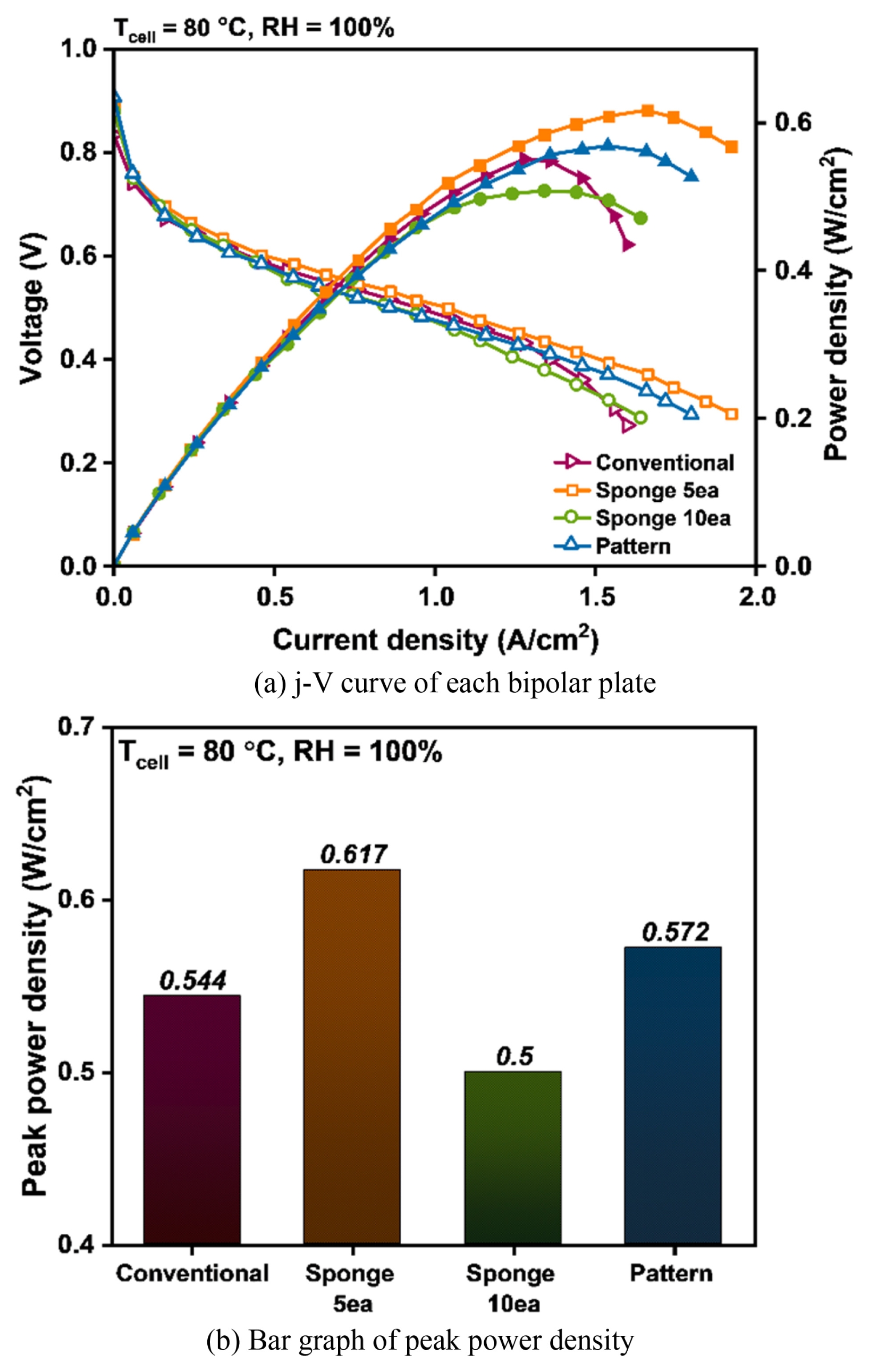
Fig. 3에 제시하였다.
Fig. 3(a)는 각 분리판별 PEMFC의 j-V 분극 곡선을 보여준다. Conventional 실험군의 최대 전력 밀도는 544 mW/cm
2로 나타났으며, Sponge 5ea, Sponge 10ea, Pattern 분리판은 각각 617, 500, 572 mW/cm
2로 나타났다. 멜라민 폼과 같은 다공성 물질은 내부 기공을 통해 생성수를 흡수 및 저장함으로써 유로 내에 형성되는 연속적인 물 기둥을 분산시켜, 반응 가스의 공급이 차단되는 것을 막는 효과를 제공한다[
14,
19]. 또한, 다공성 삽입물은 유로를 부분적으로 점유함에 따라 국소적인 유로 막힘 효과를 유도해, 채널을 따라 형성되는 압력 구배를 증가시킨다[
20]. 이러한 유로 내 국소적 압력 상승은 반응 가스가 채널을 따라 흐르는 주 경로뿐만 아니라, 리브 하부를 통해 기체확산층 방향으로 횡방향 침투를 유도해 촉매층의 산소 몰 농도를 증가시켜 성능을 향상시킨다[
21,
22]. Sponge 5ea조건에서 최대 전력밀도가 Conventional 대비 약 13.4% 향상된 것은, 이러한 국소적 압력 구배가 기체확산층으로의 반응 가스 공급을 촉진하여 촉매층 산소 농도를 높인 결과로 분석된다.
반면, Sponge 10ea에서는 Conventional 대비 약 8.1%의 성능 감소가 나타났다. 이는 삽입물의 밀도가 과도하게 증가함에 따라 유로 내 유동 저항 및 물질 전달 저항이 급격히 증가하여, 압력 구배에 따른 가스 확산 증진 효과보다 반응 가스 공급 저해 효과가 지배적으로 작용했기 때문으로 해석된다. 즉, 다공성 삽입물에 의한 압력 상승은 일정 수준까지는 성능 향상 요인으로 작용하지만, 임계 수준을 초과할 경우 유로 폐색 및 물질 전달 제한으로 인해 오히려 성능 저하를 초래할 수 있음을 시사한다.
Pattern의 경우 Conventional 대비 약 5.1%의 성능 향상이 관찰되었다. 이러한 결과는 동일한 삽입물 개수 조건에서도 배치 형상에 따라 유로 내 유동 경로와 압력 분포가 달라질 수 있음을 의미하며, 직선 배열 대비 국부적인 유속 변화와 가스 분산 효과가 보다 균일하게 형성된 결과로 판단된다[
14,
21]. 또한, Sponge 5ea와 Pattern 조건은 동일한 형상의 직사각형 삽입물을 사용하였음에도 유로 내 배치 위치에 따라 상이한 성능 특성을 보였다. 모든 삽입물이 유로 중앙에 배치된 Sponge 5ea는 유동 경로상에서 동일한 지점에 국소 압력 상승을 일으켜, 상대적으로 강한 압력 구배를 형성해 기체확산층으로의 반응 가스 유입을 극대화하였다. 반면 삽입물을 일정하지 않게 배치한 Pattern 조건은 가스의 유동 경로를 복잡하게 하고 압력 분포를 유로 전체로 분산시켰다. 이러한 배치 방식은 가스가 GDL 내부로 침투하기 위한 추진력을 약화시켰으며, 그 결과로 Sponge 5ea대비 높은 전하 전달 저항(0.253 Ω cm
2)이 발생한 것으로 판단된다. 이는 다공성 삽입물의 존재뿐만 아니라 삽입물의 개수와 배치 형상이 PEMFC의 성능을 결정하는 핵심 인자임을 보여준다.
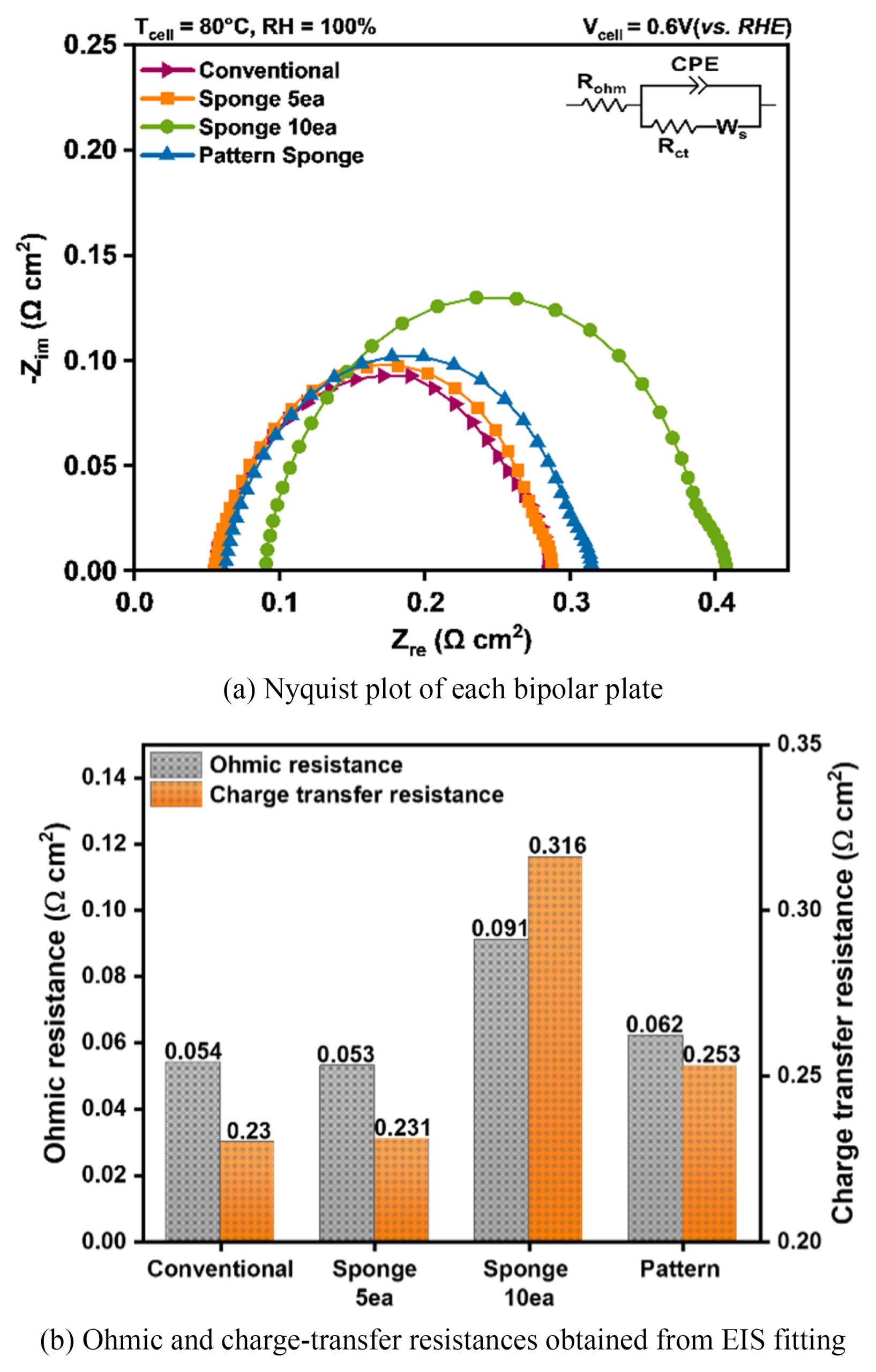
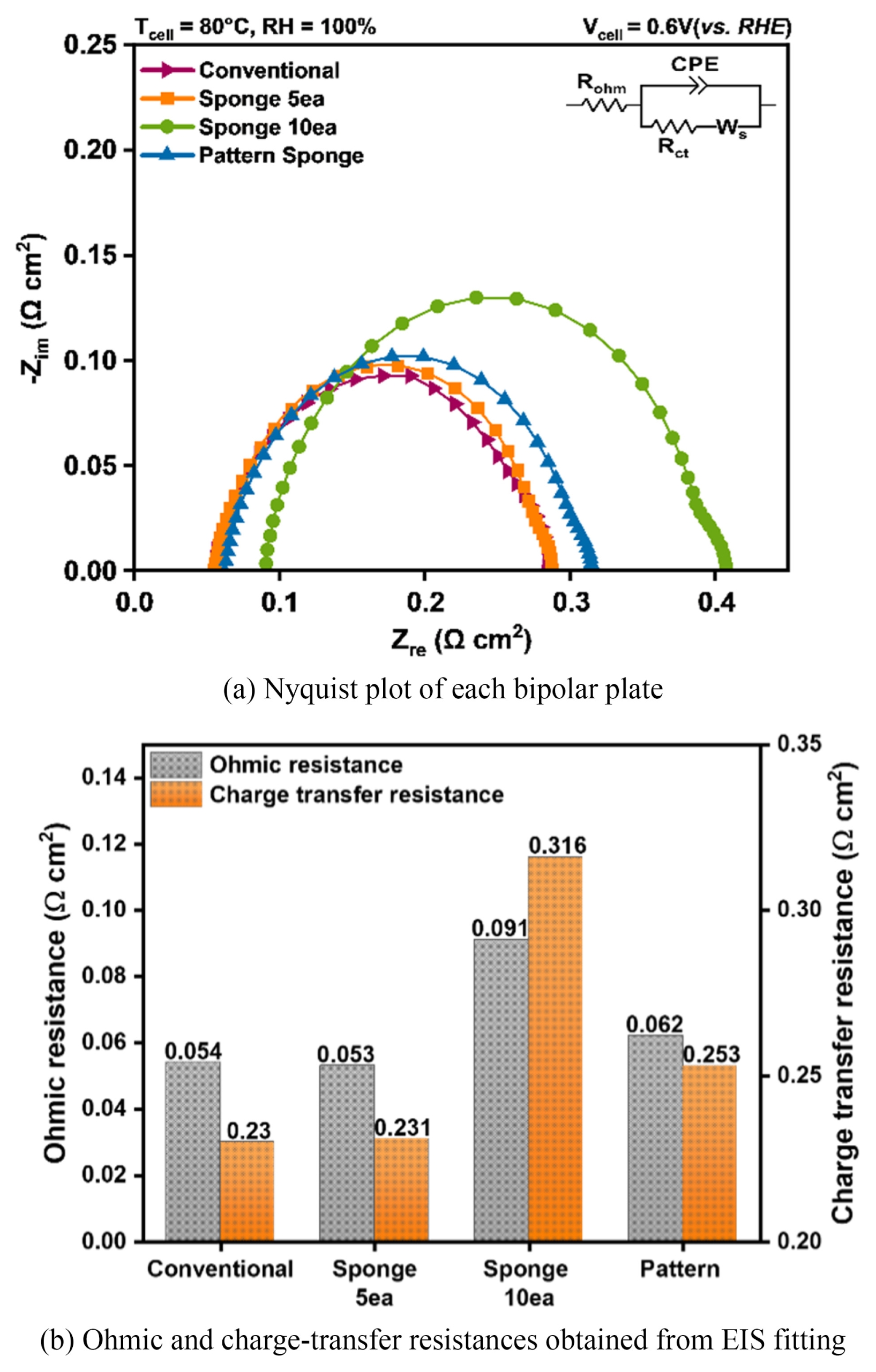
Fig. 4(a)는 각 분리판 조건에 따른 PEMFC의 EIS 측정 결과를 나이퀴스트 플롯으로 제시한 그림이다.
Fig. 4(b)에 정리된 바와 같이 오믹 저항은 Conventional과 Sponge 5ea에서 각각 0.0538 과 0.0532 Ω cm
2로 거의 동일한 수준을 보였다. 이는
Fig. 3에 서 확인된 Sponge 5ea의 압력 구배 효과가 오믹 저항 증가 없이 가스 확산층 내 물질 전달을 개선하여 성능 향상을 달성했음을 의미한다. 반면, Sponge 10ea에서는 오믹 저항이 0.0907 Ω cm
2 로 크게 증가하였다. 이는 다공성 삽입물의 개수가 증가함에 따라 유로 내 가스 유동 및 수분 분포가 변화하고, 이로 인해 막 수화 상태가 영향을 받아 이온 전도도가 저하되었을 가능성을 시사한다. Pattern 조건에서도 오믹 저항은 0.0622 Ω cm
2로 Conventional 대비 소폭 증가하였으나, Sponge 10ea에 비해서는 상대적으로 낮은 값을 유지하였다.
전하 전달 저항의 경우, Conventional과 Sponge 5ea 조건에서 각각 0.230 Ω cm
2와 0.231 Ω cm
2로 유사한 값을 나타냈다. Sponge 5ea조건에서 대조군 대비 전하 전달 저항의 유의미한 차이가 관찰되지 않는 것은, 삽입물에 의한 유동 저항 증가가 물질 전달 촉진에 의해 상쇄된 것으로 분석된다. 이는
Fig. 3에서 관찰된 Sponge 5ea의 성능 향상이 전극 반응 속도의 변화보다는 유로 채널 내부의 물 제거로 인한 물질 전달 개선에 기인한다고 해석할 수 있다. 그러나 Sponge 10ea 조건에서는 전하 전달 저항이 0.316 Ω cm
2로 크게 증가하였다. 이는 과도한 삽입물로 인해 산소 전달이 제한됨에 따라 반응 속도가 저하되었음을 의미한다. 5ea 조건에서는 삽입물 간 충분한 이격 거리가 확보되어 유동이 안정화될 수 있는 공간적 여유를 제공하지만, 10ea 조건은 유동이 회복되기 전 반복적인 저항체에 직면하게 된다. 이로 인해 누적된 압력 강하가 반응 가스의 원활한 공급을 저해하는 요인으로 작용한다.
Pattern 조건에서도 전하 전달 저항은 0.253 Ω cm2로 Conventional 대비 증가하였다. 이러한 결과는 패턴이 일정 수준의 횡방향 대류와 물 배출 개선 효과를 제공하지만, 동시에 압력 구배 형성에 따른 반응 기체 공급 제한으로 전기화학적 손실을 동반함을 보여준다.
종합적으로, 본 연구 결과는 분리판 유로 내부에 다공성 삽입물을 배치함으로써 유로 내 압력 구배가 형성되고, 이에 따라 반응 가스의 횡방향 확산과 물 배출 거동이 변화하여 PEMFC의 성능에 유의미한 영향을 미칠 수 있음을 보여준다. 특히, 다공성 삽입물을 적절한 개수로 삽입한 조건에서는 플러딩 완화와 가스 전달 개선 효과가 동시에 작용하여 성능 향상이 관찰되었으나, 과도한 삽입의 경우 고전류 밀도 영역(>1.0 A/cm
2)에서 전압이 급격히 하강하는 현상이 대조군에 비해 훨씬 이른 시점에 발생하였다. 이는 유로 내 삽입물의 밀도가 임계치를 초과하여 반응 가스의 확산경로를 물리적으로 차단하고, 결과적으로 물질 전달 제한을 유도했음을 시사한다. 또한,
Fig. 4(a)의 나이퀴스트 플롯에서 Sponge 10ea의 경우, 대조군 및 Sponge 5ea와 비교했을 때 저주파수 영역에서의 반원의 지름이 상대적으로 확대되는 거동 또한 관측 가능하다. 특히 전하 전달 저항이 0.316 Ω cm
2로 대조군(0.230 Ω cm
2)대비 약 37% 증가한 점은, 삽입물의 과잉으로 촉매층으로의 산소 공급이 원활하지 못해 전극 반응 속도가 물질 전달 저항에 의해 지배받고 있음을 입증하는 정량적 근거가 된다. 결론적으로 유로의 과도한 폐색은 압력 구배에 의한 가스 침투 효과보다 물질 전달 저해 효과를 가중시켜 전체적인 셀 성능 저하를 초래하는 것으로 분석된다.
한편, 본 연구는 단기적인 전기화학적 성능 평가에 초점을 맞추었으며, 다공성 삽입물의 장기 수분 축적 거동 및 내구성에 대한 영향은 고려되지 않았다. 따라서 향후 연구에서는 장기 운전 조건에서의 성능 안정성 및 내구성 평가를 통해 본 설계 전략의 실용성을 추가적으로 검증할 필요가 있다.
4. 결론
본 연구에서는 PEMFC 분리판 유로 내부에 다공성 물질인 멜라민 폼을 적용함에 따른 전기화학적 성능 변화를 체계적으로 분석하였다. 기존 유로 구조를 유지한 상태에서 멜라민 폼 삽입 개수와 배치 형상을 변화시킨 결과, 다공성 삽입물은 유로 내 압력 구배를 형성하여 반응 가스의 횡방향 확산을 촉진하고 플러딩을 완화함으로써 PEMFC 성능에 유의미한 영향을 미칠 수 있음을 확인하였다.
특히, Sponge 5ea 조건에서는 최대 전력 밀도가 약 13.4% 향상되었으며, 이는 물질 전달 개선 효과에 기인한 것으로 해석된다. 반면, 삽입물 개수가 과도하게 증가한 경우에는 유동 저항 및 물질 전달 저항이 증가하여 성능 저하가 발생하였으며, 이는 다공성 삽입물 적용에 있어 최적 개수와 배치 설계의 중요성을 시사한다. 또한, 삽입물의 배열 형상 역시 성능에 영향을 미치는 주요 인자로 확인되었다.
종합적으로, 본 연구는 기존 분리판 유로에 추가적인 가공 없이도 다공성 삽입물을 통해 PEMFC의 물 관리 및 가스 전달 특성을 효과적으로 제어할 수 있는 설계 가능성을 제시한다. 나아가 본 연구에서 제안한 분리판 유로 내 다공성 삽입물 설계는 PEMFC의 물 관리 및 가스 전달 특성 최적화를 위한 기초 설계 지침으로 활용될 수 있을 것으로 판단된다. 향후 장기 운전 조건에서의 내구성 평가 및 다양한 운전 조건에 대한 확장 연구를 통해, 본 설계 전략은 PEMFC 성능 향상과 친환경 재생 에너지 시스템의 실용적 적용에 기여할 수 있을 것으로 사료된다.
Fig. 1Schematic of the PEMFC and bipolar plate
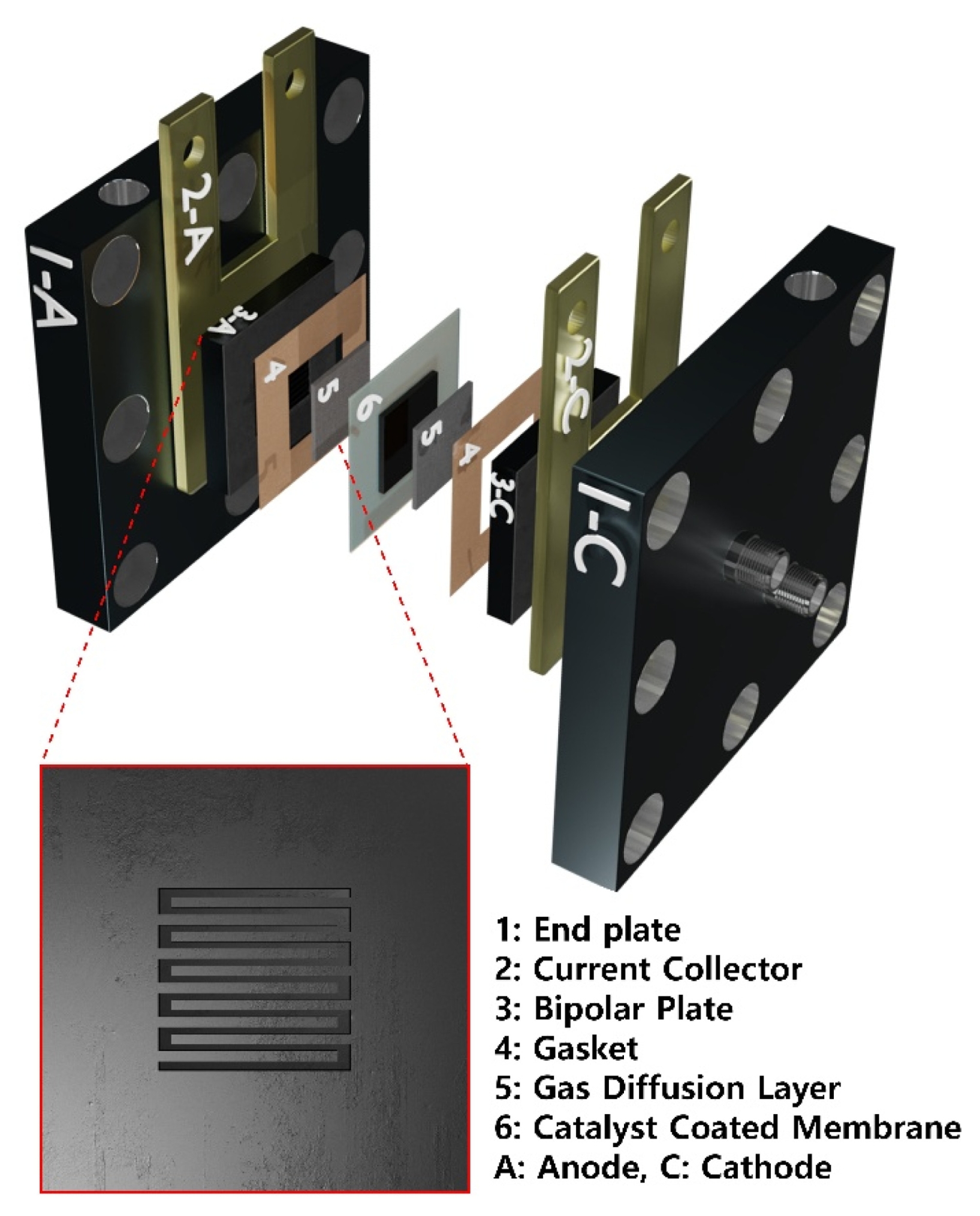
Fig. 2Photographs and schematic illustrations of bipolar plate flowfield structures under different melamine foam insertion condi.tions
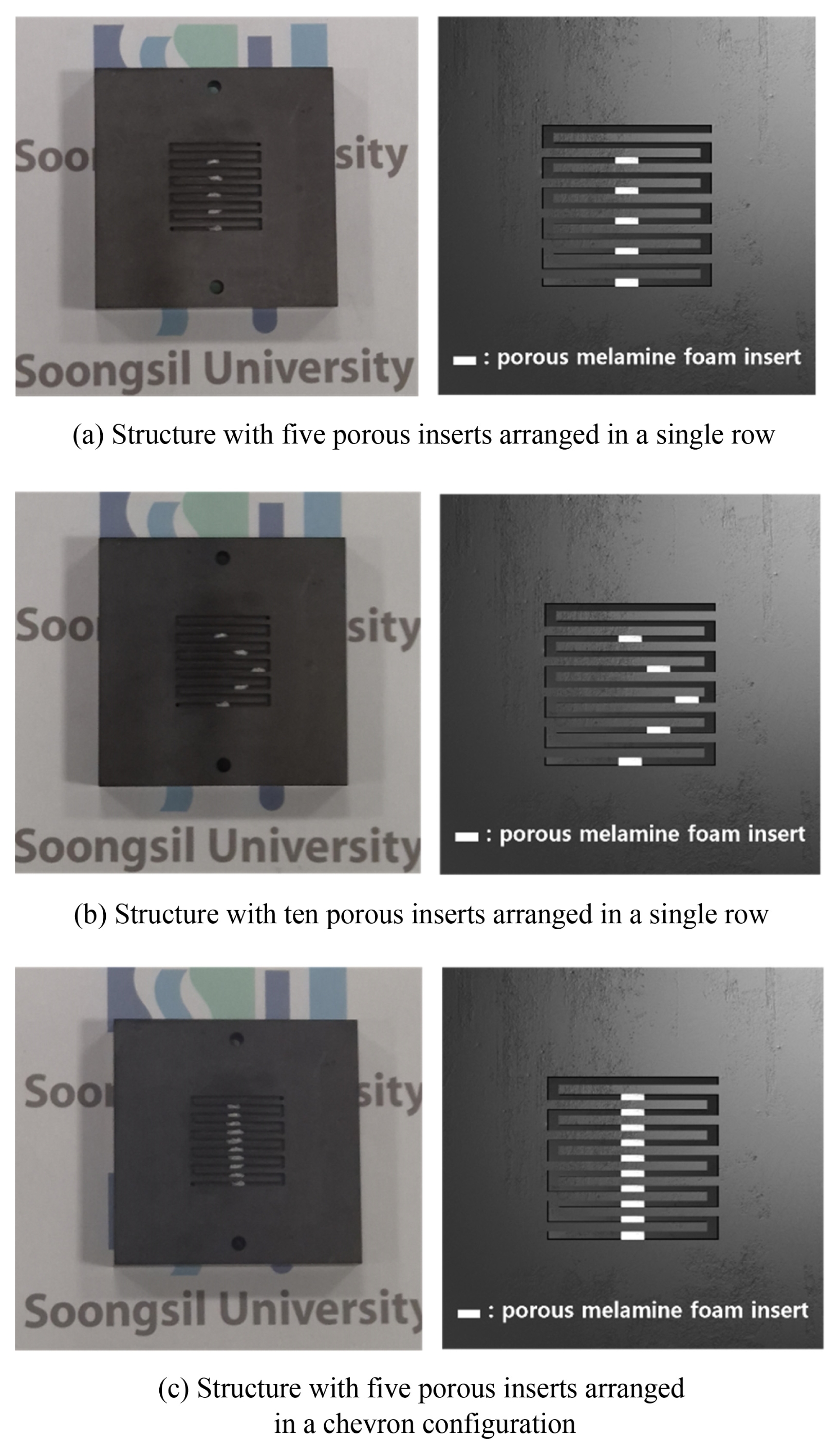
Fig. 3Electrochemical performance of PEMFCs under various bipolar plates
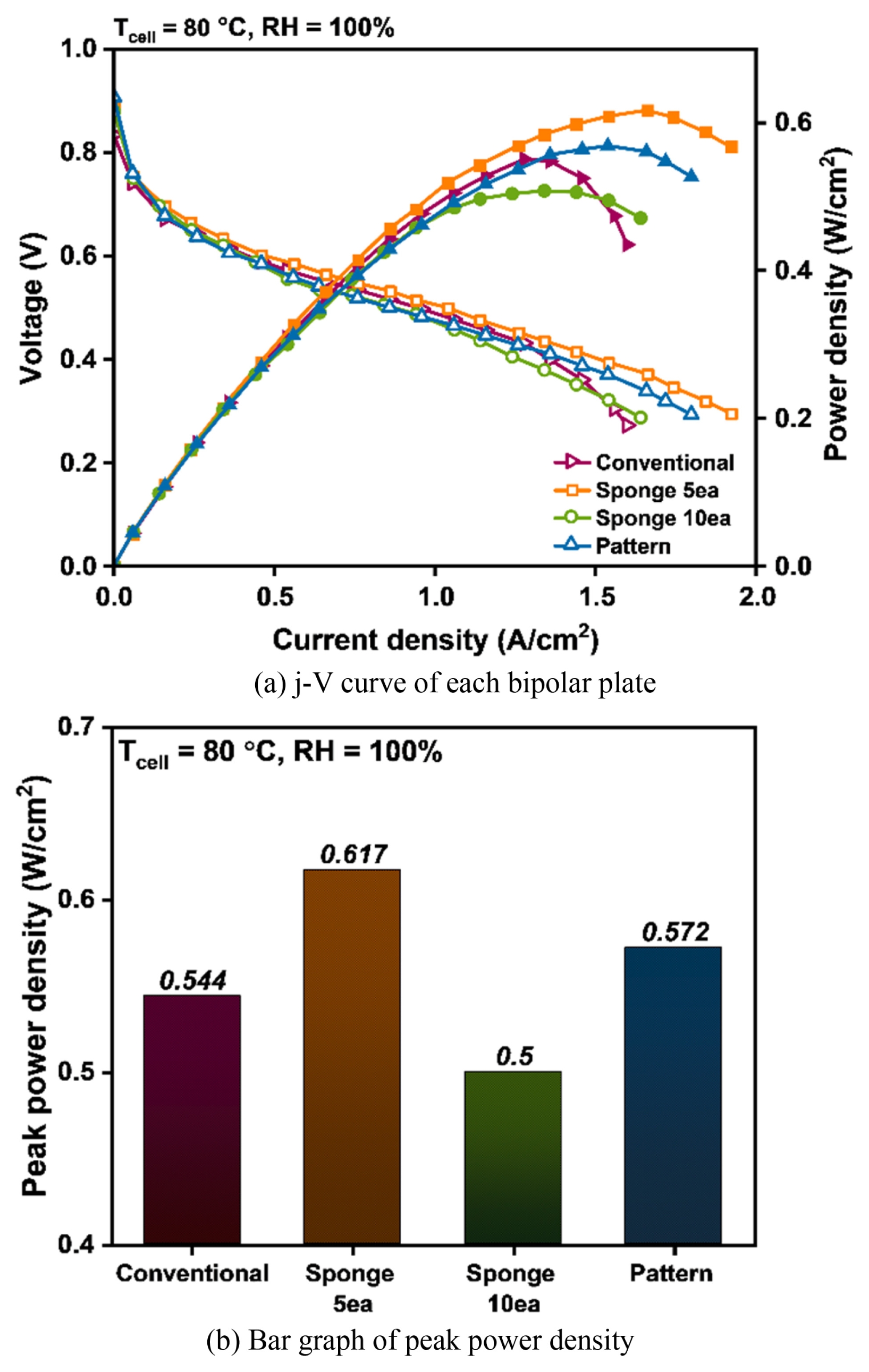
Fig. 4EIS measurement for PEMFC under various bipolar plates
REFERENCES
- 1. Qiao W., Rej B., Shah R.. 2025;Clean hydrogen for road transport in developing countries. The World Bank. https://hdl.handle.net/10986/43010.
- 2. Vengatesan, S., Jayakumar, A., Sadasivuni, K. K., (2024), FCEV vs. BEV—a short overview on identifying the key contributors to affordable & clean energy (SDG-7), Energy Strategy Reviews, 53, 101380.
- 3. Parikh, A., Shah, M., Prajapati, M., (2023), Fuelling the sustainable future: A comparative analysis between battery electrical vehicles (BEV) and fuel cell electrical vehicles (FCEV), Environmental Science and Pollution Research, 30(20), 57236-57252.
- 4. Kim, D., Park, G., Baek, J., Lim, J., Park, J., Youn, J., Yang, S., Na, J., Cho, Y., Jeong, S., Kim, G., Jeong, Y.-J., Park, T., (2025), Polytetrafluoroethylene-coated carbon nanotube sheet as superhydrophobic microporous layer for polymer electrolyte membrane fuel cells, International Journal of Hydrogen Energy, 186, 151708.
- 5. Na, J., Park, G., Park, J., Yang, S., Oh, H.-M., Baek, J., Kim, D., Youn, J., Lim, J., Park, T., (2025), Visualization of initial evolution of flooding in proton exchange membrane fuel cells with parallel flow channels, International Journal of Hydrogen Energy, 114, 239-249.
- 6. Zhao, T., Jiang, K., Fan, W., Lu, D., Zheng, D., Cui, H., Yang, L., Lu, G., Liu, Z., (2023), Nature-inspired hybrid wettability surface to enhance water management on bipolar plates of PEMFC, Chemical Engineering Journal, 466, 143288.
- 7. Wang, Y., Liao, X., Liu, G., Xu, H., Guan, C., Wang, H., Li, H., He, W., Qin, Y., (2023), Review of flow field designs for polymer electrolyte membrane fuel cells, Energies, 16(10), 4207.
- 8. Yin, Y., Wang, X., Shangguan, X., Zhang, J., Qin, Y., (2018), Numerical investigation on the characteristics of mass transport and performance of PEMFC with baffle plates installed in the flow channel, International Journal of Hydrogen Energy, 43(16), 8048-8062.
- 9. Zhang, Z., Wang, C., Chen, C., Zheng, Z., (2024), Optimal design of locally improved structure for enhancing mass transfer in PEMFC cathode flow field, International Journal of Hydrogen Energy, 57, 798-811.
- 10. Dong, Z., Qin, Y., Zheng, J., Guo, Q., (2023), Numerical investigation of novel block flow channel on mass transport characteristics and performance of PEMFC, International Journal of Hydrogen Energy, 48(67), 26356-26374.
- 11. Zhang, Y., Tu, Z., (2024), Flow-field design of the bipolar plates in polymer electrolyte membrane fuel cell: Problem, progress, and perspective, Applications in Energy and Combustion Science, 17, 100244.
- 12. Marappan, M., Narayanan, R., Manoharan, K., Vijayakrishnan, M. K., Palaniswamy, K., Karazhanov, S., Sundaram, S., (2021), Scaling up studies on PEMFC using a modified serpentine flow field incorporating porous sponge inserts to observe water molecules, Molecules, 26(2), 286.
- 13. Palaniswamy, K., Marappan, M., Jothi, V. R., (2016), Influence of porous carbon inserts on scaling up studies for performance enhancement on PEMFC, International Journal of Hydrogen Energy, 41(4), 2867-2874.
- 14. Karthikeyan, M., Karthikeyan, P., Muthukumar, M., Kannan, V. M., Thanarajan, K., Maiyalagan, T., Hong, C.-W., Jothi, V. R., Yi, S.-C., (2020), Adoption of novel porous inserts in the flow channel of PEM fuel cell for the mitigation of cathodic flooding, International Journal of Hydrogen Energy, 45(13), 7863-7872.
- 15. Singh, R. S., Gautam, A., Rai, V., (2019), Graphene-based bipolar plates for polymer electrolyte membrane fuel cells, Frontiers of Materials Science, 13(3), 217-241.
- 16. Antunes, R. A., De Oliveira, M. C. L., Ett, G., Ett, V., (2011), Carbon materials in composite bipolar plates for polymer electrolyte membrane fuel cells: A review of the main challenges to improve electrical performance, Journal of Power Sources, 196(6), 2945-2961.
- 17. Semeniuk, B. P., Lundberg, E., Göransson, P., (2021), Acoustics modelling of open-cell foam materials from microstructure and constitutive properties, The Journal of the Acoustical Society of America, 149(3), 2016-2026.
- 18. Ye, X., Chen, Z., Ai, S., Hou, B., Zhang, J., Liang, X., Zhou, Q., Liu, H., Cui, S., (2019), Porous SiC/melamine-derived carbon foam frameworks with excellent electromagnetic wave absorbing capacity, Journal of Advanced Ceramics, 8(4), 479-488.
- 19. Liu, Y., Luo, X., Tu, Z., Chan, S. H., (2021), Droplet dynamics in a proton exchange membrane fuel cell with ejector-based recirculation, Energy & Fuels, 35(14), 11533-11544.
- 20. Heidary, H., Kermani, M. J., Advani, S. G., Prasad, A. K., (2016), Experimental investigation of in-line and staggered blockages in parallel flowfield channels of PEM fuel cells, International Journal of Hydrogen Energy, 41(16), 6885-6893.
- 21. Wang, C.-Y., (2004), Fundamental models for fuel cell engineering, Chemical Reviews, 104(10), 4727-4766.
- 22. Jiao, K., Bachman, J., Zhou, Y., Park, J. W., (2014), Effect of induced cross flow on flow pattern and performance of proton exchange membrane fuel cell, Applied Energy, 115, 75-82.
Biography
- Dongjin Kim
M.S. candidate in the School of Mechanical Engineering, Soongsil University. His research interest is focused on enhancing water management by structurally modifying microporous layers to achieve stable fuel cell performance.
- Jaejoong Kim
B.S. candidate in the School of Mechanical Engineering, Soongsil University. His research focuses on improving PEMFC performance by modifying the catalyst layer.
- Geon Go
B.S. candidate in the School of Mechanical Engineering, Soongsil University. His research interest is focused on the automotive industry, energy efficiency-related industries, and hydrogen fuel cells.
- Suhyun Min
B.S. candidate in the School of Mechanical Engineering, Soongsil University. His research interest is focused on eco-friendly cars, science and technology, and hydrogen-related industries.
- Seungwoo Lee
B.S. candidate in the School of Mechanical Engineering, Soongsil University. His research interest is focused on Climate Change, Power Sources, and Renewable Energy.
- Taehyun Park
Associate Professor in the School of Mechanical Engineering, Soongsil University. He received his Ph.D. in Mechanical and Aerospace Engineering from Seoul National University. His research interest is fuel cells (PEMFCs and SOFCs) and their systems for FCEVs, power plants, and portable power sources.