ABSTRACT
Cooperative 3D printing (C3DP) with multiple robotic manipulators can reduce build time through parallel deposition, but it requires layer partitioning that accounts for collision clearance, workload balance, G-code toolpath compatibility, and interlayer boundary alignment. This study presents a Voronoi- and graph-based layer partitioning framework for C3DP. STL geometry and G-code were integrated into layer-aligned data, and a 65 mm collision clearance was defined from the measured end-effector collision radius as the minimum separation preventing collisions between robots approaching non-adjacent Voronoi cells. Each layer was divided into Voronoi cells so that non-adjacent cells could be treated as collision-free regions. Cell adjacency and toolpath-based processing time were modeled as a weighted graph, and adjacent cells were clustered into workload-balanced task regions. Interlayer seed offsets staggered the partition boundaries, and graph coloring identified regions that could be printed simultaneously.The framework was evaluated by workload-balance simulations and printing experiments. Balance deteriorated when clusters were excessive relative to graph nodes. In experiments, the end-effector separation always exceeded the 65 mm clearance. Partitioned printing reduced the layer printing time from 70.063 to 63.57 min, a 9.3% reduction, and the second layer covered the preceding partition boundary, confirming the staggered-boundary implementation.
-
KEYWORDS: Cooperative 3D printing, Robotic additive manufacturing, Layer partitioning, Collision avoidance, Weighted graph clustering, Graph coloring
-
KEYWORDS: 협동 3D 프린팅, 로봇 기반 적층 제조, 레이어 분할, 충돌 회피, 가중치 그래프 클러스터링, 그래프 컬러링
1. 서론
적층 제조(Additive Manufacturing)는 재료를 층별로 적층하여 형상을 구현하는 제조 방식으로, 기존 절삭가공에 비해 재료 손실이 적고 복잡한 형상의 부품을 효과적으로 제작할 수 있다는 장점을 가지며[
1], 이에 따라 항공우주[
2], 건설[
3] 등 다양한 산업 분야로 적용 범위가 확대되고 있다. 특히 대형 부품 및 구조물 제조 수요가 증가하면서 대형 적층 제조(Large-scale Additive Manufacturing)에 대한 관심도 높아지고 있다[
4]. 그러나 제조 대상이 대형화될수록 레이어 수와 적층 경로 길이가 증가하여 전체 제조 시간이 길어지며[
5], 기존 갠트리 기반 시스템은 작업 공간 확장을 위해 대형 챔버와 장거리 구동 구조가 요구되므로 설비 비용과 운용 부담이 증가한다[
6]. 따라서 대형 적층 제조의 생산성과 확장성을 확보하기 위해서는 단일 장비 기반 공정을 보완할 수 있는 새로운 제조 방식이 필요하다.
이러한 한계를 극복하기 위한 방법으로 협동 3D 프린팅(Cooperative 3D Printing, C3DP)이 연구되고 있다[
7,
8]. 협동 3D 프린팅은 다수의 프린터 또는 로봇이 하나의 부품을 병렬로 제조하는 방식으로, 제조 시간을 단축하고 대형 구조물 제조에서 적층 제조의 적용 가능성을 높일 수 있다. 그러나 여러 로봇이 동일 형상과 작업 공간을 공유하기 때문에 로봇 간 충돌 회피, 작업 영역 분할, 작업량 균등화, 출력 순서 계획, 분할 경계 품질을 함께 고려해야 한다. 특히 로봇 팔 기반 협동 3D 프린팅에서는 기구학적 제약과 작업 공간 중첩으로 인해 단일 프린터용 슬라이싱 및 적층 경로 생성 기법을 그대로 적용하기 어려워 협동 3D 프린팅용 레이어 분할은 기존 적층 경로를 로봇별 작업 영역에 맞게 절단 및 재구성할 수 있어야 한다. 또한 협동 제조에 필수적인 좌표계 정합 및 캘리브레이션에 존재하는 오차에 의한 분할 경계부의 적층 품질 저하는 인쇄물의 구조적 취약성을 유발할 수 있어 레이어 분할에서 고려해야 할 요소이다[
9]. 협동 3D 프린팅과 관련하여 충돌 회피 및 스케줄링, 작업 영역 분할, 기존 G-code 활용, 분할 경계 결합 성능 향상에 관한 다양한 연구가 수행되어 왔다. 기존 연구들은 청크 기반 슬라이싱과 출력 스케줄링을 통해 충돌 없는 병렬 제조 가능성을 보였으며[
8,
10,
11], 안전 영역과 간섭 영역을 구분하거나 보로노이 분할 및 그래프 기반 방법을 이용하여 다중 로봇 또는 다중 프린터의 동시 작업 가능 영역을 도출하였다[
7,
12,
13]. 또한 셀 클러스터링, 경로 순서 최적화, 구조 요소 기반 분해 등을 통해 작업 영역의 형상과 인접 관계가 충돌 가능성, 스케줄링 복잡도, 제조 시간에 직접적인 영향을 미침을 보였다[
14,
15]. 한편 기존 슬라이서 또는 G-code 기반 적층 경로를 협동 3D 프린팅 환경으로 확장하려는 연구도 진행되었다. 선행연구들은 기존 용융 필라멘트 제조(Fused Filament Fabrication, FFF) 슬라이서가 생성한 적층 경로를 하위 경로 또는 다중 압출기용 G-code로 분할하고, 우선순위 또는 스케줄 정보를 이용하여 충돌을 회피하는 방법을 제안하였다[
16-
18]. 또한 분할 경계가 인쇄물의 구조적 성능에 영향을 줄 수 있다는 점을 고려하여, 중첩 영역, 위상학적 맞물림 경계, 나선형 맞물림 타일 등을 이용해 분할 영역 간 결합성을 향상시키려는 연구가 수행되었다[
12,
17,
19,
20]. 이러한 연구들은 협동 3D 프린팅에서 충돌 회피, 작업 영역 분할, 기존 적층 경로 활용, 분할 경계 설계가 모두 중요한 요소임을 보여준다.
그러나 로봇 팔 기반 협동 3D 프린팅에서 엔드이펙터 치수를 고려한 충돌 판단 기준, G-code 기반 작업 시간 정량화 및 균등화, 층간 분할 경계의 반복 중첩 완화를 하나의 레이어 분할 절차 안에서 함께 고려하는 연구는 아직 제한적이다. 따라서 기존 G-code 적층 경로를 활용하면서 로봇 팔 기반 협동 3D 프린팅의 충돌 회피와 작업량 균등 분배를 동시에 고려할 수 있는 레이어 분할 프레임워크가 요구된다.
본 연구에서는 로봇 팔 기반 협동 3D 프린팅을 위한 보로노이-가중치 그래프(Weighted Graph) 기반 레이어 분할 프레임워크를 제안한다. 제안 프레임워크는 기존 G-code 기반 적층 경로를 활용하면서, 엔드이펙터 치수 기반 충돌 회피, 작업 시간 기반 영역 분할, 층간 경계 중첩 완화, 그래프 컬러링 기반 동시 접근 가능 영역 도출을 하나의 절차로 고려한다. 본 논문의 구성은 다음과 같다. 2장에서는 데이터 전처리, 레이어 영역 분할, 제조 작업 데이터 생성으로 구성된, 협동 3D 프린팅을 위한 레이어 분할 프레임워크를 설명한다. 3장에서는 시작 노드 선택 방식, 그래프 노드 수와 클러스터 수가 작업량 균등성에 미치는 영향을 분석하고, 2대 로봇 기반 협동 3D 프린팅 실험 환경에서 제안 방법의 실제 적용 가능성을 검증한다. 마지막으로 4장에서는 연구 결과를 요약하고 향후 연구 방향을 제시한다.
2. 협동 3D 프린팅을 위한 레이어 분할 프레임워크
2.1 레이어 분할 프레임워크 개요
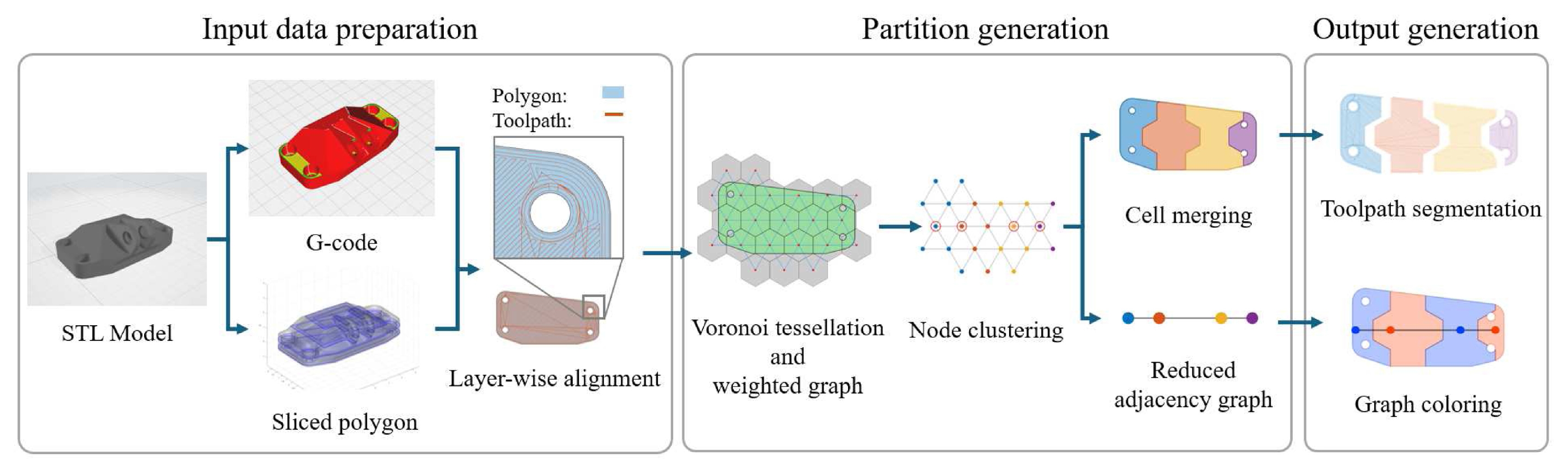
Fig. 1은 본 연구에서 제안하는 협동 3D 프린팅을 위한 레이어 분할 프레임워크의 전체 절차를 나타낸다. 제안한 프레임워크는 크게 데이터 전처리, 레이어 영역 분할, 제조 작업 데이터 생성의 세 단계로 구성된다. 본 프레임워크는 기존 G-code 기반 적층 경로를 활용하면서 엔드이펙터 간 충돌 회피, 작업 시간 기반 영역 분할, 층간 분할 경계의 반복 중첩 완화, 그리고 로봇별 적층 경로 및 제어 데이터 생성을 하나의 절차로 연결하는 것을 목표로 한다. 첫 번째 단계는 데이터 전처리이다. 원본 STL 형상 정보와 G-code 제조 정보를 동일한 레이어 높이 기준으로 정합하여, 레이어 단면 형상과 해당 레이어의 적층 경로 정보를 함께 포함하는 레이어 정합 데이터(Layer-aligned Data)를 구성한다. 이 데이터는 이후 경계 절단 비용 계산과 작업 시간 기반 영역 분할의 입력으로 사용된다.
두 번째 단계는 레이어 영역 분할이다. 먼저 엔드이펙터의 충돌 반경을 고려하여, 서로 인접하지 않은 셀 사이에서는 엔드이펙터 간 직접 충돌을 회피할 수 있는 이격 거리가 확보되도록 보로노이 테셀레이션을 수행한다. 이때 보로노이 시드 간격은 엔드이펙터 치수에 따라 결정되며, 홀수 층과 짝수 층에는 서로 다른 시드 오프셋을 적용하여 분할 경계가 적층 방향으로 동일 위치에 반복 형성되는 것을 완화한다. 이후 생성된 초기 셀의 인접 관계와 셀별 적층 경로 수행 시간, 경계 절단 비용을 반영하여 가중치 그래프를 구성한다. 구성된 가중치 그래프에 대해 그래프 탐색 기반 클러스터링을 수행하여 인접 셀을 병합하고, 클러스터 간 작업 시간 편차를 줄이는 방향으로 최종 분할 영역을 생성한다.
세 번째 단계는 제조 작업 데이터 생성이다. 최종 분할 영역이 생성되면, 해당 영역의 경계 정보를 이용하여 기존 G-code 적층 경로를 분할하고 각 영역에 대응되는 하위 적층 경로를 생성한다. 또한 최종 분할 영역 간 인접 관계를 축약 그래프로 표현하고, 그래프 컬러링을 수행하여 서로 인접하지 않은 영역 조합을 도출한다. 이때 동일 색상으로 분류된 영역들은 엔드이펙터 간 직접 충돌 없이 동시에 접근 가능한 영역 조합으로 해석된다. 최종적으로 제안한 프레임워크는 로봇별 하위 적층 경로와 동시 접근 가능 영역 조합을 출력한다. 로봇별 하위 적층 경로는 후속 단계에서 로봇 팔의 관절 궤적 및 압출 명령 생성에 사용될 수 있으며, 동시 접근 가능 영역 조합은 병렬 작업 계획에 활용된다.
이후 2.2절에서는 레이어 정합 데이터 구성 과정을 설명하고, 2.3절에서는 엔드이펙터 치수 기반 초기 셀 분할을 다룬다. 2.4절에서는 가중치 그래프 구성과 클러스터링을 통한 최종 분할 영역 생성을 설명하며, 2.5절에서는 층간 시드 오프셋을 통한 경계 중첩 완화 방법을 제시한다. 마지막으로 2.6절과 2.7절에서는 각각 그래프 컬러링 기반 동시 작업 영역 도출과 적층 경로 분할 및 로봇 제어 데이터 생성을 설명한다.
2.2 데이터 전처리 및 레이어 정합 데이터 구성
본 연구에서 제안하는 레이어 분할법은 단순히 레이어 단면 형상을 여러 영역으로 나누는 것이 아니라, 각 영역에 포함되는 적층 경로의 작업 시간과 경계 절단으로 인해 발생하는 추가 비용을 함께 고려한다. 따라서 작업량 기반의 영역 분할을 수행하기 위해서는 대상 형상의 기하학적 정보와 실제 제조에 사용되는 적층 경로 및 공정 정보가 동일한 레이어 기준으로 연계되어야 한다. 이를 위해 본 연구에서는 원본 STL 파일과 상용 슬라이싱 소프트웨어인 UltiMaker Cura 5.11.0에서 생성한 G-code를 함께 입력 데이터로 사용하였다. G-code로부터는 각 명령의 위치 좌표(x,y,z), 이동 속도, 압출량, 명령 종류(G0/G1)를 추출하였다. 명령 종류와 압출량 변화 여부를 이용하여 압출 이동과 비압출 이동을 구분하였으며, 이동 속도는 이후 셀별 작업 시간 계산과 로봇 제어 데이터 생성에 사용하였다. 한편, MATLAB으로 구현한 프로그램을 이용하여 STL 파일을 G-code에서 추출한 레이어 높이에 따라 절단하고, 각 레이어의 단면을 다각형 형태로 재구성하였다. 이후 재구성된 레이어 단면 다각형과 동일한 z 높이에 해당하는 G-code 적층 경로 및 공정 정보를 매칭하여, 형상 정보와 제조 정보를 함께 포함하는 레이어 정합 데이터(Layer-aligned Data)를 구성하였다. 이 레이어 정합 데이터는 기하학적 단면 정보뿐 아니라 실제 제조에 사용되는 적층 경로, 이동 속도, 압출 정보를 함께 포함하므로, 이후 분할 과정에서 형상 정보와 제조 정보를 동시에 반영할 수 있다.
2.3 엔드이펙터 치수 기반 초기 셀 분할
다수의 로봇이 동일 레이어에 동시에 접근할 경우, 서로 가까운 작업 영역에서는 엔드이펙터 간 직접 간섭이 발생할 수 있다. 따라서 초기 셀 분할 단계에서는 레이어를 단순히 기하학적으로 나누는 것뿐 아니라, 비인접 셀 간에는 엔드이펙터 충돌을 회피할 수 있는 이격 거리가 확보되도록 셀 크기와 시드 간격을 설정해야 한다. 본 연구에서는 이를 위해 엔드이펙터의 충돌 반경을 반영한 보로노이 테셀레이션(Voronoi Tessellation)을 적용하였다. 먼저 레이어 단면 다각형을 충분히 포함할 수 있는 영역에 보로노이 시드를 배치하고, 이를 기반으로 보로노이 셀을 생성하였다. 이후 생성된 보로노이 셀을 레이어 단면 다각형과 클리핑하여, 실제 레이어 영역과 중첩되는 셀만 초기 셀 영역으로 정의하였다. 이렇게 생성된 초기 셀은 이후 가중치 그래프의 노드로 사용되며, 작업 시간 기반 영역 병합과 동시 접근 가능 영역 판별의 기본 단위가 된다.
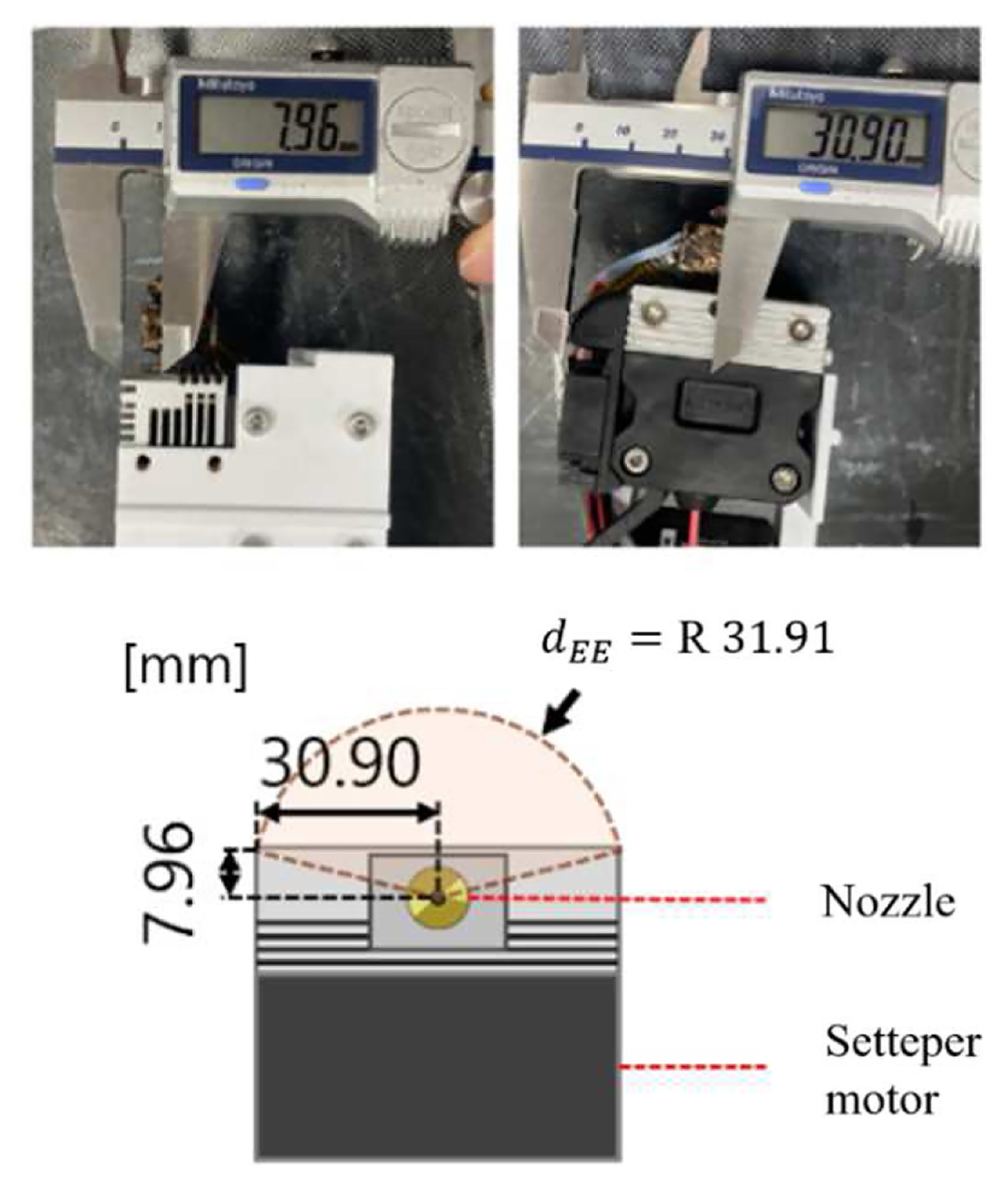
엔드이펙터 간 충돌 판단 기준을 설정하기 위해,
Fig. 2와 같이 공구 중심점(Tool Center Point, TCP)인 노즐 끝단을 기준으로 엔드이펙터가 점유하는 충돌 가능 영역의 반경을 엔드이펙터 충돌 반경
dEE로 정의하였다. 두 엔드이펙터가 서로 다른 작업 영역에 동시에 접근하는 경우, TCP 간 최소 이격 거리는 두 엔드이펙터의 반경을 합한 2
dEE 이상으로 설정하였다.
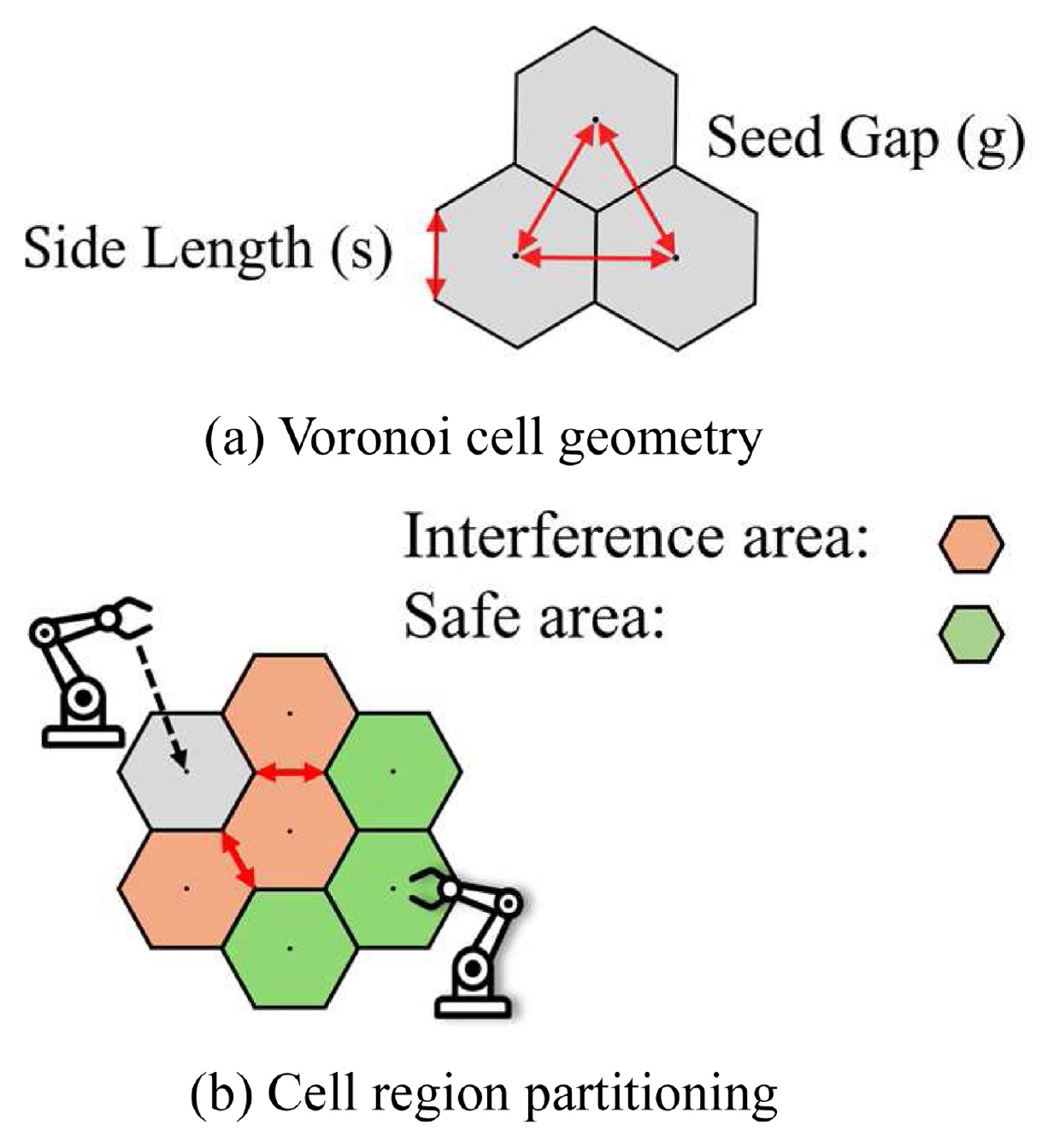
Fig. 3은
Fig. 2에서 정의한 2
dEE를 보로노이 셀 설계에 적용하는 과정을 나타낸다.
Fig. 3(a)는 충돌 회피 이격 거리를 고려하여 보로노이 셀의 설계 기준 길이
s와 시드 간격
g를 정의하는 개념을 보여준다.
s는 비인접 셀 간 최소 이격 거리 보다 크게 정의해야 하므로,
식(1)과 같이 정의한다.
g는
s를 만족하는 보로노이 셀 배열을 생성하기 위한 시드 간격이며, 육각형 보로노이 셀 배열의 기하 관계에 따라
식(2)와 같이 계산하였다. 이와 같이 정의된 보로노이 셀 배열을 바탕으로 동일 레이어 내 셀 간 관계를 충돌 관점에서 구분하였다.
Fig. 3(b)는 셀 인접성에 따른 간섭 영역과 동시 접근 가능 후보 영역을 나타낸다. 그림과 같이 로봇이 접근하려는 셀과 경계를 공유하는 인접 셀은 충돌 회피 이격 거리가 확보되지 않으므로 간섭 영역에 해당하는 주황색 셀로 구분하였다. 반면 비인접 셀은 이격 거리가 확보된 영역으로 간주하여 동시 접근 가능 후보 영역인 초록색 셀로 정의하였다. 이러한 엔드이펙터 충돌 반경 기반 초기 셀 분할은 이후 그래프 컬러링 단계에서 동시 접근 가능 영역 조합을 판별하기 위한 기하학적 기반을 제공한다.
초기 보로노이 셀은 영역별 엔드이펙터 간 충돌 관계를 표현할 수 있지만, 이를 그대로 최종 인쇄 단위로 사용할 경우 셀 경계에서 기존 적층 경로가 과도하게 절단되고 분리된 경로를 연결하기 위한 비압출 이동이 증가할 수 있다. 또한 로봇별 작업 시간이 크게 달라지면 병렬 인쇄를 통한 전체 공정 시간 단축 효과가 감소한다. 따라서 본 연구에서는 초기 셀을 충돌 관계 분류와 작업 시간 비용을 정량화 하기 위한 기본 단위로 사용하고, 실제 제조 단위는 인접 셀을 병합한 최종 작업 영역으로 재구성하였다. 이를 위해 각 레이어의 초기 셀에 대해 셀 인접 관계와 적층 경로 수행 시간을 반영한 가중치 그래프를 구성하였다. 가중치 그래프
G = (
V, E)에서 각 노드
i ∈
V는 하나의 보로노이 셀을 의미하고, 각 간선 (
i, j) ∈
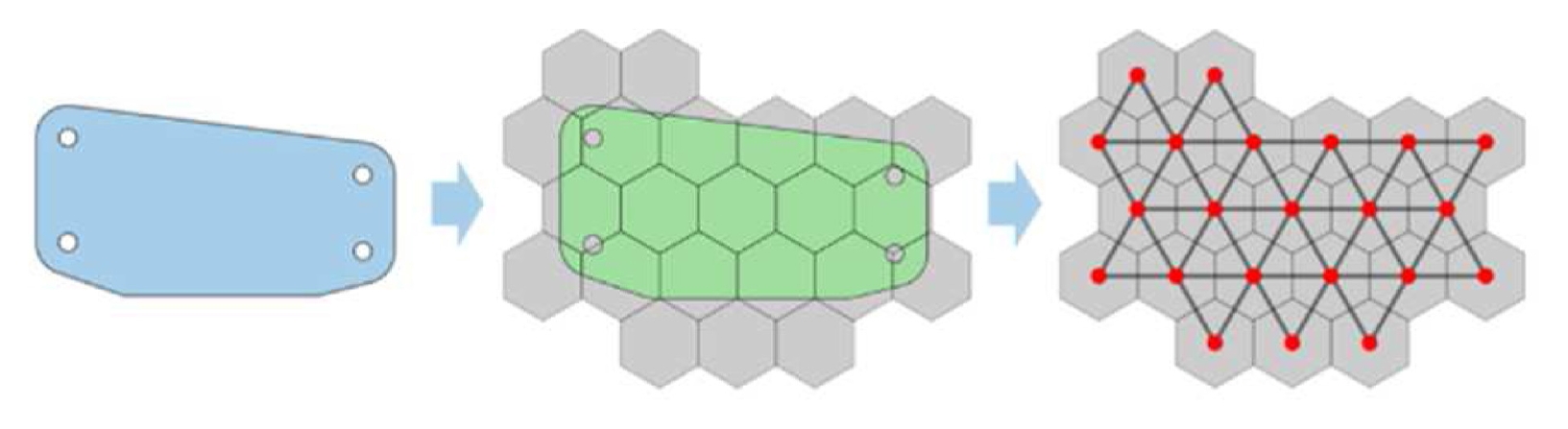
E는 두 셀이 서로 인접함을 의미한다. 셀 간 인접 관계는 보로노이 셀의 경계 공유 여부를 기준으로 정의하였으며, 이를 들로네 삼각분할(Delaunay Triangulation) 결과와 대응시켜 무방향 그래프로 표현하였다.
Fig. 4는 레이어 단면 다각형 에 보로노이 테셀레이션이 적용되고 인접 그래프가 정의되는 과정을 보인다.
각 노드에는 해당 셀의 하위 적층 경로를 독립적으로 수행하는 데 필요한 작업 시간을 노드 가중치로 부여하였다.
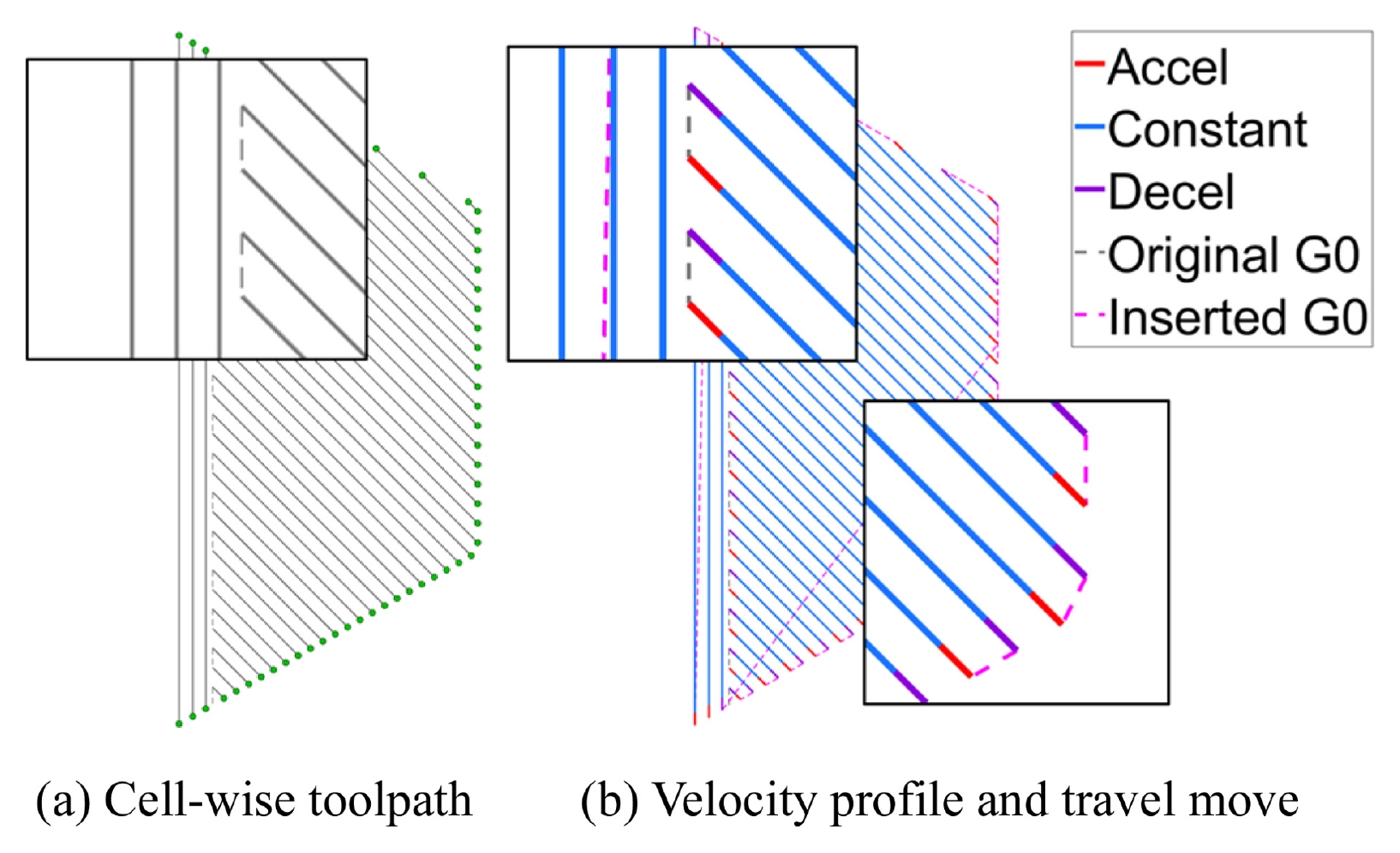
Fig. 5(a)는 하나의 셀 내부에 포함된 경로를 나타내며, 회색 실선은 적층 경로 세그먼트를, 회색 점선은 기존 비압출 경로를 나타낸다. 초록색 점은 셀 경계에 의해 적층 경로가 절단되는 지점을 의미한다. 셀 경계에서 절단된 적층 경로는 불연속적인 세그먼트로 분리되므로, 이를 연속적인 제조 경로로 재구성하기 위해 비압출 이동이 필요하다. 셀
i 의 노드 가중치
wi는
식(3)과 같이 셀
i의 하위 적층 경로를 수행하는 데 필요한 압출 이동 시간
Tiprint와 비압출 이동 시간
Titravel의 합으로 정의하였다. 이때
Titravel은 원래 G-code에 포함된 비압출 이동과, 셀 단위 경로 재구성 과정에서 필요한 비압출 이동을 포함한다. 각 이동 시간은 G-code에서 추출한 경로 길이와 이동 속도, 로봇 팔의 속도 및 가속도 조건을 바탕으로 사다리꼴 속도 프로파일을 적용하여 산정하였다.
인접한 두 셀
i와
j 사이의 간선 가중치
pij 는 두 셀의 공통 경계에서 적층 경로가 절단됨으로써 발생하는 경계 절단 비용으로 정의하였다.
Fig. 5(b)는 절단된 적층 경로 세그먼트와 비압출 이동에 사다리꼴 속도 프로파일을 적용하여 시간 비용을 계산하는 개념을 나타낸다. 그림에서 실선은 압출 이동 구간이며, 빨간색, 파란색, 보라색 선은 각각 가속, 등속, 감속 구간을 의미한다. 회색 점선은 기존 G-code에 포함된 비압출 이동을 나타내고, 분홍색 점선은 셀 경계 절단으로 인해 추가되는 비압출 이동을 의미한다. 간선 가중치
pij는
식(4)와 같이 경계 (
i,j)의 절단으로 인해 발생하는 삽입 비압출 이동 시간
TijinsertedTrravel과, 절단된 세그먼트의 시작 및 종료 지점에서 발생하는 추가 가속·감속 시간
TijcutAccelDecel의 합으로 계산하였다. 이 값은 두 셀이 서로 다른 작업 영역으로 분리될 때 발생하는 추가 시간 비용이며, 두 셀이 동일 클러스터로 병합될 경우 제거되는 경계 절단 비용으로 사용된다.
두 인접 셀이 동일 클러스터로 병합되면 해당 경계는 없어지므로, 그 경계에서 발생하던 경계 절단 비용은 제거된다. 따라서 클러스터
Cc의 총 작업 시간
Wc는
식(5)와 같이 클러스터에 포함된 노드 가중치의 합에서 클러스터 내부 간선의 경계 절단 비용 합을 차감하여 계산하였다. 이를 통해 셀 병합으로 제거되는 적층 경로 절단 및 추가된 비압출 이동의 시간 효과를 클러스터 작업 시간에 반영하였다.
클러스터링은 k개의 시작 노드 집합 S = {s1,...,sk} 에서 시작하였다. 각 시작 노드는 하나의 초기 클러스터를 형성하며, 이후 각 클러스터는 인접한 미할당 노드를 순차적으로 포함하면서 확장된다. 후보 노드는 항상 현재 클러스터와 인접한 경계 노드(Boundary Node) 중에서 선택되므로, 최종 클러스터는 연결된 부분그래프 형태를 유지한다. 매 단계에서는 현재 작업 시간이 가장 작은 클러스터를 우선적으로 확장하였다.
선택된 클러스터
Cc에 미할당 후보 노드
v를 추가할 때의 임시 클러스터 작업 시간
W^c(v)는
식(6)과 같이 계산하였다. 여기서
wv는 후보 노드
v의 작업 시간이고,
u는 클러스터
Cc에 이미 포함되어 있으면서
v와 인접한 노드이다. 따라서
∑puv는 후보 노드
v가
Cc에 편입될 때 경계가 없어져서 가중치 합에서 제거되는 경계 절단 비용의 합을 의미한다. 후보 노드는 클러스터 간 작업량 균등성을 개선하는 방향으로 선택하였다. 이를 위해 후보 노드
v를 추가했을 때의 임시 클러스터 작업 시간
W^c(v)와 전체 클러스터의 평균 작업 시간
W¯의 차이를
식(7)과 같이 평가하고,
J(
v)가 가장 작은 후보 노드를 해당 클러스터에 편입하였다. 모든 노드가 하나의 클러스터에 할당될 때까지 이 과정을 반복하였다.
클러스터 확장은 너비 우선 탐색(Breadth-First Search, BFS)의 인접 노드 기반 단계적 확장 특성을 활용하여 수행하였다. BFS는 시작 노드와 직접 인접한 노드부터 탐색하고, 이후 탐색 범위를 단계적으로 확장하므로, 현재 클러스터와 인접한 미할당 노드로 후보를 제한하면서 영역을 성장시키는 본 연구의 구조에 적합하다. 다만 실제 병합 대상은 단순한 BFS 방문 순서로 결정하지 않고,
식(6)의 임시 클러스터 작업 시간과
식(7)의 후보 선택 점수를 기준으로 결정하였다. 최종 분할 결과의 작업량 균등성은
식(8)의 변동계수(Coefficient of Variation, CV)와
식(9)의 최대/최소 작업량 비율
Rmax/min으로 평가하였다. 두 지표는 값이 작을수록 클러스터별 작업 시간이 균등하게 분배되었음을 의미한다.
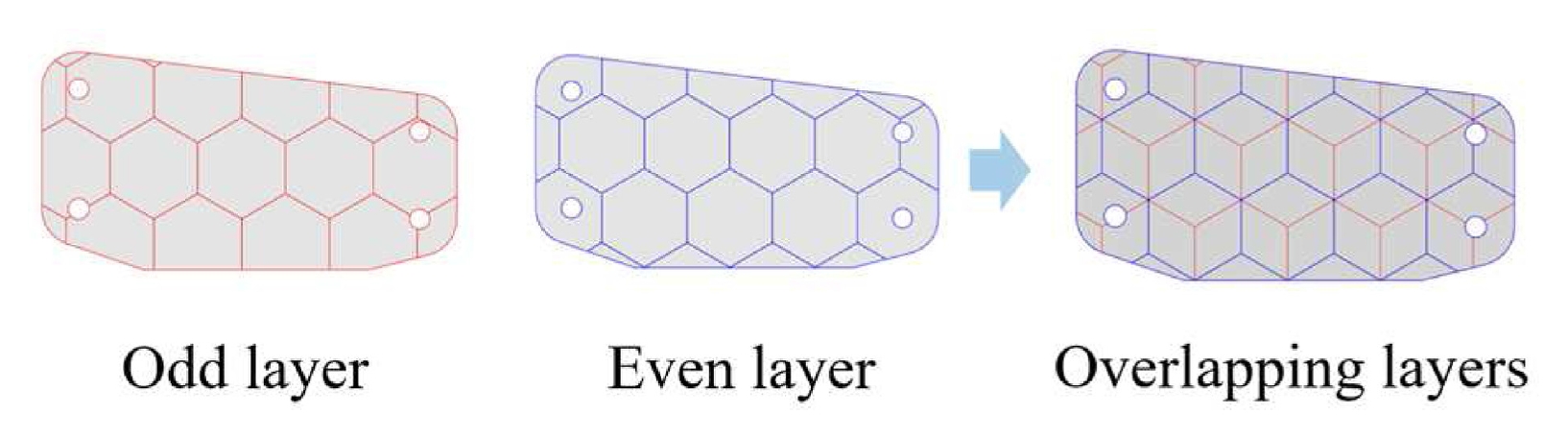
분할 경계가 적층 방향으로 동일 위치에 반복 형성되는 것을 완화하기 위해, 홀수 층과 짝수 층에 서로 다른 보로노이 시드 오프셋(Seed Offset)을 적용하였다. 홀수 층에서는 기준 시드 배열을 사용하고, 짝수 층에서는 평면 내 오프셋을 적용하여 인접 레이어의 보로노이 셀 경계가 동일 위치에 반복 형성되지 않도록 하였다. 이 방식은 레이어 내 충돌 회피 및 작업량 균등 분할 절차를 유지하면서, 층간 분할 경계의 위치만 분산시키기 위한 후속 설계 단계로 적용된다.
Fig. 6은 홀수 층과 짝수 층에 서로 다른 시드 오프셋을 적용했을 때 형성되는 층간 경계 배치를 나타낸다. 오프셋을 적용하지 않는 경우에는 인접 레이어의 보로노이 셀 경계가 동일한 위치에 반복될 수 있으며, 이 경우 분할 경계가 적층 방향으로 연속적인 선형 계면을 형성할 가능성이 있다. 반면
Fig. 6과 같이 홀수 층과 짝수 층의 보로노이 시드 위치를 서로 다르게 설정하면, 두 레이어의 셀 경계는 동일한 선을 따라 중첩되지 않고 교차점 형태로 만나게 된다. 이에 따라 하위 레이어에서 형성된 분할 경계는 상위 레이어의 셀 내부 영역, 즉 적층 면에 의해 부분적으로 덮이게 되며, 분할 경계가 적층 방향으로 연속 성장하는 것을 완화할 수 있다.
시드 오프셋은 2.3절에서 정의한 보로노이 셀의 설계 기준 길이
s를 기준으로
식(10)과 같이 설정하였다. 여기서
l은 레이어 번호이고,
ol은 해당 레이어에 적용되는 시드 오프셋 벡터이다. 즉, 홀수 층에는 기준 시드 배열을 적용하고, 짝수 층에는 일정한 평면 내 오프셋을 부여하여 인접 레이어 간 보로노이 셀 경계가 서로 엇갈리도록 하였다.
이를 통해 레이어의 초기 보로노이 셀 자체가 서로 엇갈린 위치에 생성된다. 이에 따라 레이어별 작업 영역 분할, 작업량 균등화, 그래 프 컬러링 기반 동시 작업 영역 도출 절차를 변경하지 않으면서, 층간 분할 경계의 반복 중첩을 완화하는 방법으로 적용될 수 있다.
2.6 그래프 컬러링 기반 동시 작업 영역 도출
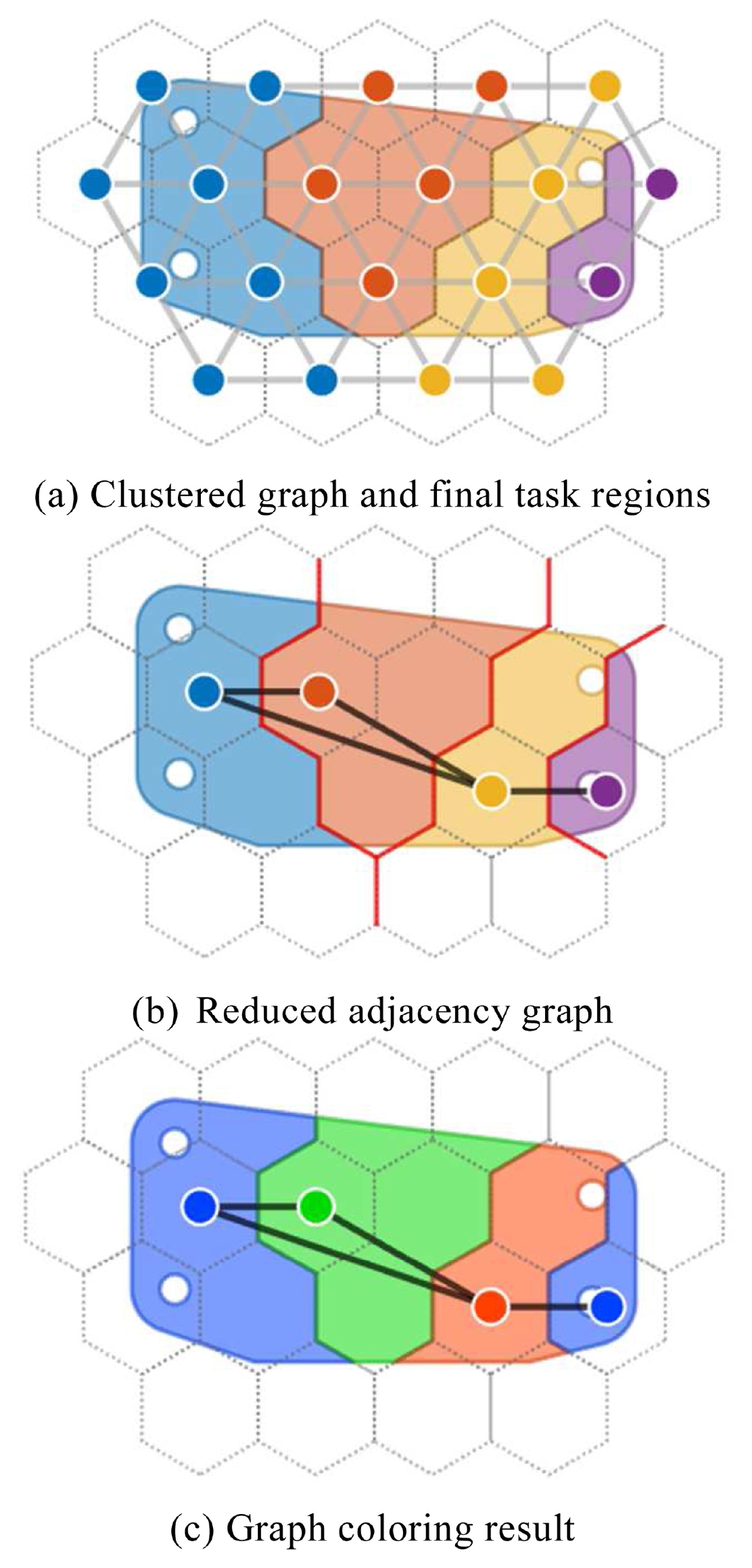
2.4절의 가중치 그래프 기반 클러스터링이 완료되면, 초기 셀들은 클러스터 간 작업 시간 편차를 줄이는 방향으로 최종 작업 영역에 병합된다. 그러나 이 단계에서는 각 작업 영역의 형상과 작업량만 결정될 뿐, 어떤 영역을 동시에 인쇄할 수 있는지는 아직 결정되지 않는다. 따라서 본 절에서는 2.3절에서 정의한 셀 간 인접성에 따른 간섭 관계를 최종 작업 영역 수준으로 확장하여, 동시 접근 가능한 작업 영역 조합을 판별하였다. 이를 위해 각 최종 작업 영역을 하나의 정점으로 치환하고, 서로 인접한 작업 영역 사이에 간선을 정의하여 축약 그래프를 구성하였다. 여기서 두 작업 영역이 인접한다는 것은 두 영역에 포함된 초기 셀 중 적어도 하나의 셀 쌍이 경계를 공유함을 의미하며, 이는 서로 다른 로봇이 두 영역에 동시에 접근할 경우 엔드이펙터 간 직접 간섭 가능성이 있음을 나타낸다. 이후 축약 그래프에 대해 그래프 컬러링을 수행하였다. 그래프 컬러링은 간선으로 연결된 인접 정점에 동일한 색이 배정되지 않도록 정점에 색을 할당하는 그래프 이론 기법이다. 따라서 동일 색상으로 분류된 정점들은 서로 인접하지 않은 작업 영역 집합이며, 본 연구에서는 이를 엔드이펙터 간 직접 충돌 없이 동시에 접근 가능한 영역 조합으로 해석하였다.
Fig. 7은 최종 작업 영역으로부터 축약 그래프를 구성하고, 그래프 컬러링을 통해 동시 접근 가능한 영역 조합을 도출하는 과정을 나타낸다.
Fig. 7(a)는 클러스터링된 노드와 이에 대응되는 최종 분할 영역을 나타내며, 노드와 다각형의 색은 동일한 클러스터를 의미한다.
Fig. 7(b)는 최종 분할 영역 간 인접 관계를 바탕으로 구성한 축약 그래프를 보여준다. 그림에서 빨간 선은 서로 다른 클러스터에 속한 셀들이 경계를 공유하는 부분을 나타내며, 이러한 접촉 관계는 축약 그래프의 간선으로 유지된다.
Fig. 7(c)는 축약 그래프에 그래프 컬러링을 적용한 결과이다. 동일한 색으로 표시된 정점들은 서로 간선으로 연결되어 있지 않으므로, 해당 정점에 대응되는 작업 영역은 동시에 접근 가능한 영역 조합으로 분류된다.
최종 분할 영역과 동시 접근 가능 영역 조합이 도출되면, 실제 로봇 실행을 위해 각 작업 영역을 로봇 팔에 할당한다. 본 연구의 실험 구현에서는 각 최종 분할 영역과 로봇 기준 위치 사이의 거리를 고려하여, 상대적으로 가까운 로봇 팔이 해당 영역을 담당하도록 수동 할당하였다. 이후 할당된 최종 분할 영역의 경계 정보를 이용하여 기존 G-code 적층 경로를 분할하고, 각 로봇 팔에 대응되는 하위 적층 경로를 생성하였다. 이때 원래 G-code의 경로 순서를 유지하면서, 할당된 영역 내부에 포함되는 적층 경로 세그먼트를 추출하고, 영역 경계를 지나는 세그먼트는 경계에서 절단하였다. 영역 분할로 인해 분리된 적층 경로 세그먼트 사이에는 Z축 상승 이동(Z-hop)을 포함한 비압출 이동(Travel Move)을 삽입하여 연속적인 제조 경로로 재구성하였다. Z축 상승 이동은 로봇 팔이 출력물을 가로질러 이동할 때 노즐과 인쇄물 사이의 간섭을 줄이기 위해 적용하였다. 이와 같은 비압출 이동 시간은 2.4절에서 정의한 경계 절단 비용에 반영하였으며, 최종 하위 적층 경로는 압출 이동과 비압출 이동이 구분된 형태로 저장하였다. 분할된 하위 적층 경로는 로봇 팔 제어를 위한 궤적 생성에 사용하였다. G-code에서 추출한 이동 속도와 로봇 팔 제어 속도 및 가속도 조건을 바탕으로 사다리꼴 속도 프로파일을 적용하였으며, 각 경로점은 보간과 역기구학 계산을 통해 로봇 관절 궤적으로 변환하였다. 압출 명령은 계산된 로봇 팔의 이동 속도와 동기화되도록 구성하였다. 최종적으로 생성된 관절 궤적과 압출 명령 시퀀스는 CSV 형식으로 저장하고, PC 기반 제어 프로그램을 통해 ROBOTIS OpenCR 제어기로 전송하였다.
3. 결과
3.1 평가 조건 및 지표
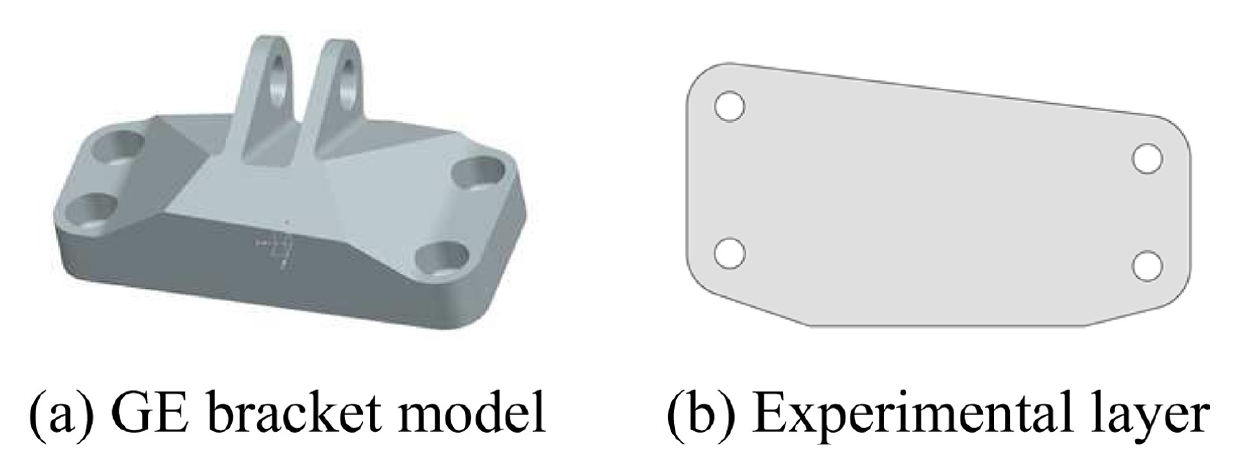
제안한 레이어 분할 프레임워크는 두 가지 목적에서 평가하였다. 첫째, 실험 대상 레이어를 대상으로 가중치 그래프 기반 클러스터링이 최종 작업 영역 간 작업량을 균등하게 분할할 수 있는지를 평가하였다. 둘째, 실제 협동 3D 프린팅 실험 환경에서 제안한 분할 결과와 그래프 컬러링 결과가 로봇 팔 기반 병렬 인쇄에 적용 가능한지를 검증하였다. 작업량 균등성 평가는
Fig. 8(a)의 GE bracket 모델에서
Fig. 8(b)에 나타낸 레이어를 사용하여 수행하였다. 모델의 STL 파일과 해당 레이어의 Gcode를 이용하여 레이어 정합 데이터를 구성하고, 보로노이 테셀레이션, 가중치 그래프 구성, 그래프 기반 셀 클러스터링을 순차적으로 수행하였다. 본 연구에서는 가중치 그래프를 구성하는 초기 셀의 개수를 그래프 노드 수
n으로, 클러스터링을 통해 생성되는 최종 작업 영역의 개수를 클러스터 수
k로 정의하였다. 또한
n/k는 하나의 최종 작업 영역이 평균적으로 포함할 수 있는 초기 셀의 수를 의미한다.
작업량 균등성은 두 관점에서 분석하였다. 첫째, 시작 노드 선택 방식에 따른 균등성 차이를 비교하였다. 비교 대상은 몬테카를로 방식(Monte Carlo), 임의 선택 방식(Random), 최원점 샘플링(Farthest Point Sampling, FPS) 기반 공간 분산 방식(Spatial), 그리고 가중치 고려 방식(Weight-aware)으로 설정하였다. 둘째, 그래프 노드 수 n, 최종 작업 영역 수 k, 그리고 n/k가 작업량 균등성에 미치는 영향을 분석하였다. 평가 지표로는
식(8)에 해당하는 클러스터별 작업 시간의 변동계수와
식(9)에 해당하는 최대/최소 작업량 비율(Max/Min ratio)을 사용하였다. 두 지표는 값이 작을수록 최종 작업 영역 간 작업량이 더 균등하게 분배되었음을 의미한다. 또한 그래프 노드 수와 최종 작업 영역 수 변화에 따른 계산 비용을 확인하기 위해 클러스터링 계산 시간도 함께 측정하였다. 단, 작업량 균등성 평가에서는
Fig. 8(b)의 실험 대상 레이어에 대해 충분한 그래프 노드 수를 확보하기 위해 셀 설계 기준 길이 s를 10 mm로 설정하였다. 이 조건에서 생성된 분할 결과는 균등성 분석에만 사용하였으며, 실제 협동 3D 프린팅 실험에는 엔드이펙터 충돌 반경을 반영하여 s = 65 mm로 설정한 별도의 분할 조건을 사용하였다.
시작 노드 선택 방식이 가중치 그래프 기반 셀 클러스터링의 작업량 균등성에 미치는 영향을 평가하였다. 분석에는 클러스터 수 대비 충분한 노드 개수를 확보하기 위해 셀 설계 기준 길이 s = 10 mm 조건에서 생성된 n = 182 그래프를 사용하였다. 각 시작 노드 선택 방식에 대해 k = 2,4,6,8 조건에서 변동계수와 최대/최소 작업량 비율을 계산하였다.
시작 노드 선택 방식은 다음과 같이 설정하였다. Random 방식은 전체 노드 중 k개의 노드를 무작위로 선택한다. Spatial (FPS) 방식은 최원점 샘플링을 이용하여 선택된 노드들 사이의 거리가 최대한 멀어지도록 시작 노드를 순차적으로 선택한다. Weight-aware 방식은 작업 시간이 큰 노드가 특정 클러스터에 집중되지 않도록, 각 노드의 작업 시간 wi 가 큰 노드를 시작 노드로 우선 선택하는 방식이다. Monte Carlo 방식은 Spatial (FPS) 기반 공간 분산 기준과 Weight-aware 기준을 확률적으로 선택하여 여러 후보 시작 노드 집합을 생성하고, 각 후보 집합에 대해 동일한 클러스터링을 수행한 뒤 균등성 지표가 가장 우수한 결과를 선택한다.
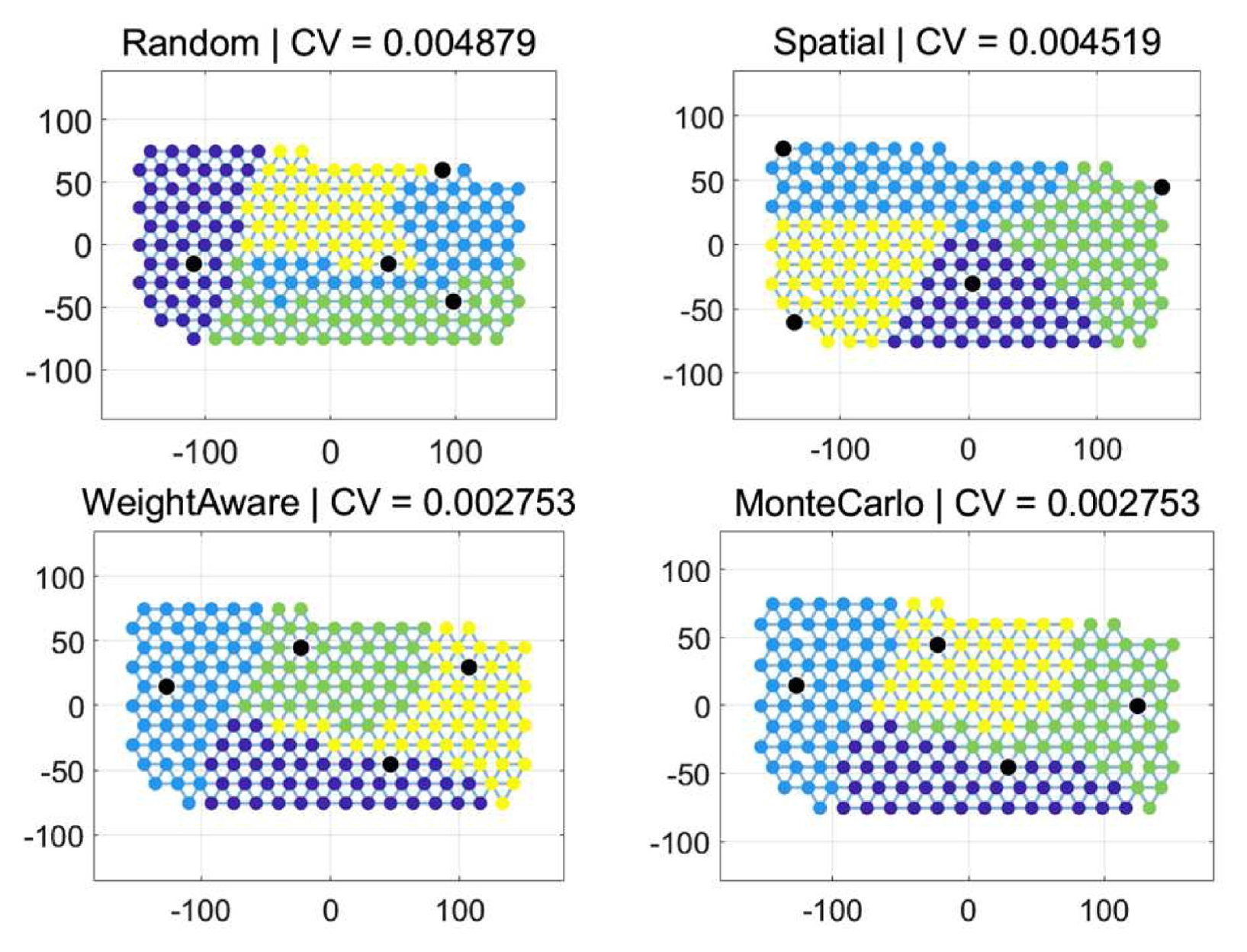
Fig. 9는 k = 4 조건에서 각 방식별 변동계수가 가장 낮은 클러스터링 결과를 나타내며,
Table 1은 시작 노드 선택 방식과 클러스터 수에 따른 균등성 지표를 나타낸다.
Table 1에서 확인할 수 있듯이, Monte Carlo 방식은 모든 k 조건에서 가장 낮은 평균 변동계수와 평균 최대/최소 작업량 비율을 보였다. 예를 들어 k = 4 조건에서 Monte Carlo 방식의 평균 변동계수는 0.0031, 평균 최대/최소 작업량 비율은 1.0062로 나타났으며, Random 방식의 평균 변동계수 0.1002 및 평균 최대/최소 작업량 비율 1.4962보다 낮았다. k = 6 조건에서도 Monte Carlo 방식은 평균 변동계수 0.0142와 평균 최대/최소 작업량 비율 1.0377을 보여, Spatial (FPS), Weight-aware, Random 방식보다 균등한 분할 결과를 나타냈다.
Random 방식은 일부 반복 실험에서 큰 편차를 보이며 가장 불안정한 결과를 나타냈다. 특히 k = 4 조건에서 Random 방식의 최대/최소 작업량 비율 최댓값은 21.4220까지 증가하였고, k = 6 조건에서도 6.4142로 나타났다. 이는 임의 시작 노드 선택이 특정 조건에서 작업량이 크게 불균형한 클러스터를 형성할 수 있음을 의미한다. 따라서 시작 노드 선택 방식은 그래프 기반 셀 클러스터링의 작업량 균등성에 직접적인 영향을 미치며, Monte Carlo 방식은 여러 후보 시작 노드 집합을 반복적으로 탐색한 뒤 균등성 지표가 가장 우수한 결과를 선택하므로, 본 실험 조건에서 가장 안정적인 균등 분할 성능을 보였다.
3.3 노드 수와 클러스터 수에 따른 균등성 분석
3.1절에서 정의한 그래프 노드 수 n, 최종 작업 영역 수 k, 그리고 n/k 비율이 작업량 균등성에 미치는 영향을 분석하였다. 시작 노드 선택 방식은 3.2절에서 가장 안정적인 균등 분할 성능을 보인 Monte Carlo 방식을 사용하였다. 분석에는
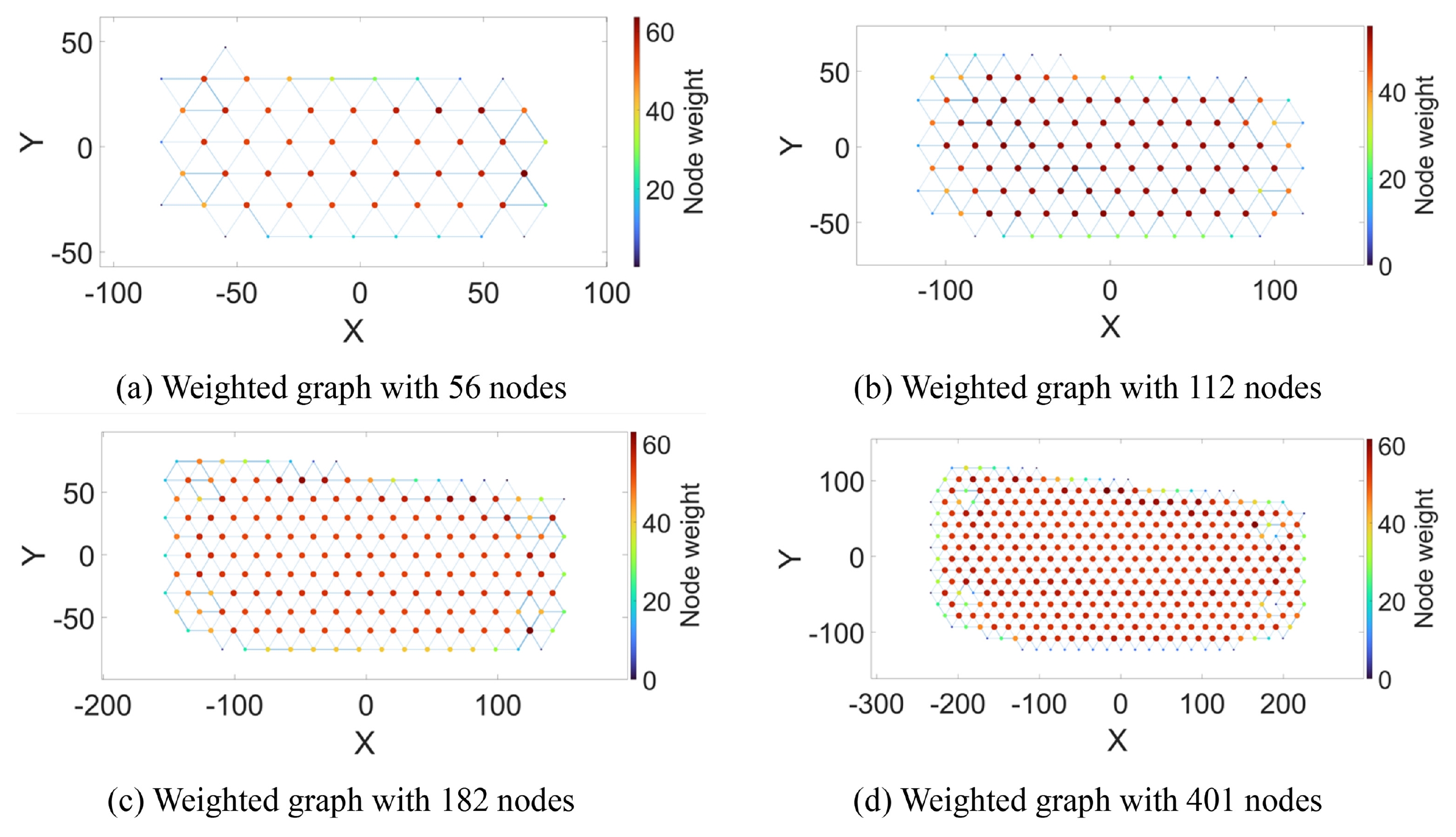
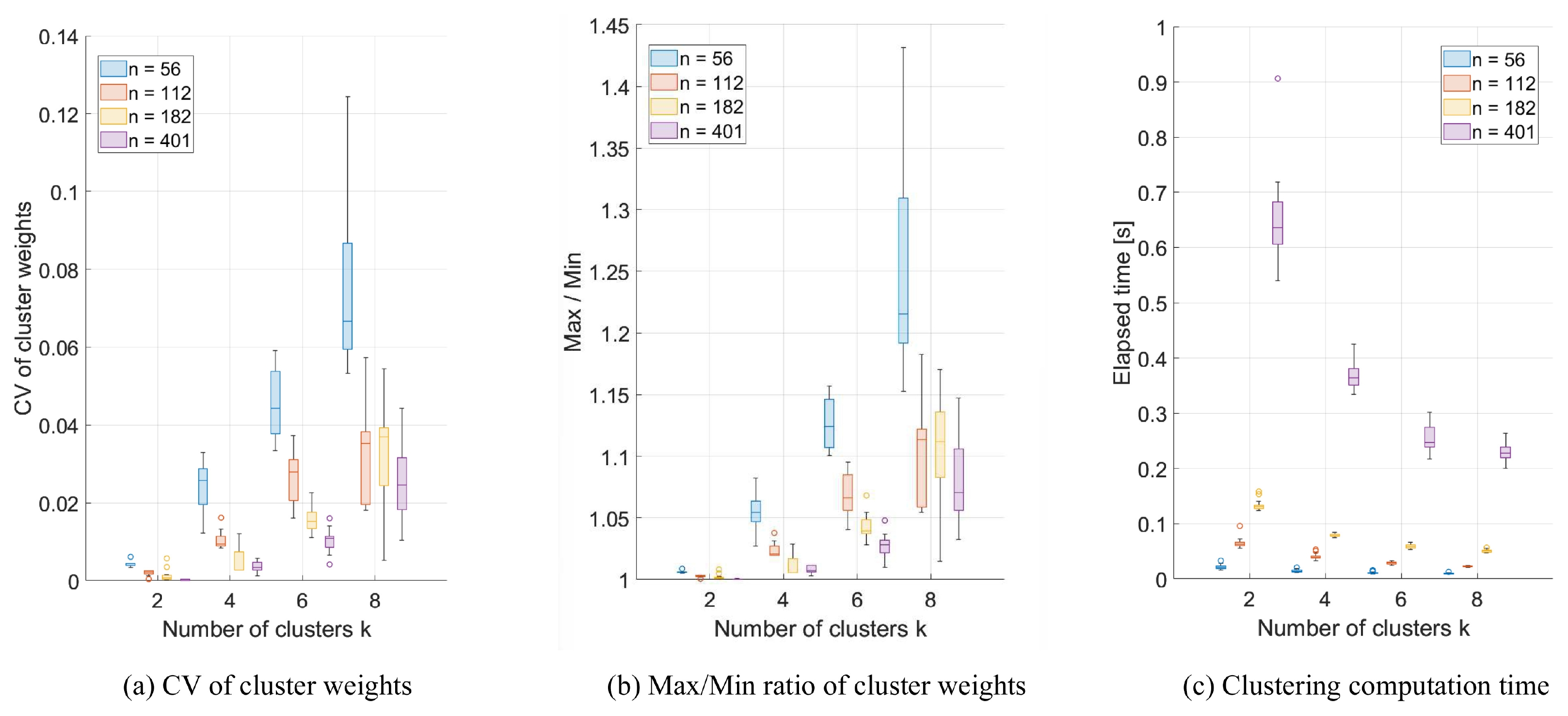
Fig. 10에 나타낸 n = 56, 112, 182, 401인 그래프를 사용하였으며, 각 그래프에 대해 k = 2, 4, 6, 8 조건에서 변동계수, 최대/최소 작업량 비율, 클러스터링 계산 시간을 평가하였다. 그래프 노드 수와 최종 작업 영역 수에 따른 변동계수와 최대/최소 작업량 비율은
Figs. 11(a)와
11(b)에 나타내었다. 동일한 그래프에서 k가 증가할수록 변동계수와 최대/최소 작업량 비율이 증가하는 경향을 보였다. 이는 k가 증가할수록 n/k가 감소하여 하나의 최종 작업 영역이 포함할 수 있는 후보 초기 셀의 조합이 제한될 가능성이 있기 때문으로 해석된다.
Fig. 11(a)에서 특히 n = 56과 같이 노드 수가 작은 그래프에서는 k = 8 조건에서 작업량 편차가 크게 증가하였다. 반면 n = 401 조건에서는 대부분의 k 조건에서 상대적으로 낮은 변동계수와 최대/최소 작업량 비율을 유지하였다.
Fig. 11(c)는 클러스터링 계산 시간을 나타낸다. 클러스터링 계산 시간은 전반적으로 그래프 노드 수가 증가할수록 증가하였다. 이는 그래프 규모가 커질수록 각 클러스터의 경계 노드 탐색과 후보 노드 평가에 필요한 연산량이 증가하기 때문이다. 다만 n = 401 조건에서도 계산 시간은 중앙값 기준 1초 미만으로 나타났으며, 이는 제안한 클러스터링 방법이 레이어 단위 분할 계산에 적용 가능한 수준의 계산 비용을 갖는다는 것을 보여준다.
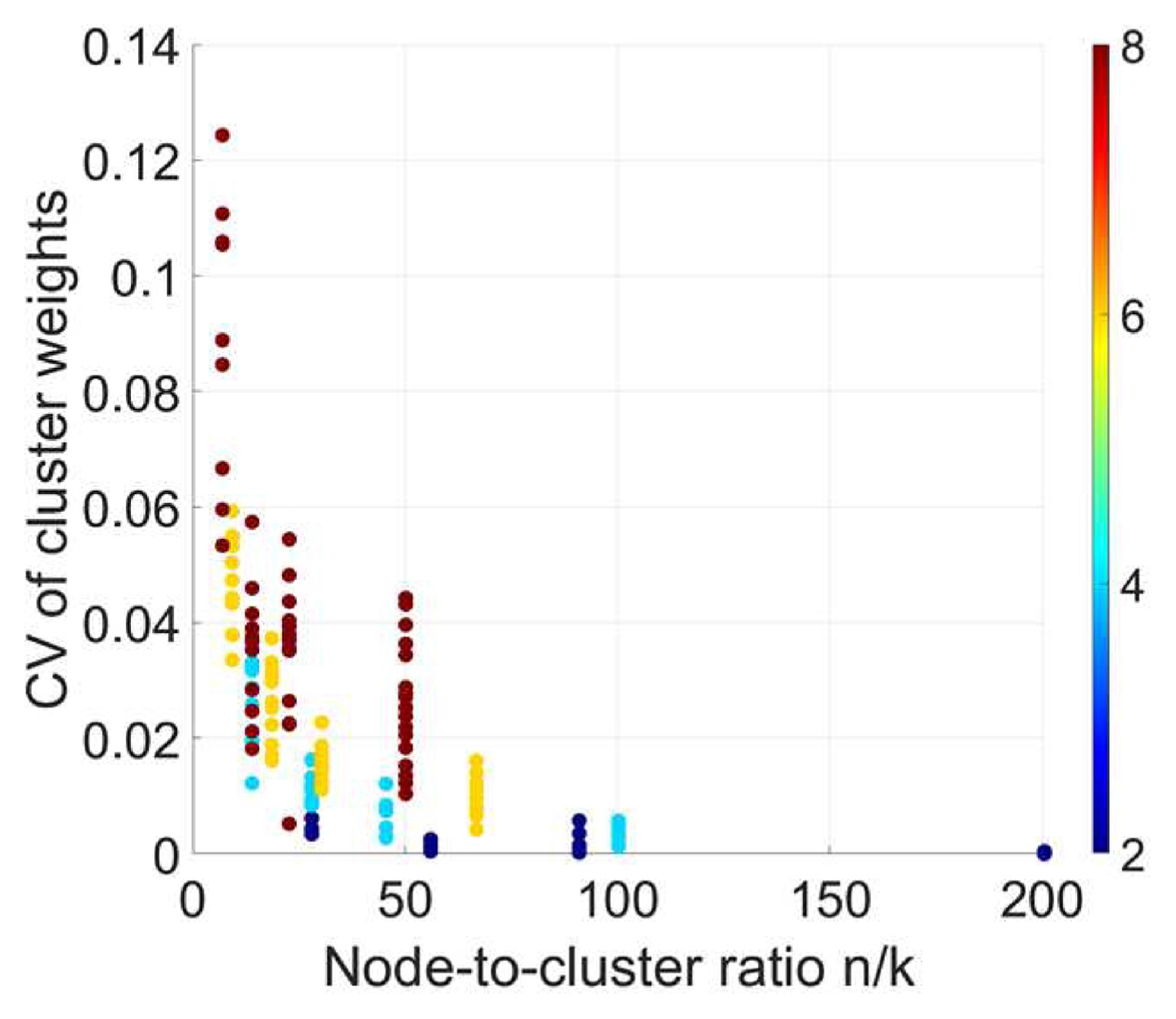
Fig. 12는 n/k와 변동계수의 관계를 나타낸다. 전반적으로 n/k가 충분히 큰 조건에서는 균등 분할이 용이한 경향을 보였으나, 모든 조건에서 n/k 증가가 변동계수의 단조 감소로 이어지지는 않았다. 이는 작업량 균등성이 단순히 그래프 노드 수와 최종 작업 영역 수의 비율에 의해서만 결정되는 것이 아니라, 그래프의 연결 구조와 노드 가중치 분포에도 영향을 받을 수 있음을 의미한다.
제안한 레이어 분할 프레임워크의 실제 적용 가능성을 확인하기 위해
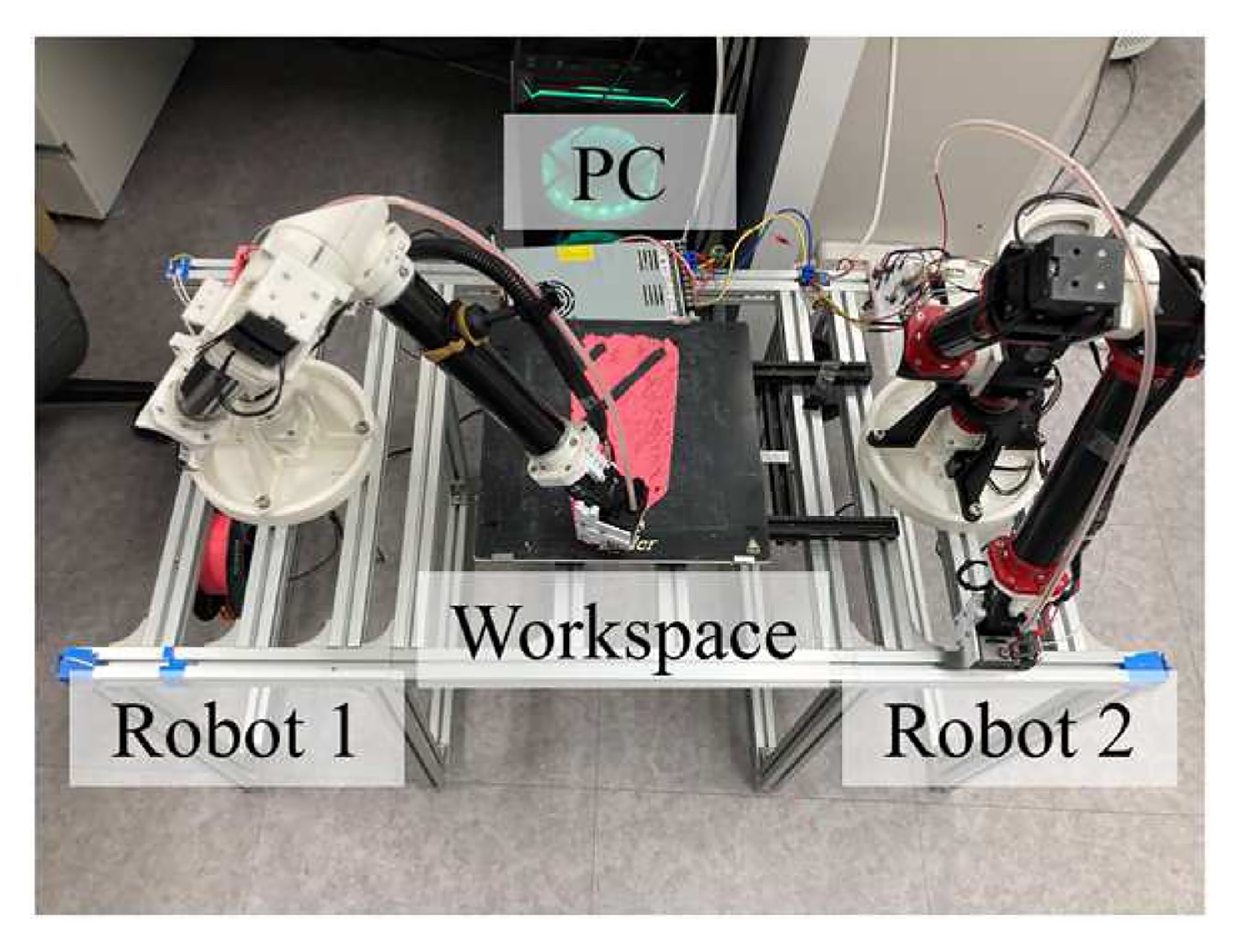
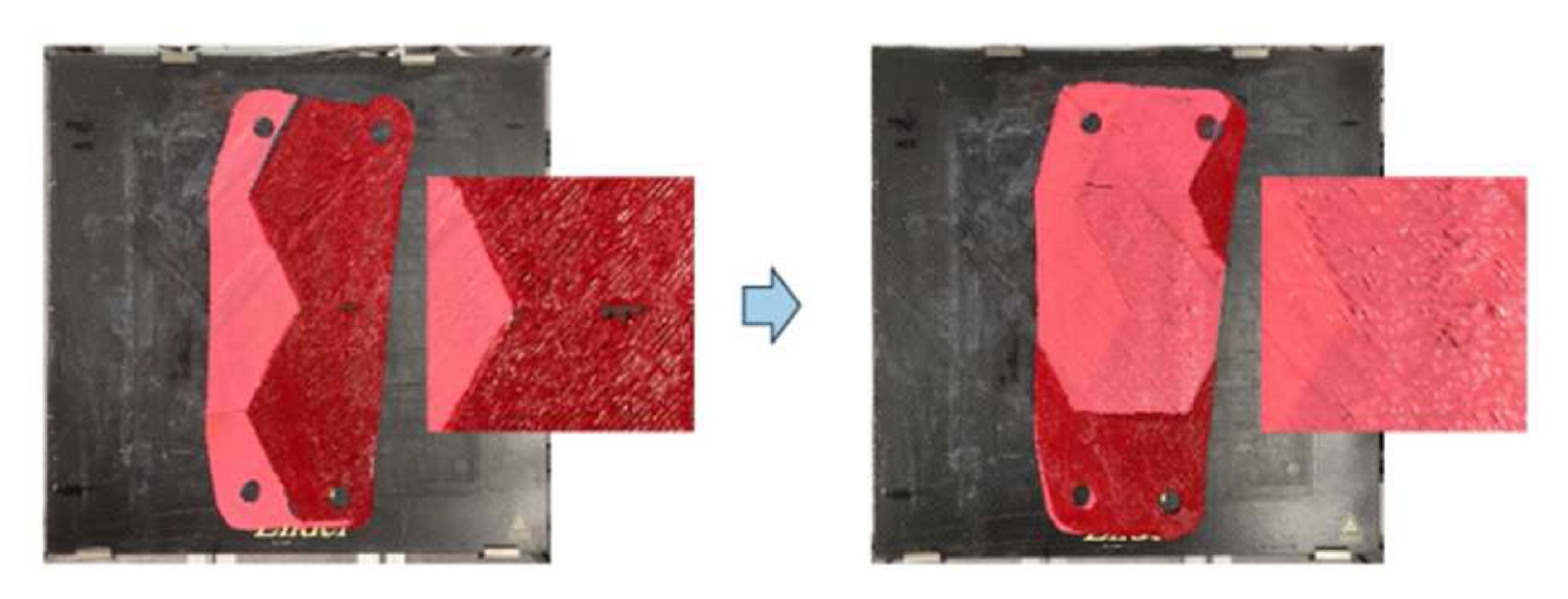
Fig. 13에 나타낸 용융 적층 제조(Fused Deposition Modeling, FDM) 방식의 로봇 팔 기반 협동 3D 프린팅 실험 환경에서 2개 레이어 인쇄 실험을 수행하였다. 본 인쇄 실험은 전체 3D 모델의 장시간 출력 성능을 검증하기보다, 제안한 프레임워크의 핵심 기능인 동시 작업 영역 도출, 엔드이펙터 간 충돌 회피, 그리고 층간 시드 오프셋 구현 가능성을 확인하는 데 목적을 두었다. 따라서 그래프 컬러링 결과 동시 접근 가능 영역 조합이 도출된 첫 번째 레이어는 해당 영역의 병렬 인쇄 중 충돌 회피 여부와 인쇄 시간 변화를 확인하는 데 사용하였다. 반면, 두 번째 레이어에서는 동시 접근 가능 영역 조합이 도출되지 않았으므로, 병렬 인쇄 검증 대상이 아니라 홀수 층과 짝수 층의 시드 오프셋에 따른 경계 덮임 효과를 확인하는 데 사용하였다.
인쇄 대상 레이어는 장비의 빌드 플레이트 크기와 로봇 팔의 작업 범위를 고려하여 225.0 × 136.5 mm로 조정하였다. 인쇄 실험에서는 실제 엔드이펙터 치수 조건을 적용하여 s = 65 mm로 설정하고 g = 112.58 mm로 계산했다. 보로노이 테셀레이션 결과 6개의 초기 셀이 생성되었고, k = 4 조건에서
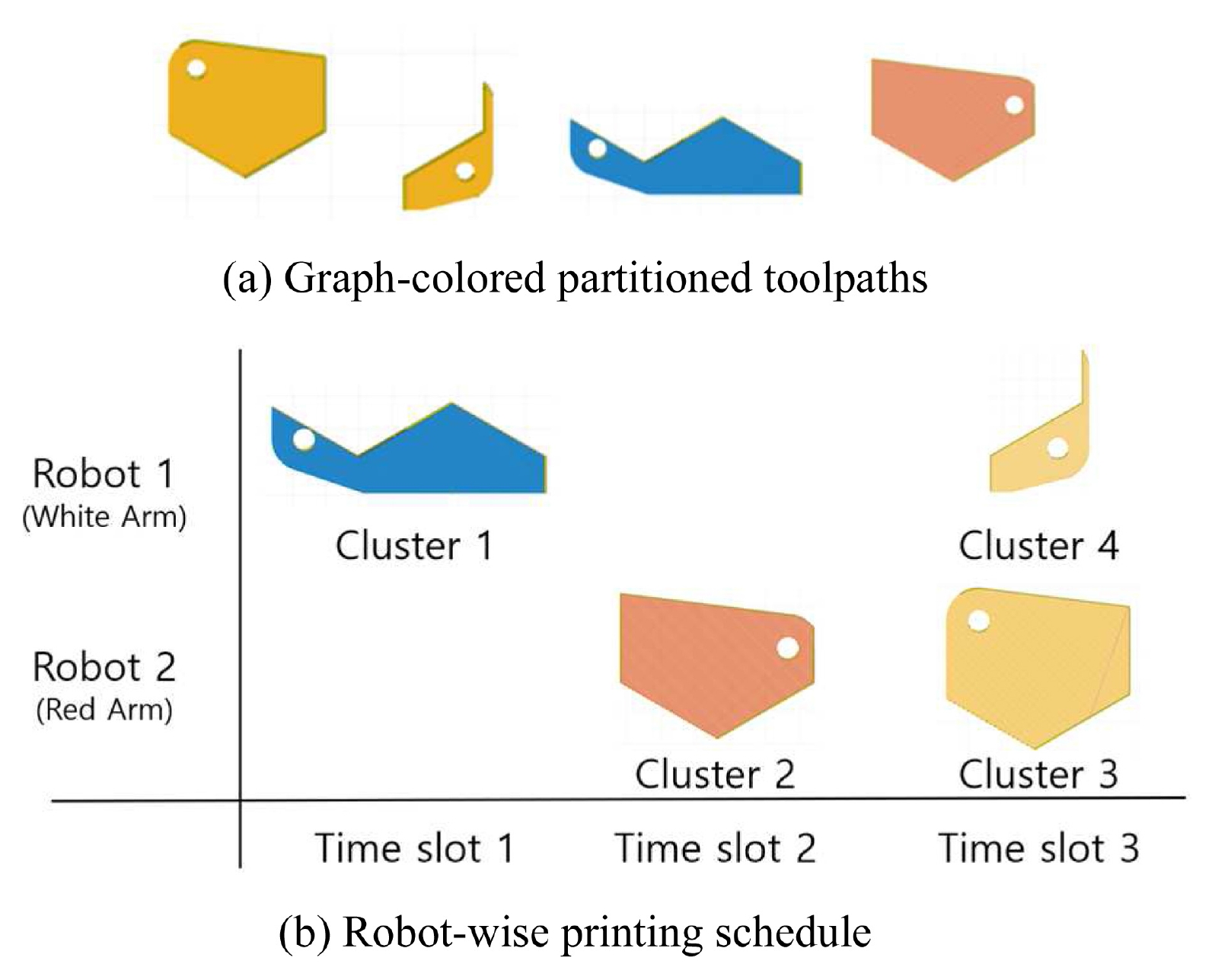
Fig. 14(a)와 같이 동시 작업 가능 영역이 생성되었다. 이후 프레임워크를 통해 생성된 분할 적층 경로 조각과 그래프 컬러링 결과를 기반으로 각 작업 영역과 로봇 기준 위치 사이의 거리를 고려하여, 더 가까운 로봇 팔이 해당 영역을 담당하도록
Fig. 14(b)와 같이 할당하였다.
Fig. 15와 같이 합동 3D 프린팅 공정을 수행했고, 인쇄 과정에서 수집된 로그 분석을 통해 로봇 팔의 관절 데이터와 인쇄 시간 정보를 수집했다.
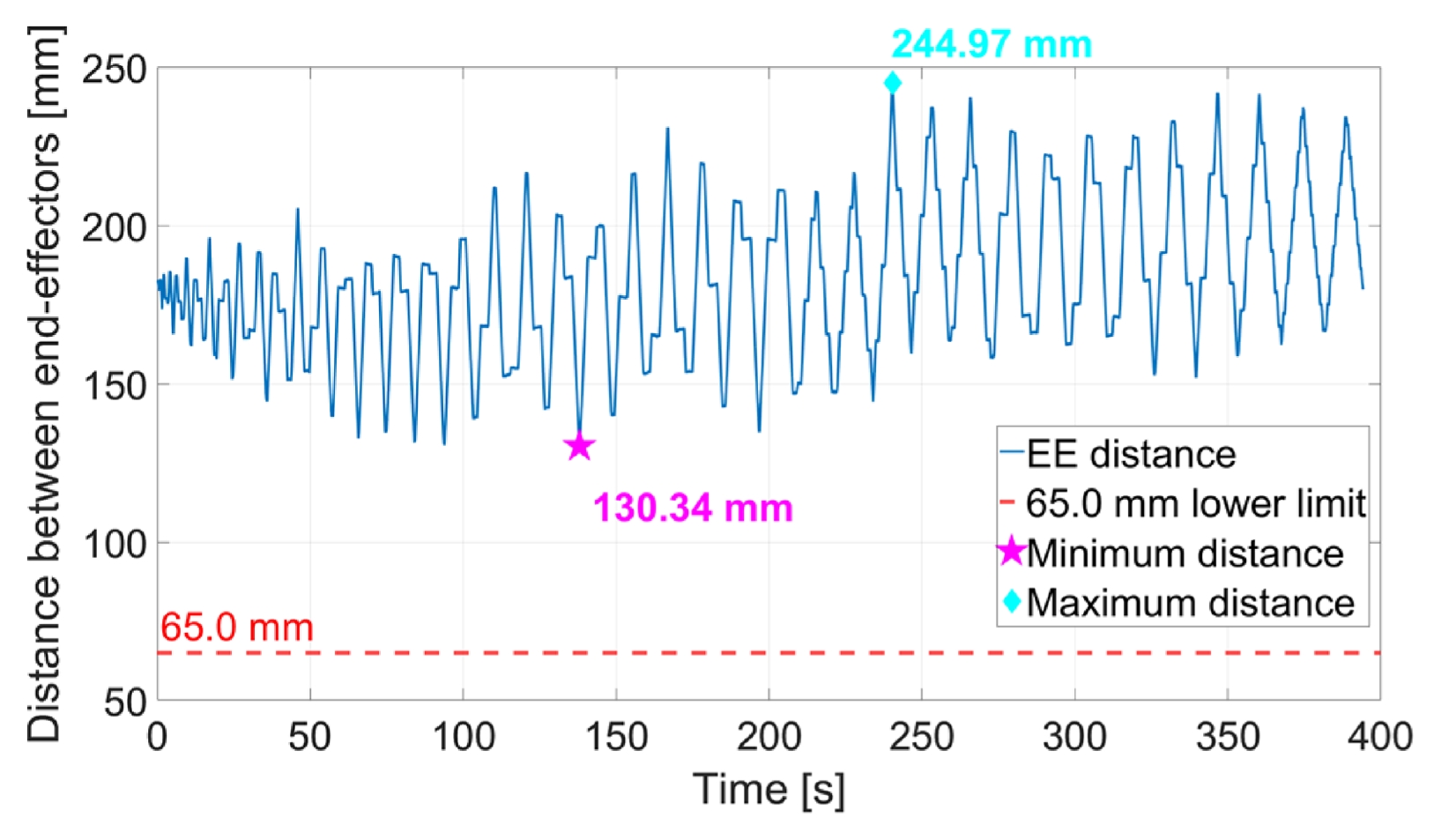
순기구학 연산과 적층 경로 배치 보정을 수행한 후 동시 인쇄 구간에서 두 엔드이펙터 사이의 거리를 계산했으며,
Fig. 16과 같이 최소 거리는 130.34 mm로 측정되었다. 이는 충돌 판단 기준 값인 6 5 mm보다 큰 값이다. 본 실험을 통해 그래프 컬러링으로 도출된 동시 작업 영역 조합은 엔드이펙터 간 직접 충돌 없이 병렬 인쇄가 가능함을 확인하였다.
Table 2는 로그 기반 인쇄 시간 분석 결과를 나타낸다. 레이어를 분할하지 않고 단일 로봇으로 인쇄한 경우 첫 번째 레이어의 인쇄 시간은 70.063 min이었다. 제안한 분할 방식을 적용한 경우에는 클러스터 1과 2를 순차적으로 인쇄하고, 클러스터 3과 4를 동시에 인쇄하였다. 따라서 동시 인쇄 구간에서는 두 클러스터 중 더 긴 클러스터 3의 인쇄 시간인 24.84 min을 반영하였다. 이에 따라 총 인쇄 시간은 63.57 min으로 계산되었으며, 이를 통해 약 9.3%의 시간 감소를 확인했다.
또한
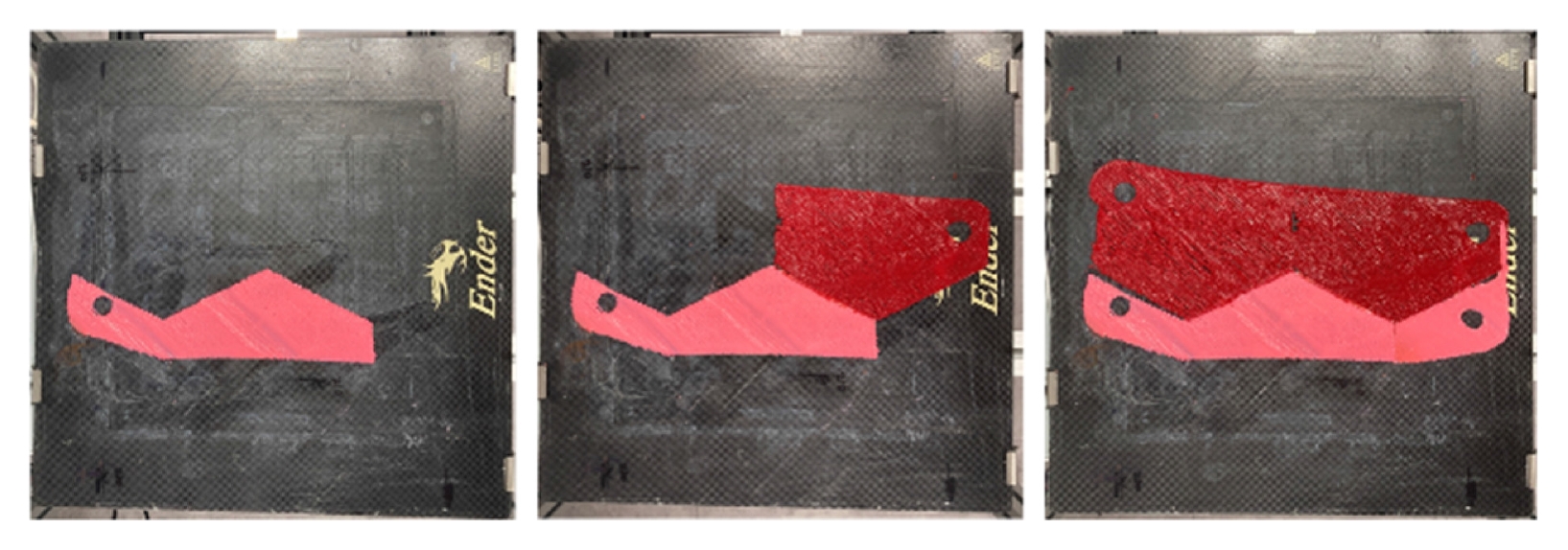
Fig. 17에서 확인할 수 있듯이 두 번째 레이어에서는 상위 레이어의 적층 경로가 이전 레이어의 분할 경계를 부분적으로 덮는 형상이 관찰되었다. 이는 2.5절에서 제안한 홀수 층과 짝수 층의 시드 오프셋에 의해 층간 분할 경계가 엇갈리게 배치되었기 때문이다. 따라서 제안한 시드 오프셋 기반 층간 경계 엇갈림 구조가 실제 인쇄에서도 구현 가능함을 확인하였다. 다만 본 실험은 2개 레이어를 대상으로 한 기능 검증에 한정되므로, 전체 3D 모델에 적용했을 때의 레이어별 작업량 균등성 유지 여부는 추가 검증이 필요하다.
4. 결론
본 연구에서는 로봇 팔 기반 협동 3D 프린팅을 위한 보로노이-가중치 그래프 기반 레이어 분할 프레임워크를 제안하였다. 제안 방법은 STL 형상과 G-code 적층 경로를 동일 레이어 기준으로 정합한 레이어 정합 데이터를 구성하고, 엔드이펙터 치수 기반 초기 셀 분할, 적층 경로 수행 시간 및 경계 절단 비용을 반영한 가중치 그래프 기반 셀 클러스터링, 층간 시드 오프셋, 그래프 컬러링을 결합한다. 이를 통해 기존 G-code 적층 경로를 활용하면서 작업량이 균등한 최종 작업 영역 생성 가능성을 확인하고, 엔드이펙터 간 직접 충돌 없이 동시에 접근 가능한 작업 영역 조합을 도출할 수 있었다. 균등 분할 성능 분석 결과, 시작 노드 선택 방식과 그래프 노드 수 대비 클러스터 수가 작업량 균등성에 큰 영향을 미치는 것으로 나타났다. 시작 노드 선택 방식 비교에서는 Monte Carlo 방식이 모든 클러스터 수 조건에서 가장 낮은 평균 변동계수와 평균 최대/최소 작업량 비율을 보여 가장 안정적인 균등 분할 성능을 보였다. 또한 그래프 노드 수 n에 비해 클러스터 수 k가 증가하여 n/k가 작아질수록 변동계수와 최대/최소 작업량 비율이 증가하는 경향을 보였다. 이는 실제 협동 3D 프린팅을 적용할 때 대상 형상, 셀 해상도, 클러스터 수를 함께 고려해야 함을 의미한다. 로봇 팔 기반 협동 3D 프린팅 실험에서 제안한 프레임워크를 통해 생성한 분할 적층 경로와 로봇별 제어 데이터가 실제 인쇄에 적용 가능함을 확인하였다. 동시 인쇄 구간에서 두 엔드이펙터 간 최소 거리는 130.34 mm로 측정되어 충돌 판단 거리인 6 5mm를 만족하였다. 또한 첫 번째 레이어의 인쇄 시간은 단일 로봇으로 분할하지 않고 인쇄한 경우 70.063 min에서 제안한 분할 방식을 적용한 경우 63.57 min으로 감소하여 약 9.3%의 시간 단축을 보였다. 두 번째 레이어에서는 상위 레이어의 적층 경로가 이전 레이어의 분할 경계를 부분적으로 덮는 형상이 관찰되어, 시드 오프셋 기반 층간 경계 엇갈림 구조가 실제 인쇄에서도 구현 가능함을 확인하였다. 향후 연구에서는 보로노이 셀의 설계 기준 길이와 클러스터 수를 자동으로 결정하는 방법, 더 많은 레이어와 복잡한 형상에 대한 검증, 그리고 층간 경계 엇갈림 구조가 인쇄물의 기계적 성능에 미치는 영향에 대한 정량 평가가 필요하다.
FOOTNOTES
-
ACKNOWLEDGEMENT
본 연구는 인천대학교 2023년도 자체연구비 지원에 의하여 연구되었음.
Fig. 1Workflow of the proposed layer partitioning framework for C3DP
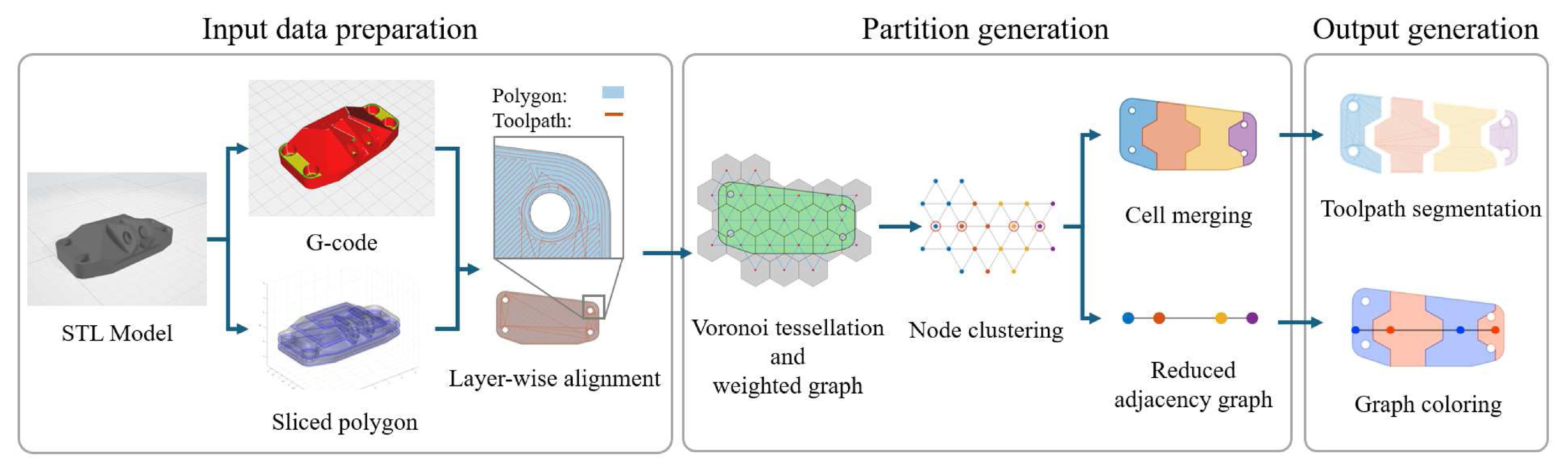
Fig. 2End-effector collision radius
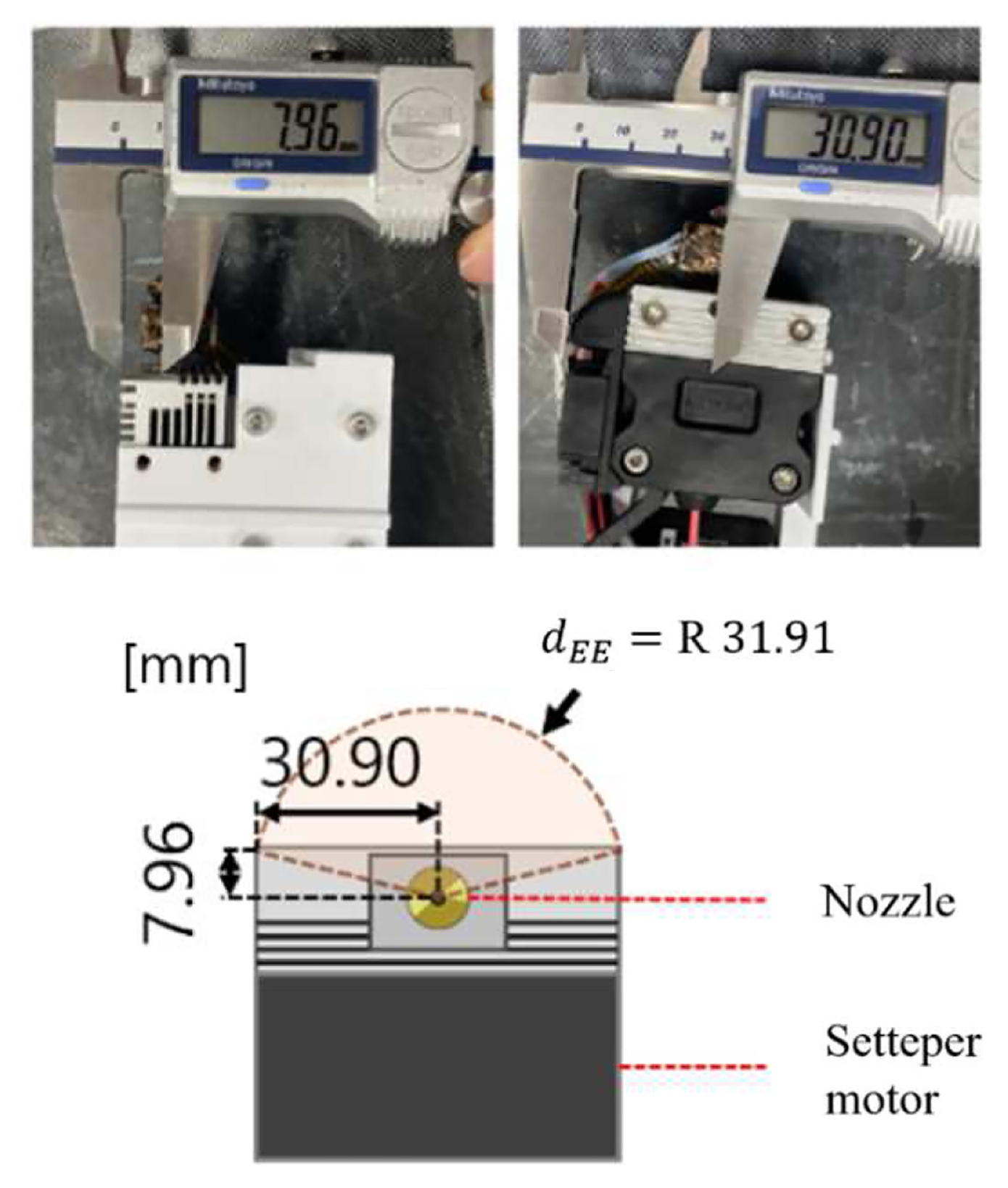
Fig. 3Definition of Voronoi cell geometry and region partitioning
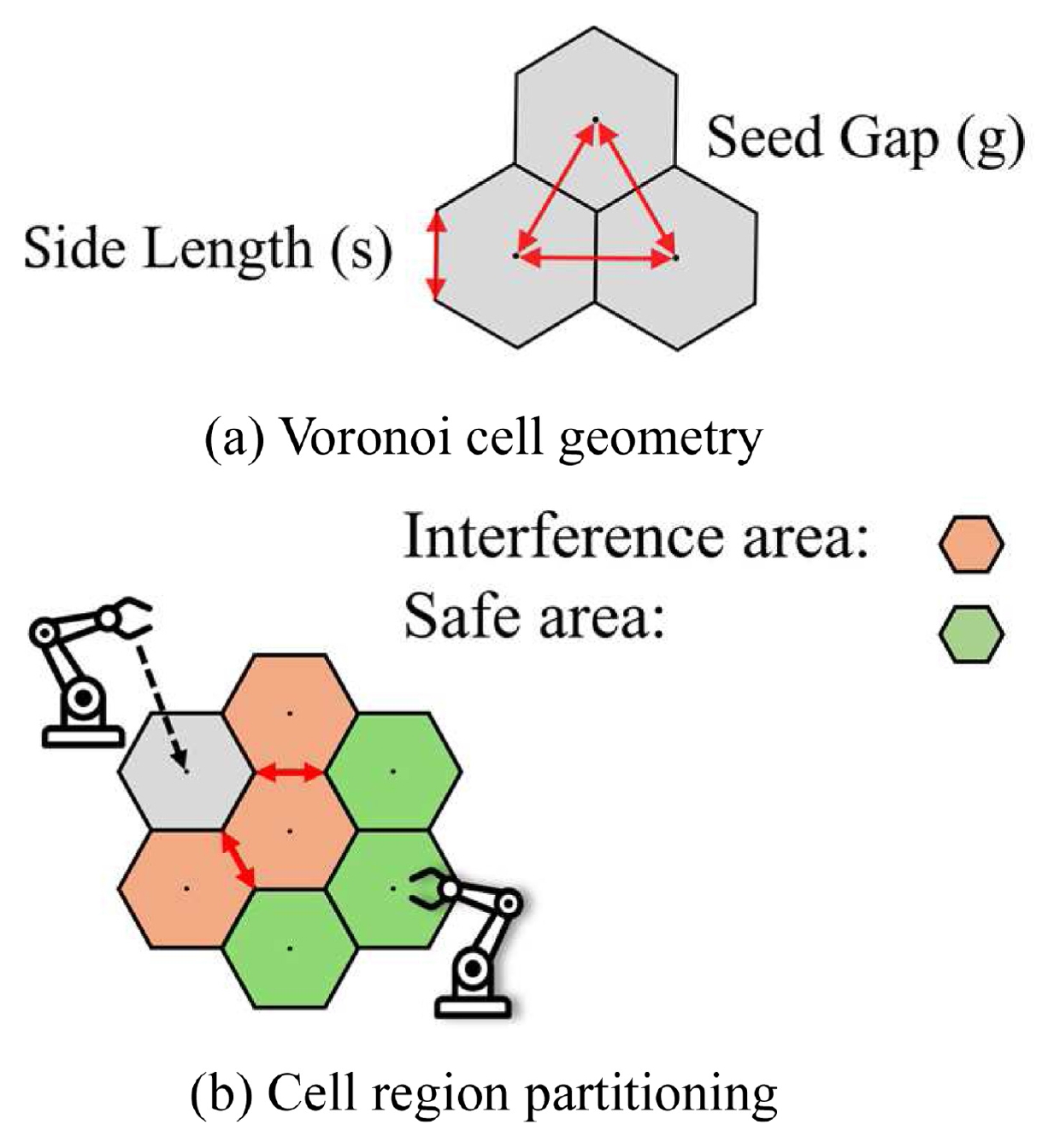
Fig. 4Adjacency graph construction from the layer polygon
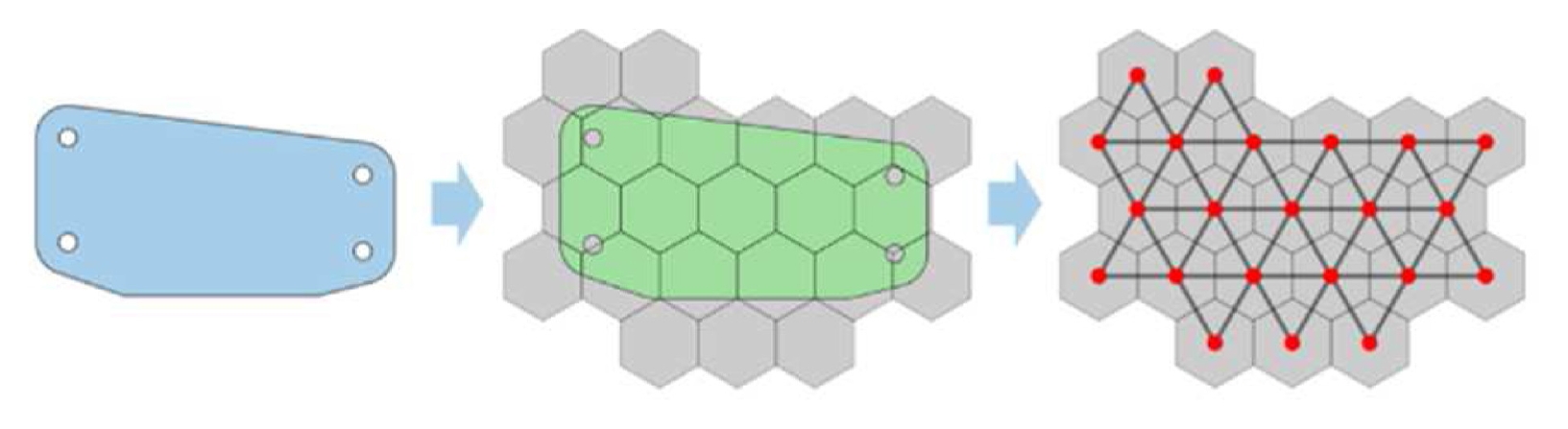
Fig. 5Cell-wise toolpath segmentation and motion-time calculation
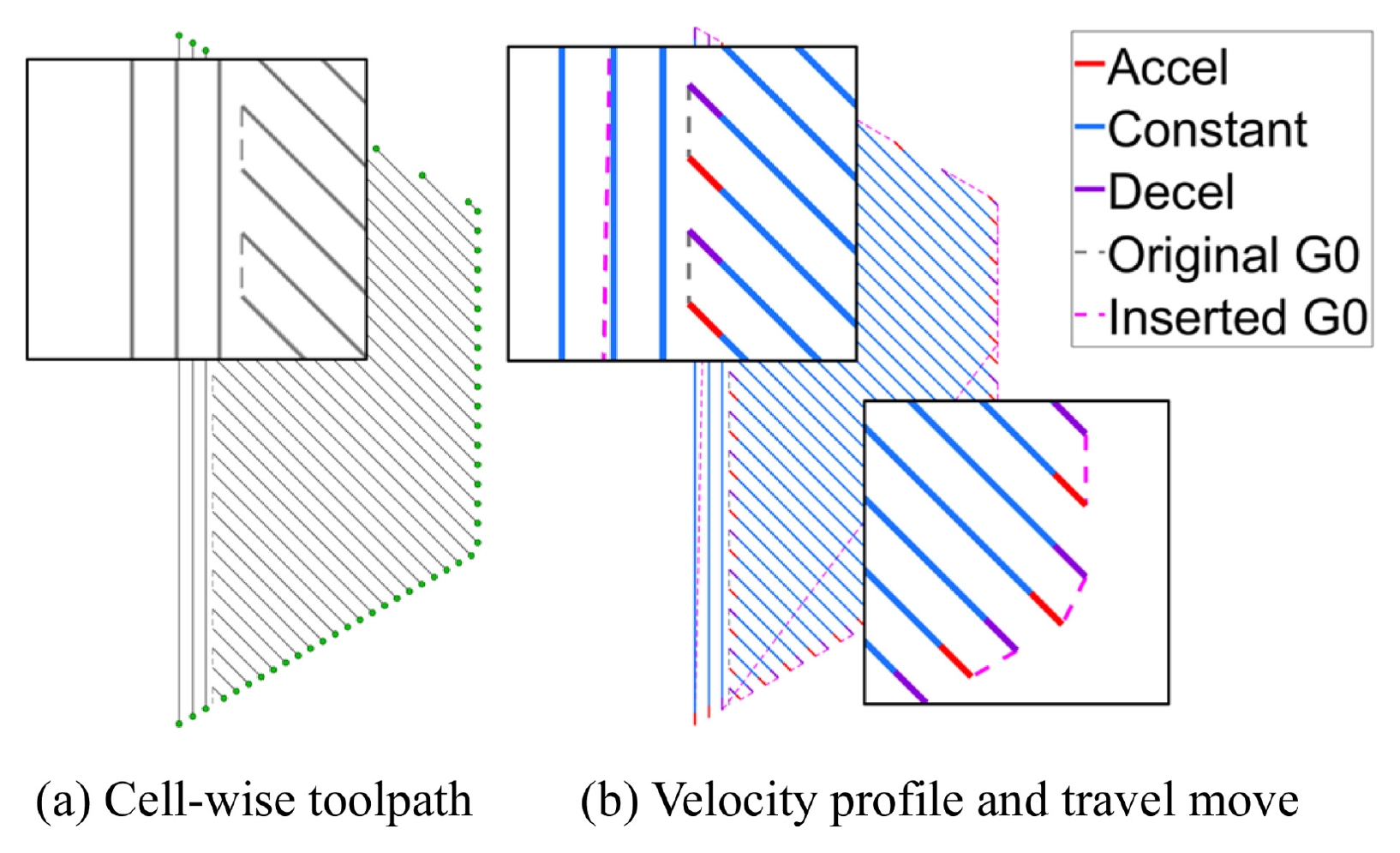
Fig. 6Implementation of the interlayer staggered structure
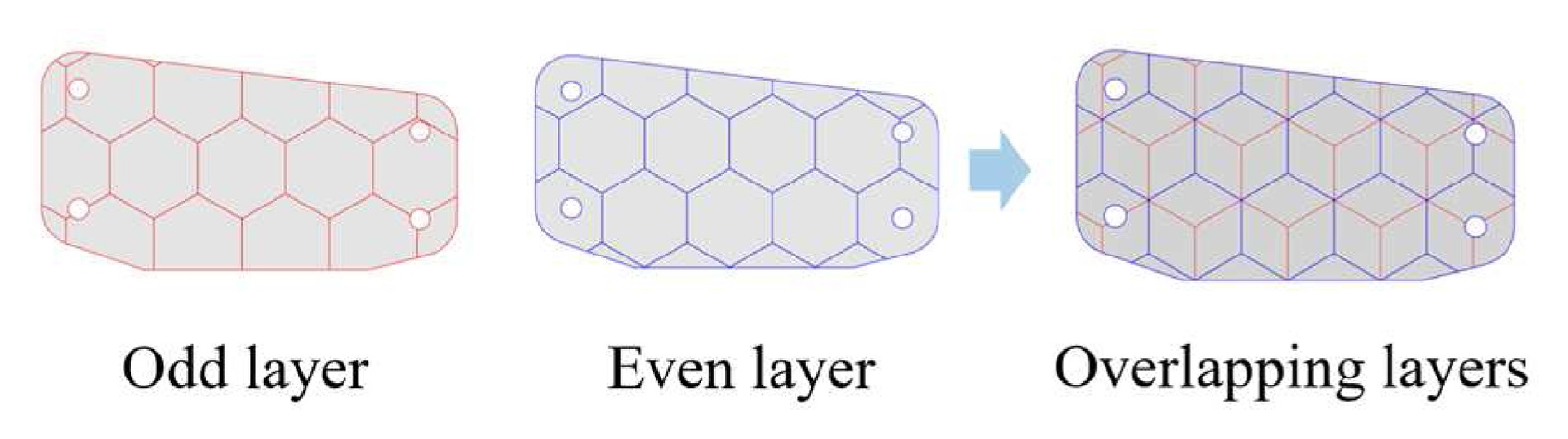
Fig. 7Simultaneous region identification using graph coloring
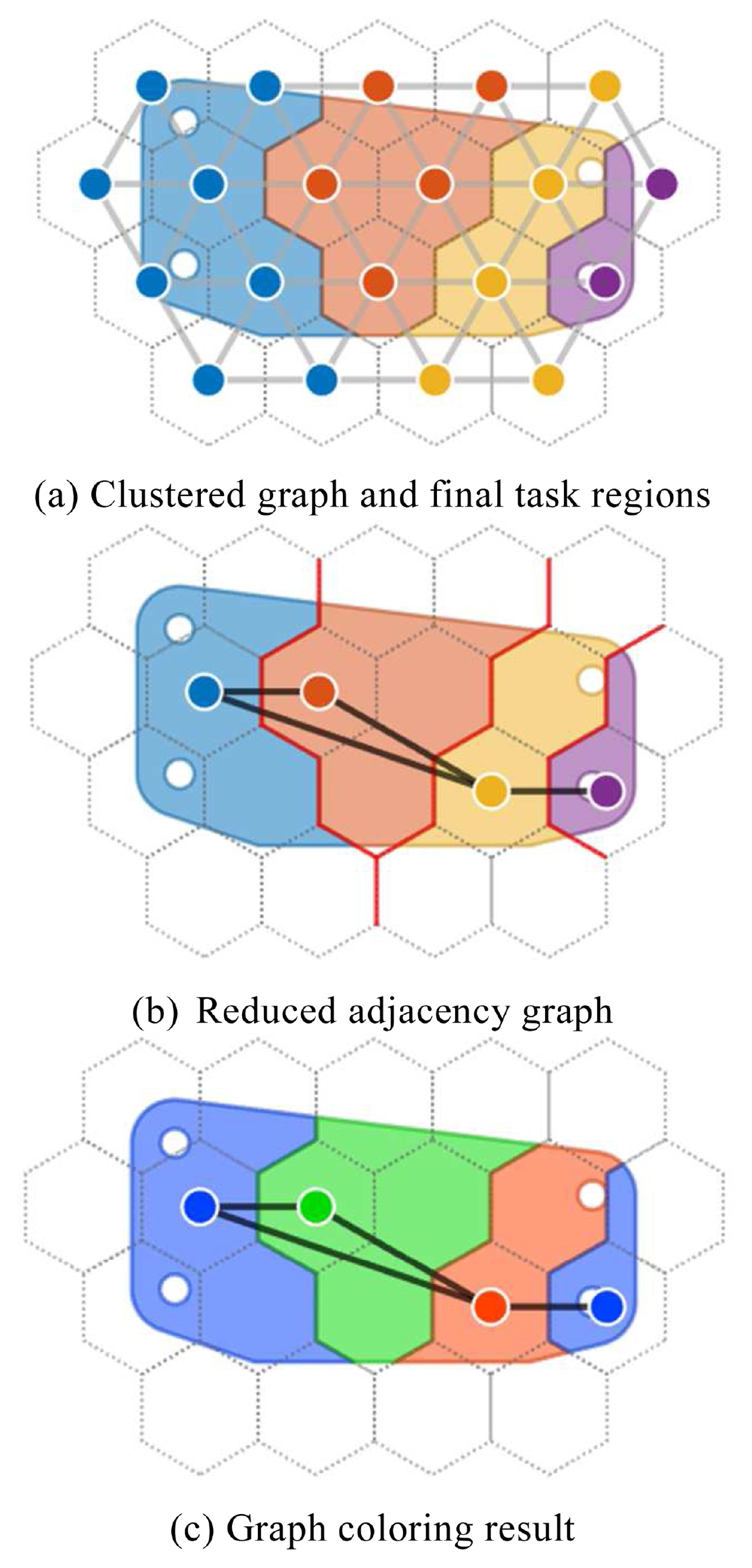
Fig. 8Test model and experimental layer
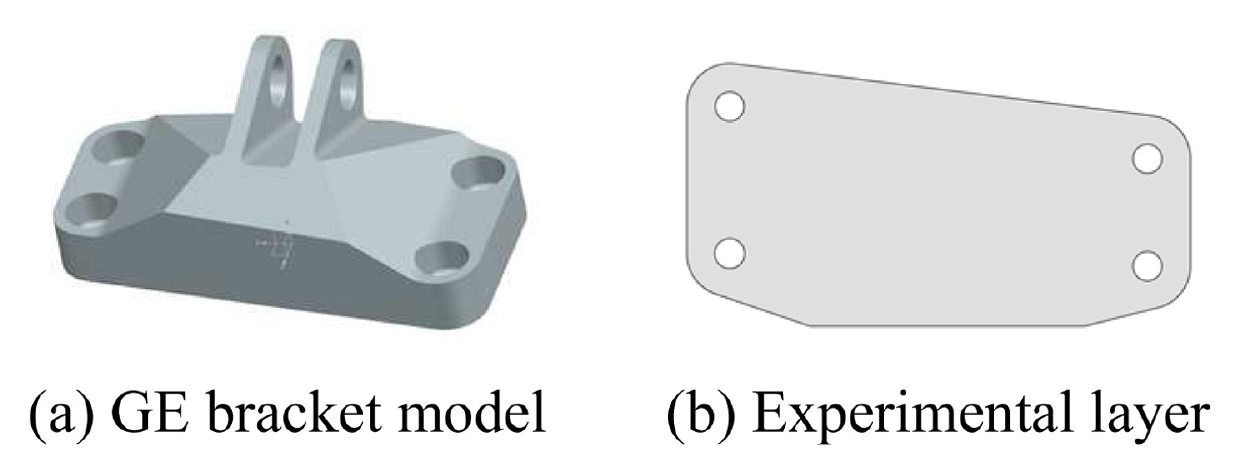
Fig. 9Best clustering results for each seed selection method at k = 4
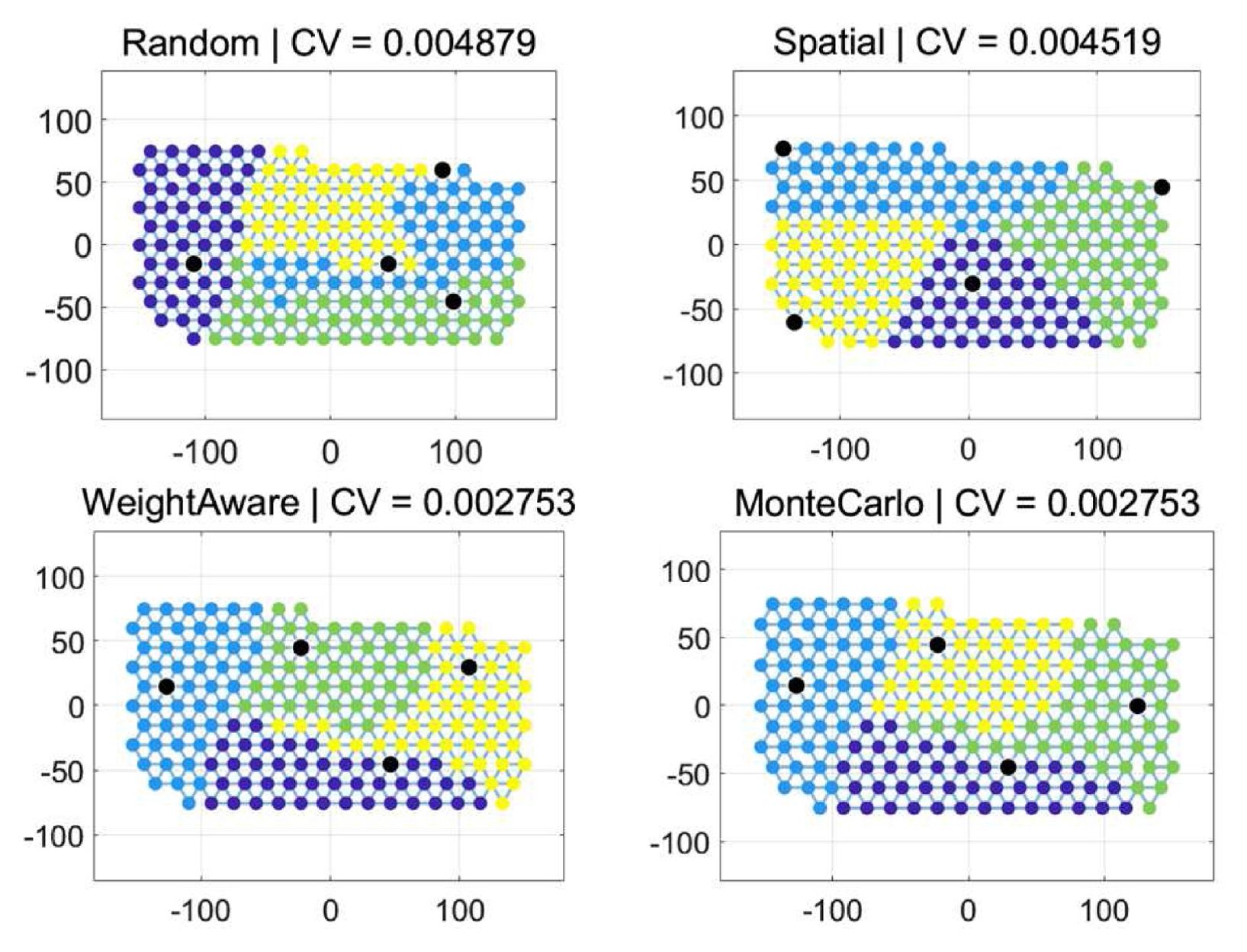
Fig. 10Weighted graphs generated from the selected layer with different node counts
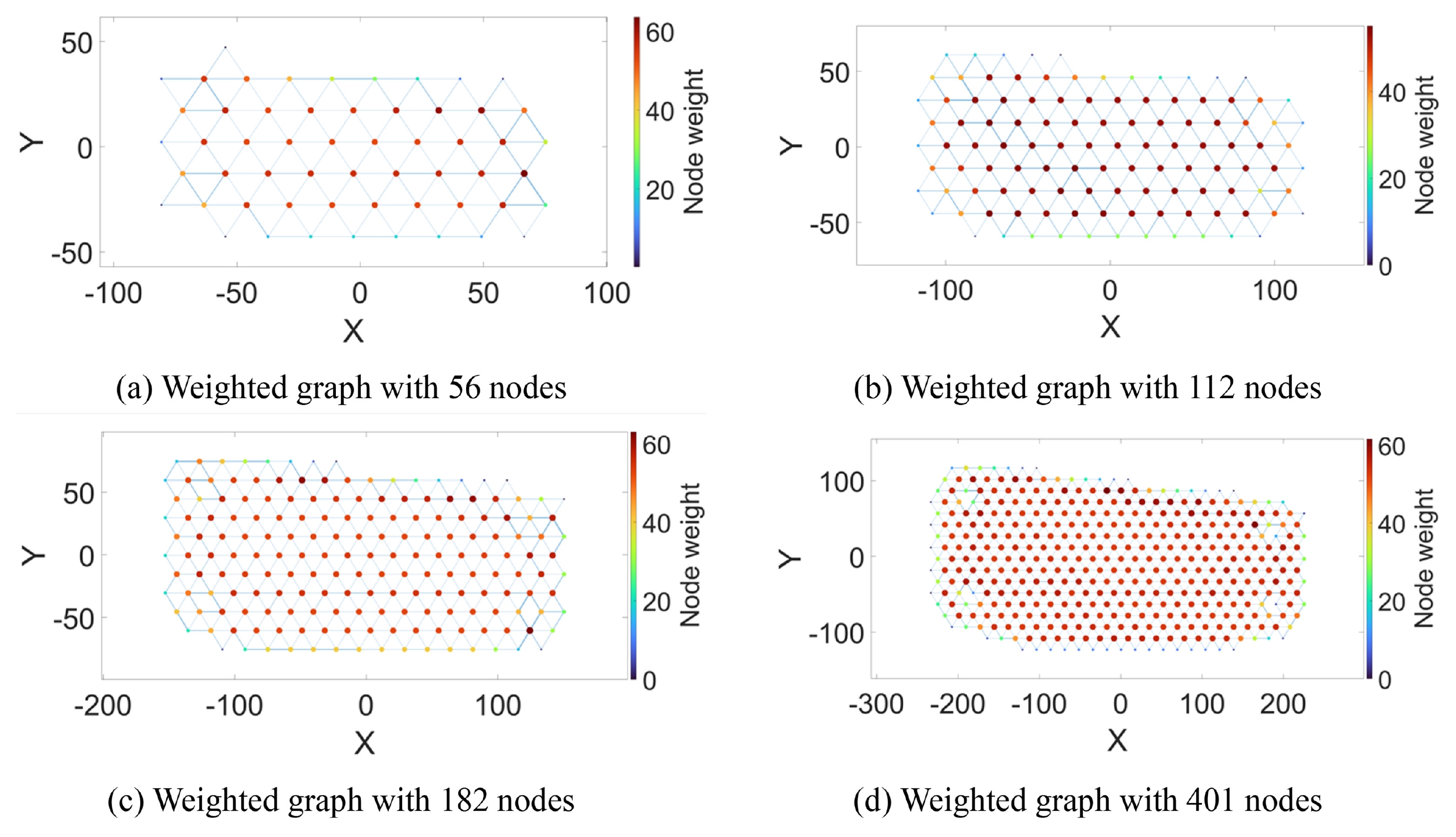
Fig. 11Workload balance and computation time boxplots for different graph sizes
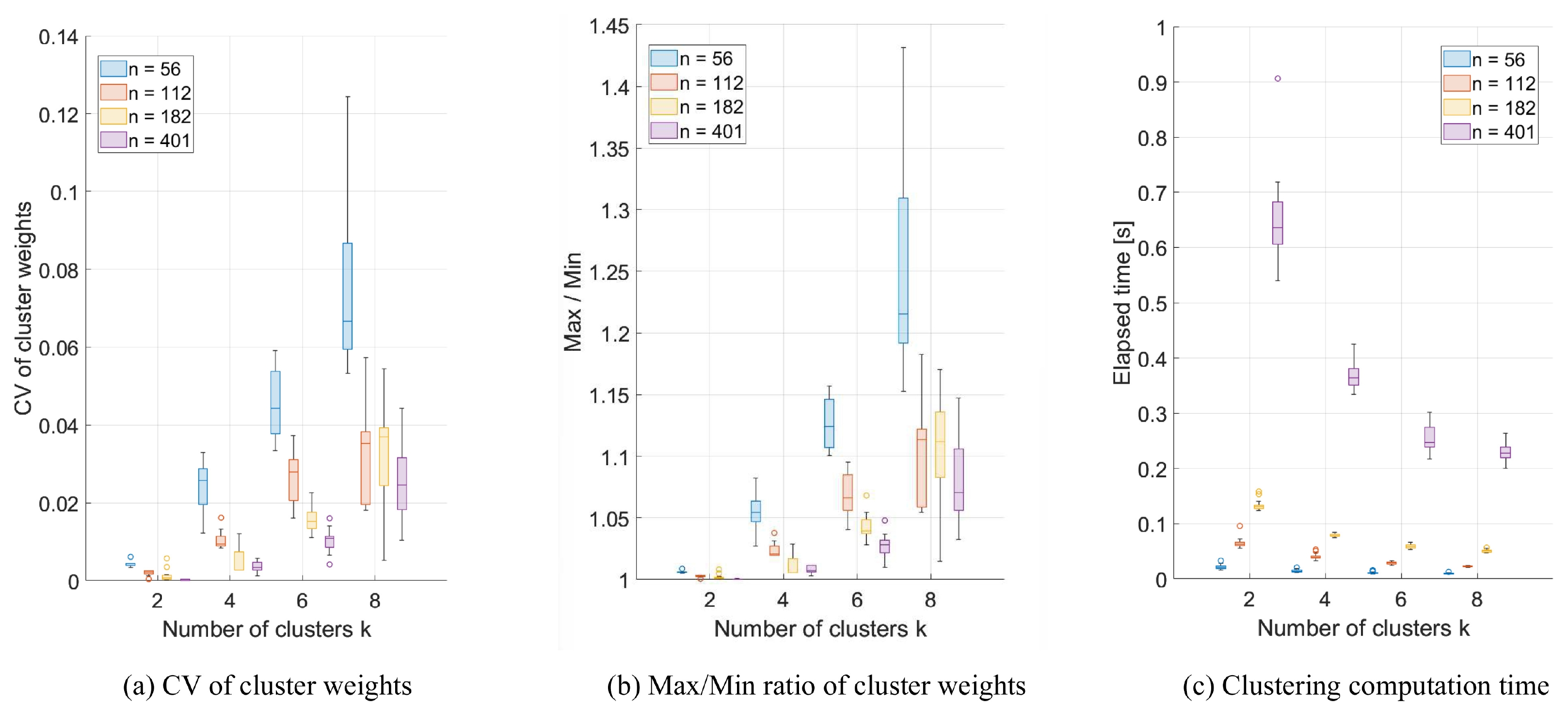
Fig. 12Relationship between node-to-cluster ratio and workload balance
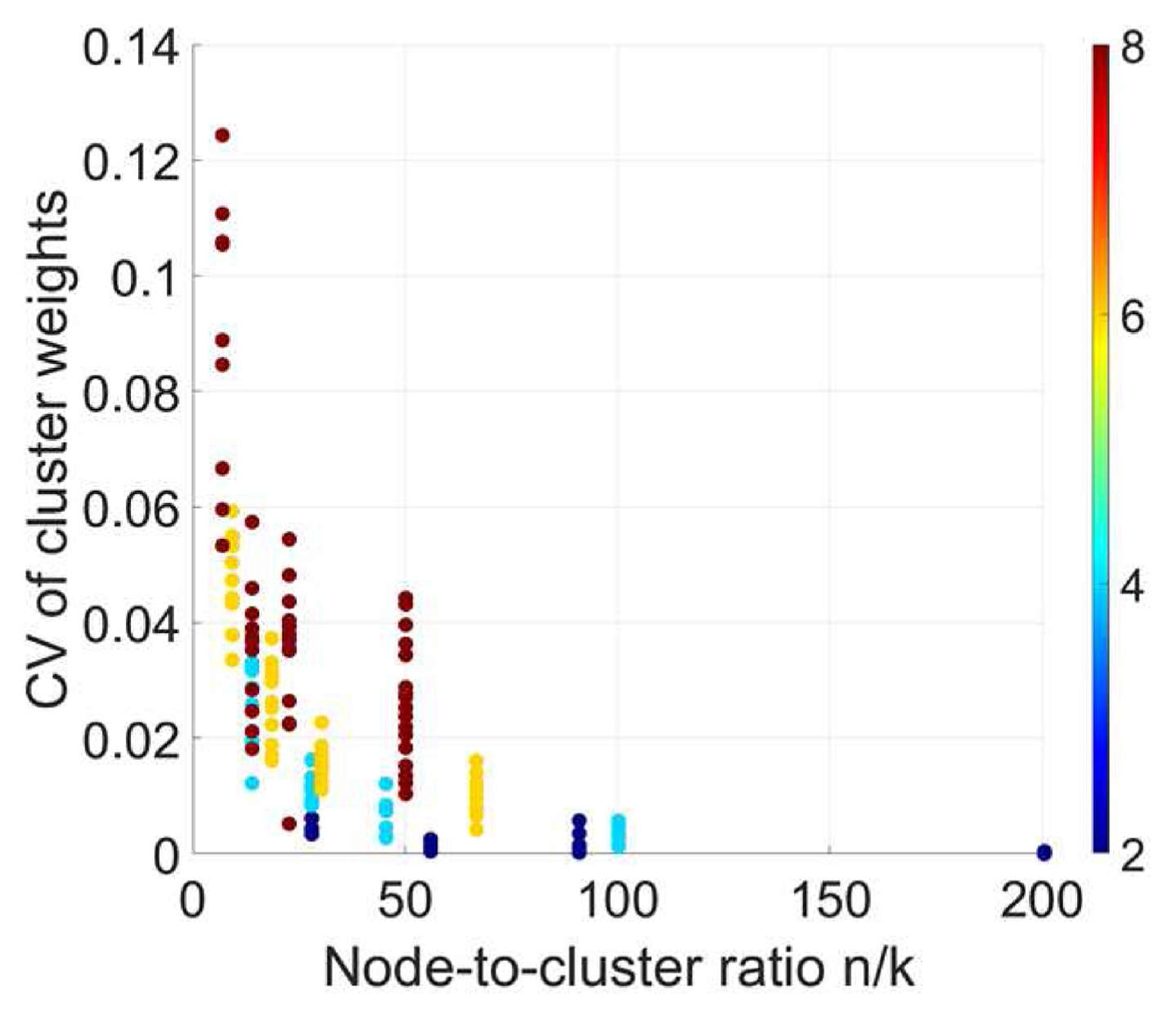
Fig. 13
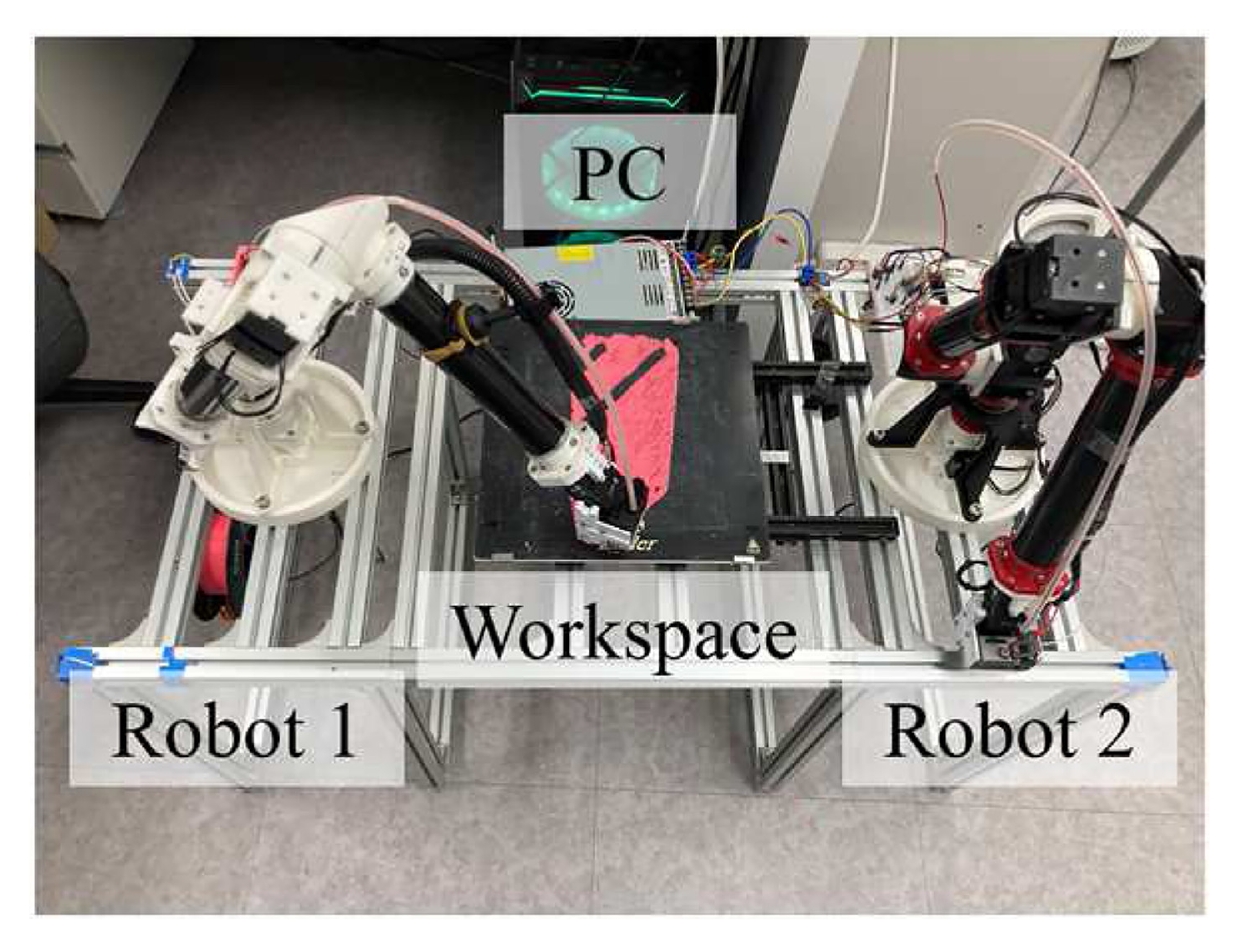
Fig. 14Graph-colored toolpaths and robot-wise printing schedule
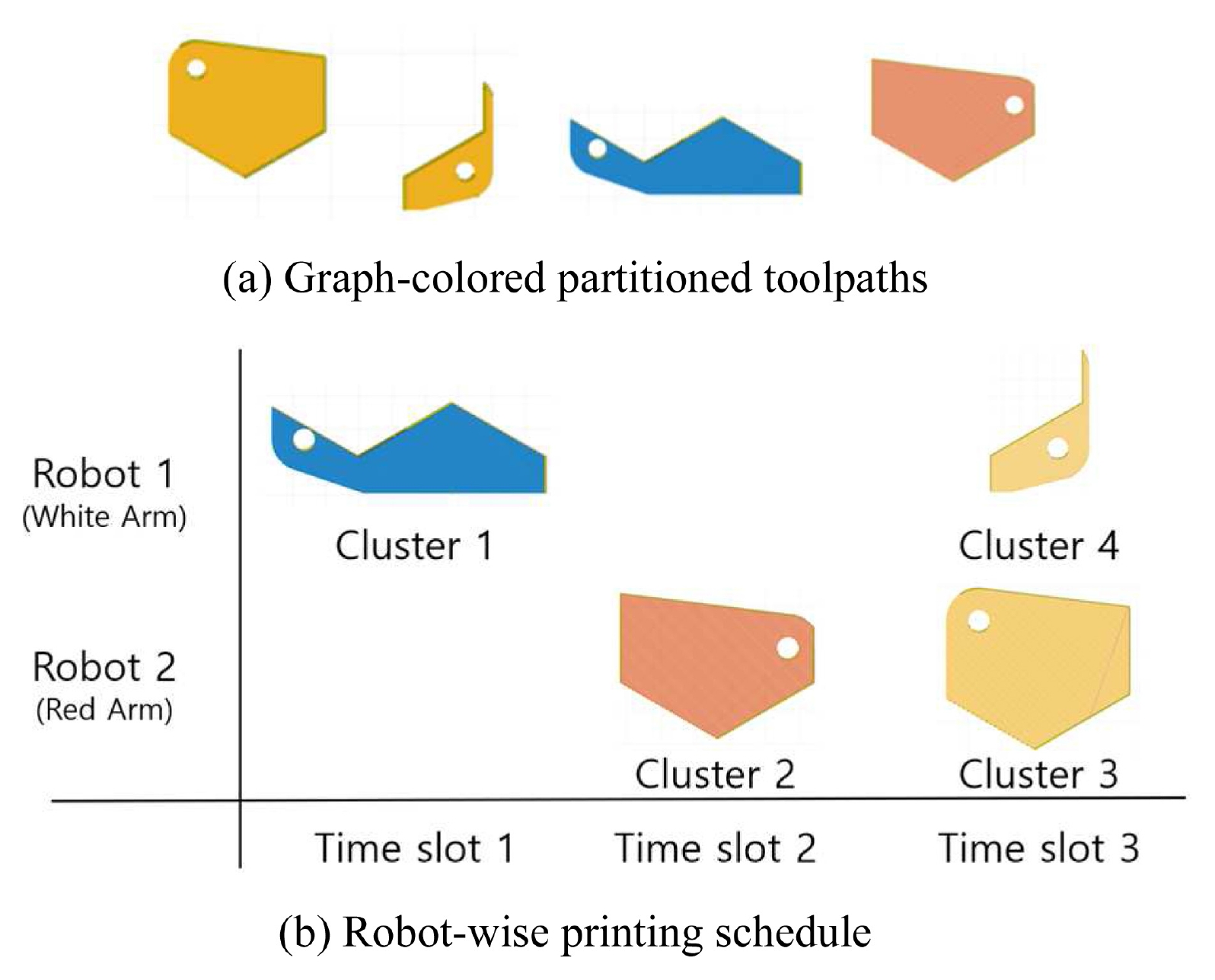
Fig. 15C3DP printing result on the testbed
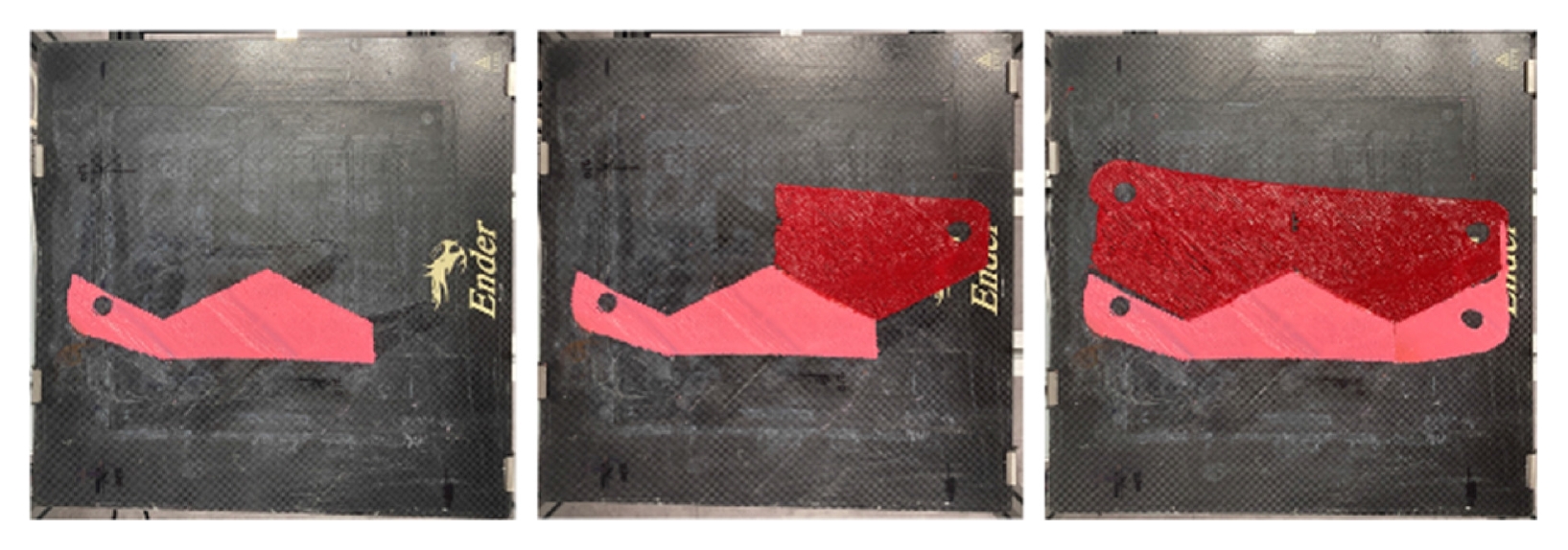
Fig. 16End-effector distance during simultaneous printing
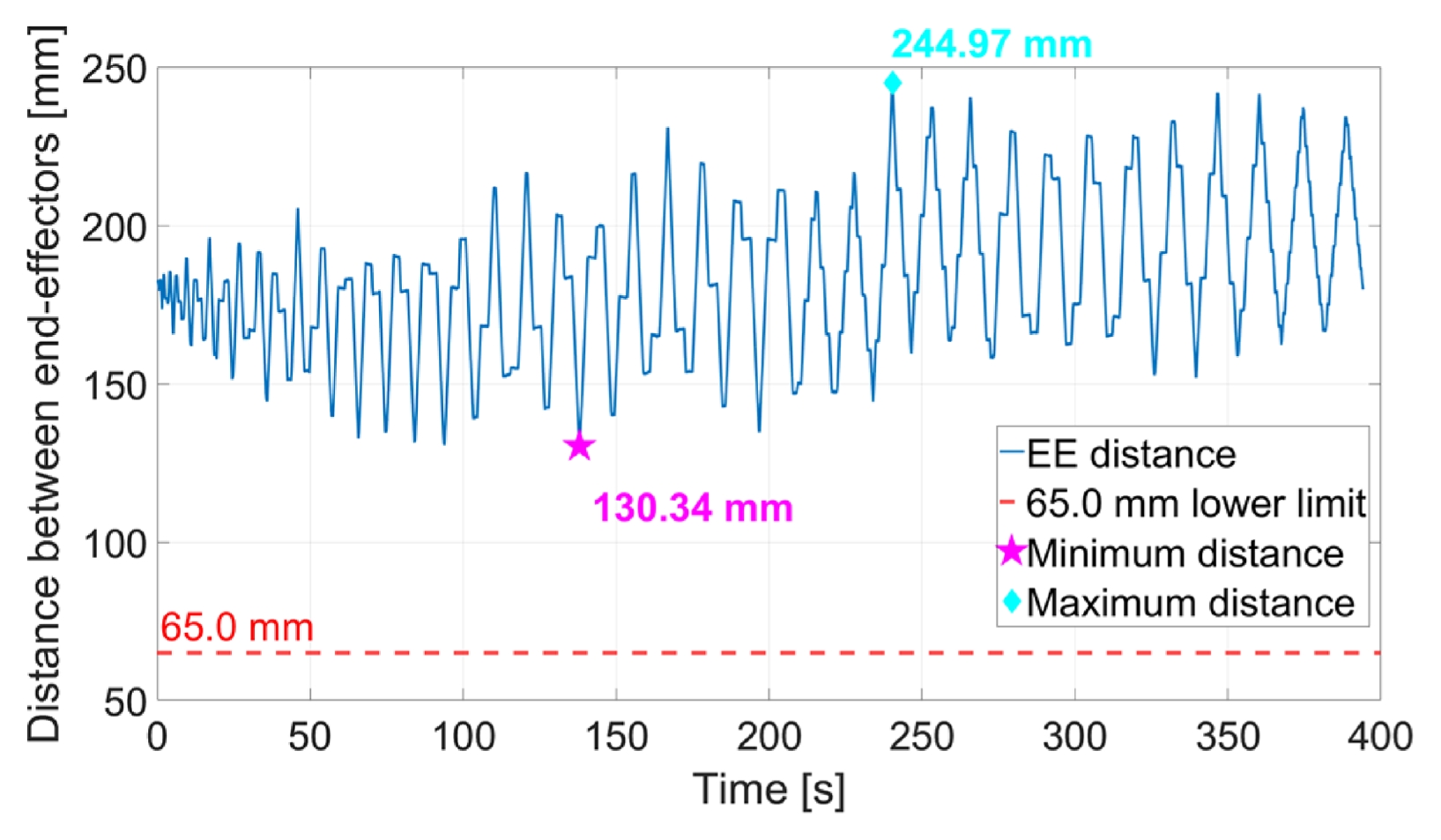
Fig. 17Interlayer boundary covering by seed offset
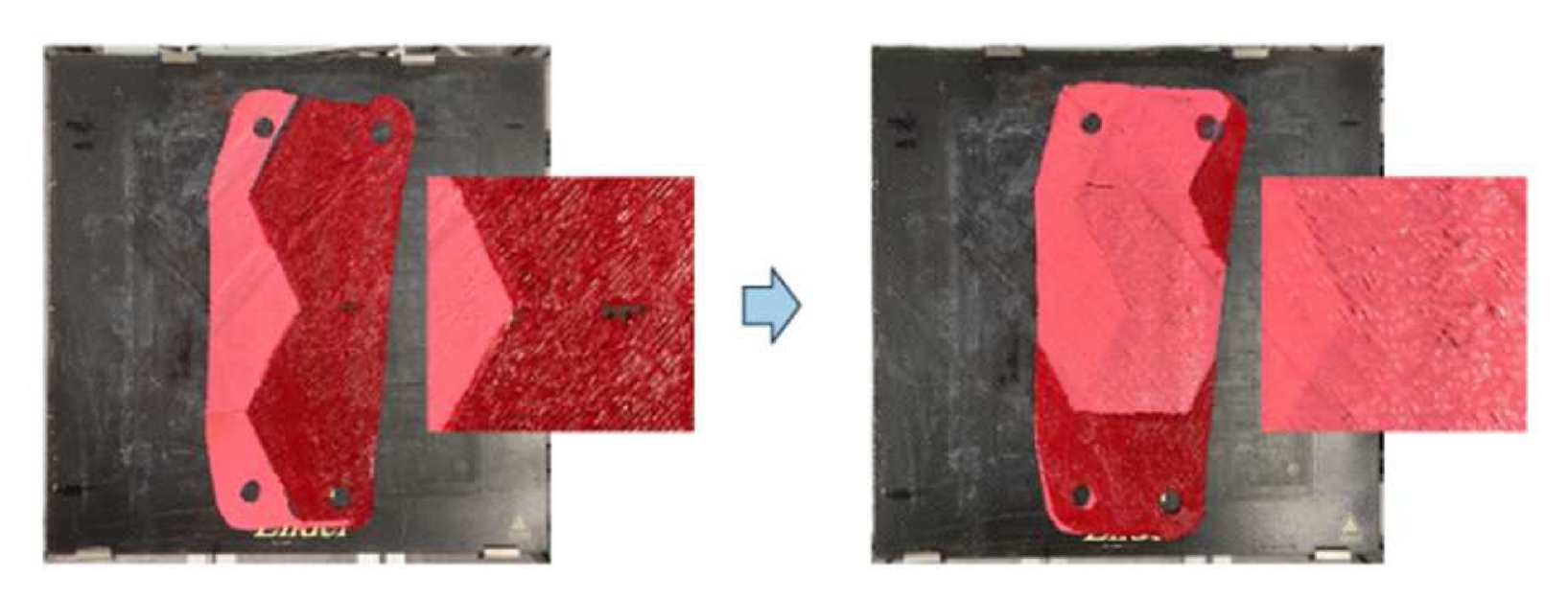
Table 1Workload balance metrics for different start-node selection strategies on the n = 182 graph
Table 1
|
Method |
k |
Mean CV |
Std. CV |
Mean Max/Min |
Max Max/Min |
|
Monte carlo |
2 |
0.0005 |
0.0004 |
1.0008 |
1.0039 |
|
Monte carlo |
4 |
0.0031 |
0.0011 |
1.0062 |
1.0200 |
|
Monte carlo |
6 |
0.0142 |
0.0021 |
1.0377 |
1.0481 |
|
Monte carlo |
8 |
0.0249 |
0.0090 |
1.0784 |
1.1618 |
|
Random |
2 |
0.0090 |
0.0127 |
1.0130 |
1.0997 |
|
Random |
4 |
0.1002 |
0.1180 |
1.4962 |
21.4220 |
|
Random |
6 |
0.1592 |
0.0976 |
1.6519 |
6.4142 |
|
Random |
8 |
0.1910 |
0.0975 |
1.9168 |
4.5664 |
|
Spatial |
2 |
0.0161 |
0.0219 |
1.0235 |
1.0997 |
|
Spatial |
4 |
0.0588 |
0.0475 |
1.1459 |
1.7129 |
|
Spatial |
6 |
0.0595 |
0.0598 |
1.1951 |
1.9726 |
|
Spatial |
8 |
0.1067 |
0.0471 |
1.3978 |
2.1335 |
|
Weight-aware |
2 |
0.0114 |
0.0169 |
1.0166 |
1.0997 |
|
Weight-aware |
4 |
0.0378 |
0.0311 |
1.0883 |
1.2709 |
|
Weight-aware |
6 |
0.0683 |
0.0586 |
1.2271 |
1.9998 |
|
Weight-aware |
8 |
0.1007 |
0.0504 |
1.3669 |
2.4085 |
Table 2Logged printing time for the unpartitioned layer and partitioned clusters in the first layer
Table 2
|
Printing segment |
Cluster |
Logged printing time [min] |
|
Unpartitioned printing |
Entire layer |
70.063 |
|
Sequential printing |
1 |
17.61 |
|
Sequential printing |
2 |
21.12 |
|
Concurrent printing |
3 |
24.84 |
|
Concurrent printing |
4 |
6.57 |
REFERENCES
- 1. Tofail, S. A., Koumoulos, E. P., Bandyopadhyay, A., Bose, S., O’Donoghue, L., Charitidis, C., (2018), Additive manufacturing: scientific and technological challenges, market uptake and opportunities, Materials Today, 21(1), 22-37.
- 2. Blakey-Milner, B., Gradl, P., Snedden, G., Brooks, M., Pitot, J., Lopez, E., Leary, M., Berto, F., Du Plessis, A., (2021), Metal additive manufacturing in aerospace: A review, Materials & Design, 209, 110008.
- 3. Paolini, A., Kollmannsberger, S., Rank, E., (2019), Additive manufacturing in construction: A review on processes, applications, and digital planning methods, Additive Manufacturing, 30, 100894.
- 4. Pignatelli, F., Percoco, G., (2022), An application-and market-oriented review on large format additive manufacturing, focusing on polymer pellet-based 3D printing, Progress in Additive Manufacturing, 7(6), 1363-1377.
- 5. Espalin, D., Alberto Ramirez, J., Medina, F., Wicker, R., (2014), Multi-material, multi-technology FDM: Exploring build process variations, Rapid Prototyping Journal, 20(3), 236-244.
- 6. Roschli, A., Post, B. K., Wang, P., Chesser, P., Barnes, A. K., Stevens, A., Heineman, J., Kunc, V., Vaughan, J., Atkins, C., (2025), The cost of scaling up in large-format additive Manufacturing, 3D Printing and Additive Manufacturing.
- 7. Shen, H., Pan, L., Qian, J., (2019), Research on large-scale additive manufacturing based on multi-robot collaboration technology, Additive Manufacturing, 30, 100906.
- 8. McPherson, J., Zhou, W., (2018), A chunk-based slicer for cooperative 3D printing, Rapid Prototyping Journal, 24(9), 1436-1446.
- 9. Čolaković-Bencerić, M., Peršić, J., Marković, I., Petrović, I., (2025), Multiscale and uncertainty-aware targetless hand-eye calibration via the Gauss–Helmert model, IEEE Transactions on Robotics, 41, 2340-2357.
- 10. Poudel, L., Zhou, W., Sha, Z., (2020), A generative approach for scheduling multi-robot cooperative three-dimensional printing, Journal of Computing and Information Science in Engineering, 20(6), 061011.
- 11. Jiang, Z., Wang, H., Sun, Y., (2021), Improved co-scheduling of multi-layer printing path scanning for collaborative additive manufacturing, IISE Transactions, 53(9), 960-973.
- 12. Krishnamurthy, V., Poudel, L., Ebert, M., Weber, D. H., Wu, R., Zhou, W., Akleman, E., Sha, Z., (2022), LayerLock: Layer-wise collision-free multi-robot additive manufacturing using topologically interlocked space-filling shapes, Computer-Aided Design, 152, 103392.
- 13. Stone, R. F., Ebert, M., Zhou, W., Akleman, E., Krishnamurthy, V., Sha, Z., (2024), SafeZone: a topologically-aware voronoi-based framework for fast collision-free cooperative 3D printing, Proceedings of the International Design Engineering Technical Conferences and Computers and Information in Engineering Conference, 88346: V02AT02A038.
- 14. Ebert, M., Stone, R., Akleman, E., Sha, Z., Krishnamurthy, V., (2025), Traveling cellsman: Partition-cluster co-parameterization for multi-robot cooperative 3D printing, Additive Manufacturing, 104987.
- 15. Zhao, T., Yan, Z., Zhao, Y., Jia, Y., Chen, S., (2024), Path planning in additive manufacturing with multi-robot collaboration based on structural primitive partitioning, Advances in Engineering Software, 197, 103754.
- 16. Jin, Y., Pierson, H. A., Liao, H., (2019), Toolpath allocation and scheduling for concurrent fused filament fabrication with multiple extruders, IISE Transactions, 51(2), 192-208.
- 17. Bacciaglia, A., Ceruti, A., (2023), Efficient toolpath planning for collaborative material extrusion machines, Rapid Prototyping Journal, 29(9), 1814-1828.
- 18. Poudel, L., Marques, L. G., Williams, R. A., Hyden, Z., Guerra, P., Fowler, O. L., Sha, Z., Zhou, W., (2022), Toward swarm manufacturing: architecting a cooperative 3D printing system, Journal of Manufacturing Science and Engineering, 144(8), 081004.
- 19. Poudel, L., Sha, Z., Zhou, W., (2018), Mechanical strength of chunk-based printed parts for cooperative 3D printing, Procedia Manufacturing, 26, 962-972.
- 20. Ebert, M., Stone, R. F., Koithan, J., Zhou, W., Pharr, M., Estrin, Y., Akleman, E., Sha, Z., Krishnamurthy, V., (2025), Noodleprint: Cooperative multi-robot additive manufacturing with helically interlocked tiles, Journal of Manufacturing Science and Engineering, 147(6), 061002.
Biography
- Hwijae Park
Master's Student in the Department of Biomedical and Robotics Engineering, Incheon National University. His research interests include manipulator motion control and planning for collaborative additive manufacturing.
- Sang-in Park
Associate Professor in the Department of Biomedical and Robotics Engineering, Incheon National University. His research interests include design for additive manufacturing, Implicit CAD, and design optimization.